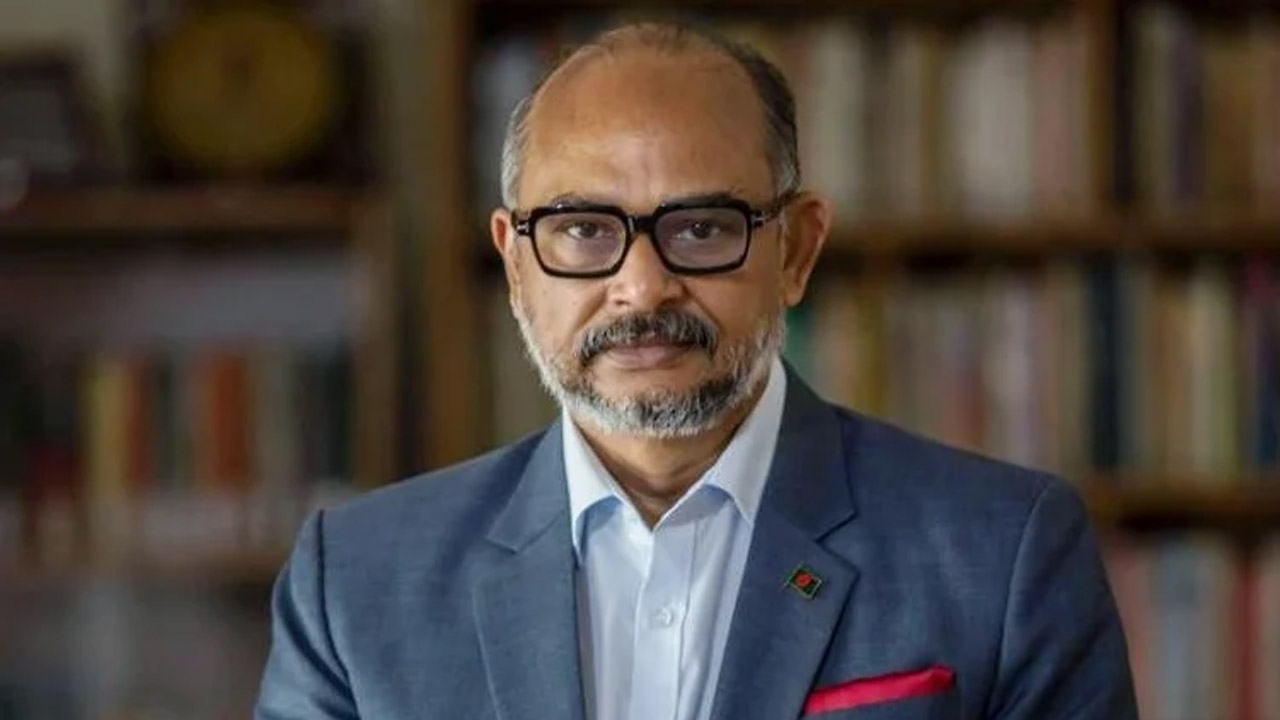
Professor Dr. Rashed Al Mahmud Titumir, the prime minister’s adviser on finance and planning, has outlined a three-stage strategy to pull the country’s economy back from deep crisis, restore it to a path of sustainable growth, and rebuild institutional structures for rapid economic expansion.
Under the government’s five-year strategic reform and development framework, these three stages are Recovery, Restoration, and Reconstruction for Acceleration.
In an interview, Titumir said: “By implementing these three stages in sequence, the economy will be brought back to stability and moved onto a path of sustainable growth.”
The first stage, Recovery, aims mainly to restore the economy’s lost standing and stabilize the macroeconomy.
“At this stage,” he said, “the government’s immediate priority is tackling the long-accumulated economic crisis. This includes debt pressure, a weak institutional structure, a liquidity crisis, declining production and employment, and restoring confidence in the economy.”
Toward this goal, he said, the government has already taken various steps to strengthen coordination between fiscal and monetary policy, increase revenue collection, and restore macroeconomic stability.
Titumir said: “Revenue income grew 12 percent from mid-February through June 30 this year, compared with the same period last year. That growth was just 2 percent over the same period the previous year.” He sees this as a sign of positive progress in the revenue sector.
He said the government is working to expand the tax base and curb tax evasion, without placing additional pressure on existing taxpayers.
The finance and planning adviser also cited rising foreign-currency reserves, a strengthening taka, growing remittance income and falling interest rates as positive indicators of economic recovery.
The second stage, Restoration, aims not just to stabilize the economy but to move it toward sustainable and inclusive growth.
“At this stage,” Titumir said, “the highest priority will be given to restoring production, investment and employment.”
Efforts are under way to reduce restrictions and unnecessary regulation and improve the investment environment through a proposed “trace and track” system. At the same time, the government plans to build Bangladesh into a gateway between South and Southeast Asia.
He said: “We’ve received investment pledges from North America, Western Europe, the Gulf region and East Asia. Interest in this investment is particularly visible in the Chattogram and Mongla economic zones.”
The government wants to prioritize investment that boosts production, creates jobs and strengthens export capacity, he said, rather than placing excessive emphasis on debt-dependent and import-dependent projects.
Agriculture and agro-products, electronics, pharmaceuticals, leather goods and light engineering have been identified as priority sectors.
At the Restoration stage, there are also plans to link economic growth with social development. This will involve emphasis on expanding social-protection programs, reforming primary education and increasing healthcare capacity.
The third stage, Reconstruction for Acceleration, aims mainly to complete institutional reforms and build the foundation needed for rapid economic expansion.
Titumir said: “Restructuring institutional frameworks is essential to make the progress achieved during the Recovery and Restoration stages sustainable.”
As part of this process, the government also plans a major transformation in the energy and power sector. Under the strategy, immediate stability in the energy sector will be ensured first, followed by expanding capacity in line with the economy’s needs.
He also spoke of plans, at a later stage, to turn households and businesses into energy producers through solar power and net metering.
“The country’s people are no longer just consumers,” Titumir said. “They are producers too.”
In his view, these three stages should not be seen as separate initiatives; they form a continuous process. First the economy will be stabilized, then production capacity and inclusive growth will be restored, and finally, institutional structures will be rebuilt for rapid economic expansion.
Titumir believes there are important lessons to be drawn from Bangladesh’s own past economic transformations in tackling the current crisis.
He said: “The change that came to the economy after the mid-1970s, through expanding overseas employment opportunities and growing remittance income, is an important example for Bangladesh. Later, the growth in women’s education and employment, and the development of the ready-made garment sector, also showed how strategic policy decisions can turn structural weaknesses into economic strength.”
He said the current strategy also aims to identify Bangladesh’s economic strengths and put them to use through practical policy initiatives.
Describing the government’s first 180 days as the initial footprint of the economic-recovery process, Titumir said: “The ultimate goal is to move Bangladesh from a phase of crisis management to a stable, productive and inclusive economy.”
“The Recovery, Restoration and Reconstruction for Acceleration framework,” he said, “is essentially a roadmap for recovering lost ground, restoring the economy’s momentum, and building the institutional foundation needed for rapid growth.”
বাংলায় মূল প্রতিবেদন পড়ুন · Read the original Bengali report