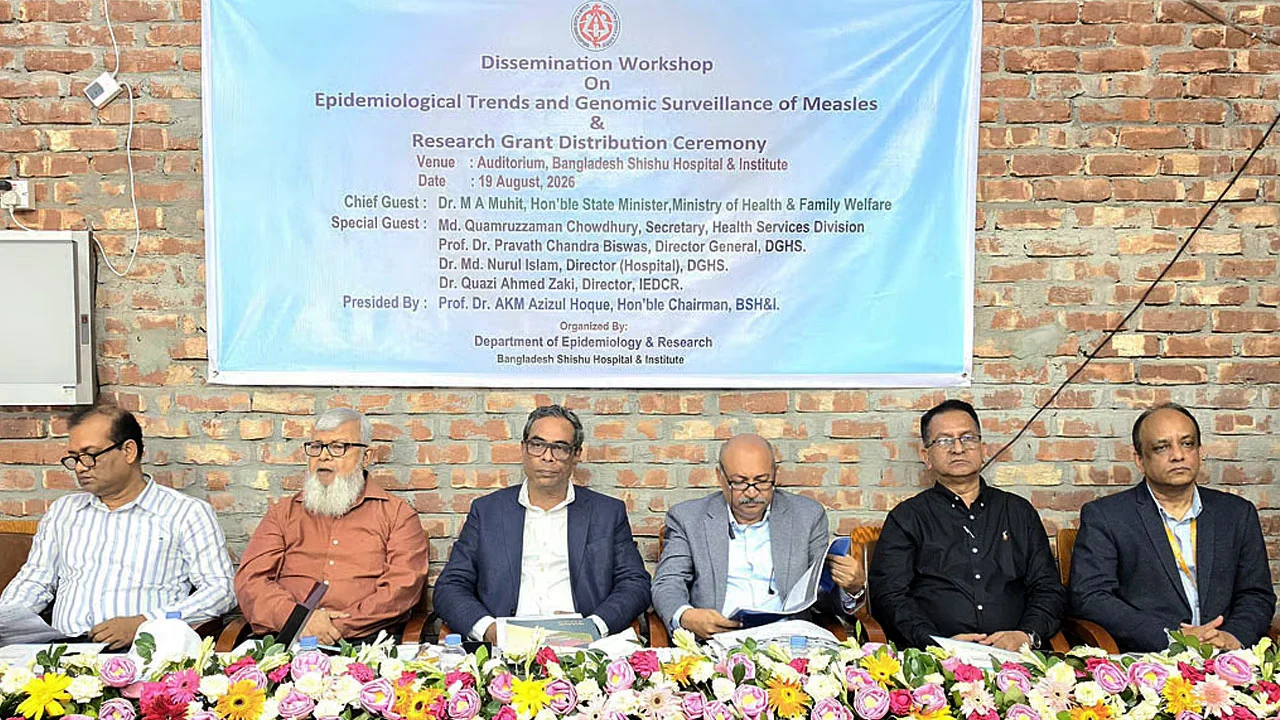
State Minister for Health M A Muhit has said he does not want to make promises beyond what is realistic. But he expressed hope that if the ongoing vaccination drive and other measures continue properly, the measles outbreak in the country will ease considerably within the next two to three months.
The state minister made the remarks in response to reporters’ questions Wednesday at an event unveiling the findings of a joint study on measles in children, held at the auditorium of Bangladesh Shishu Hospital and Institute. The study was conducted jointly by Bangladesh Shishu Hospital and icddr,b.
M A Muhit said a long-standing problem cannot be resolved magically in a single day or within the coming week. He said the situation has become complicated because of shortfalls in the vaccination program and a shortage of health workers at the field level. He said he did not want to make the unrealistic promise that measles would be under control within a week. But if government initiatives proceed as planned, he said, the measles outbreak will ease within two to three months.
Asserting that there has been no shortfall in the government’s sincerity in tackling measles, the state minister for health said vaccination activities began as quickly as possible given the circumstances. Field workers in remote areas and elsewhere have taken on additional responsibilities to carry out the work, he said. He noted that against a requirement of 40,000 field workers, only 25,000 were initially available. Even so, roughly 20 million children were brought under vaccination coverage within a month, which he described as a major undertaking even by international standards.
Describing measles as an extremely contagious disease, the state minister said the study had produced important findings on children’s antibodies, breast milk, and other key factors. However, he said, measles deaths cannot be prevented simply by adding more hospitals, ICUs, or thousands of ventilators. The most effective way to control the disease is vaccination, he said, which is currently under way. Alongside adding new hospitals and ICUs, he said, the government’s main goal is to ensure healthy children.
Outlining the government’s future plans to protect children’s health, he said the current government is giving the highest priority to child health. Five full-fledged children’s hospitals will begin operating in the country’s five divisional cities within the next two to three months, he said. He also spoke of plans to rapidly recruit 5,000 doctors, 1,000 nurses, and 100,000 new field workers to address the health sector’s staffing shortage.
Meanwhile, child deaths from measles and measles-like symptoms continue across the country. According to the Directorate General of Health Services, a total of 918 people died of measles and measles-like symptoms nationwide between March 15 and Tuesday. Of them, 99 died of confirmed measles, while another 819 died with measles-like symptoms.
According to the directorate’s figures, the number of suspected measles cases during this period stands at 144,780. A total of 17,989 people have been confirmed to have measles.
A K M Azizul Haque, chairman of the governing board of the Children’s Hospital and Institute, presided over the event. Special guests included Directorate General of Health Services Director General Professor Provat Chandra Biswas, Director Md Nurul Islam, and IEDCR Director Kazi Ahmed Zaki.
The study’s main findings were presented by Bangladesh Shishu Hospital and Institute Director Professor Mirza Mohammad Ziaul Islam and icddr,b Senior Director Mustafizur Rahman.
বাংলায় মূল প্রতিবেদন পড়ুন · Read the original Bengali report