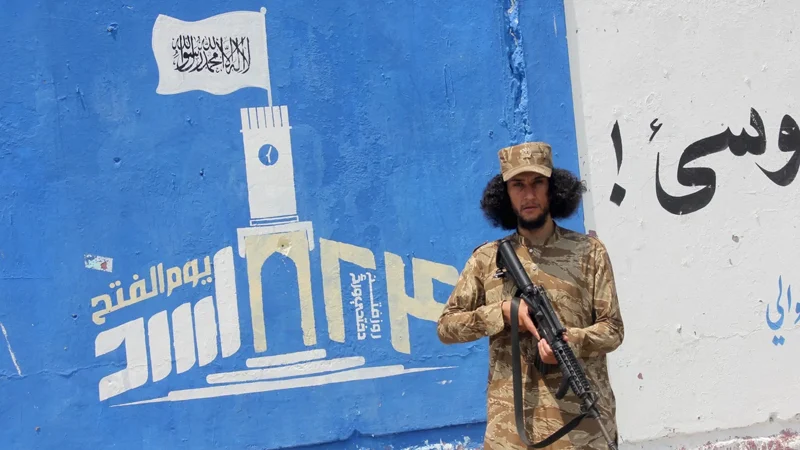
The Taliban has completed five years in power since seizing control of Afghanistan on August 15, 2021. During this period, the country has had no foreign troops and no significant armed opposition has emerged. The Taliban government has consolidated its control over the country. In exchange, however, Afghanistan has become a poorer, more isolated, and more repressive state — with sweeping restrictions on women and girls emerging as the defining feature of Taliban rule.
Administration in Kabul, power centered in Kandahar
Taliban Supreme Leader Haibatullah Akhundzada controls major state decisions from Kandahar. Over the past five years, he has transformed the Taliban from an insurgent group into a tightly centralized governing system. Kandahar-based leadership retains significant influence even over key posts such as the prime minister, central bank, and chief justice.
In Kabul, leaders such as Mullah Abdul Ghani Baradar, Sirajuddin Haqqani, Mawlavi Yaqoob, and Amir Khan Muttaqi handle day-to-day administration, the economy, and foreign policy. However, Kandahar’s leadership continues to hold greater sway over major political, judicial, and administrative decisions.
The Taliban is not relying solely on military strength to maintain control. It has also built a system of patronage, financial incentives, ideological loyalty, and administrative structures to reward its followers. This network includes stipends and salaries for students and teachers at roughly 15,000 registered madrasas.
Deep economic crisis
Since taking power, Afghanistan has been grappling with a major economic shock. Before the Taliban takeover, international grants accounted for roughly 75 percent of government expenditure. That assistance stopped after the change in power. At the same time, roughly $7 billion in central bank assets was frozen.
While the Taliban government has managed to increase revenue from customs and mineral royalties, this has not translated into significant improvement in ordinary people’s living standards. Reports indicate that roughly 75 percent of Afghans still cannot meet basic needs.
Citing a May report from the United Nations Development Programme (UNDP), reports note that while the Afghan economy grew 2.3 percent in fiscal year 2023-24, growth slowed to 1.9 percent in 2024-25. Population pressure has also increased since more than 5 million Afghans were deported from Iran and Pakistan after 2023.
Restrictions on women
The most widely discussed and criticized aspect of Taliban rule is its severe restrictions on women. Girls’ secondary education remains suspended. Women are barred from studying or teaching at universities. Women also face numerous restrictions on movement, employment, and public life.
Reports say the International Criminal Court has issued sealed arrest warrants against Taliban Supreme Leader Haibatullah Akhundzada and Chief Justice Abdul Hakim Haqqani, citing the persecution of women as a crime against humanity.
Excluding women from the workforce also carries a significant economic cost. According to the United Nations, restricting women’s labor force participation could cost Afghanistan up to $1 billion annually — roughly 6 percent of the country’s gross domestic product.
Deteriorating relations with Pakistan
Pakistan once viewed the Taliban’s return to power as a strategic success for itself. But that relationship is now in deep crisis. Tensions along the border between the two countries have escalated over accusations that the Taliban has failed to suppress the Pakistan-based militant group Tehrik-i-Taliban Pakistan (TTP).
Since late 2023, Pakistan has deported roughly 2.6 million Afghans, repeatedly closed border crossings, and carried out retaliatory airstrikes on Afghan territory. The Taliban, meanwhile, continues to deny accusations of sheltering the TTP.
This situation has also created a significant internal problem for the Taliban, as hardline elements within the group view TTP members as historic allies, making it politically difficult to take firm action against them.
Minorities also under pressure
Religious and ethnic minorities have also faced increased pressure under Taliban rule. Reports say the Shia and Hazara communities, who make up roughly 15 percent of the country’s population, have faced various forms of marginalization.
Education and legal recognition of Shia jurisprudence have been curtailed. Some cultural institutions have been shut down, and Shia clerics have been excluded from newly formed provincial ulama councils. Crackdowns have also targeted Salafi minorities.
What lies ahead
Five years on, the Taliban remains firmly entrenched both militarily and administratively. No organized opposition group currently possesses the foreign backing, territory, or unified leadership needed to seriously threaten Kabul’s control.
However, significant risks remain within the Taliban itself. Disagreements among leadership are growing, and providing employment, food, and livelihoods for a rapidly growing population is becoming increasingly difficult. Current economic policy is insufficient to meet these demands.
Pragmatic relationships with Russia, China, and Central Asian neighbors are providing the Taliban some economic support. But the lack of recognition from the Western world, combined with its strict ideological governance, continues to further isolate the country.
বাংলায় মূল প্রতিবেদন পড়ুন · Read the original Bengali report