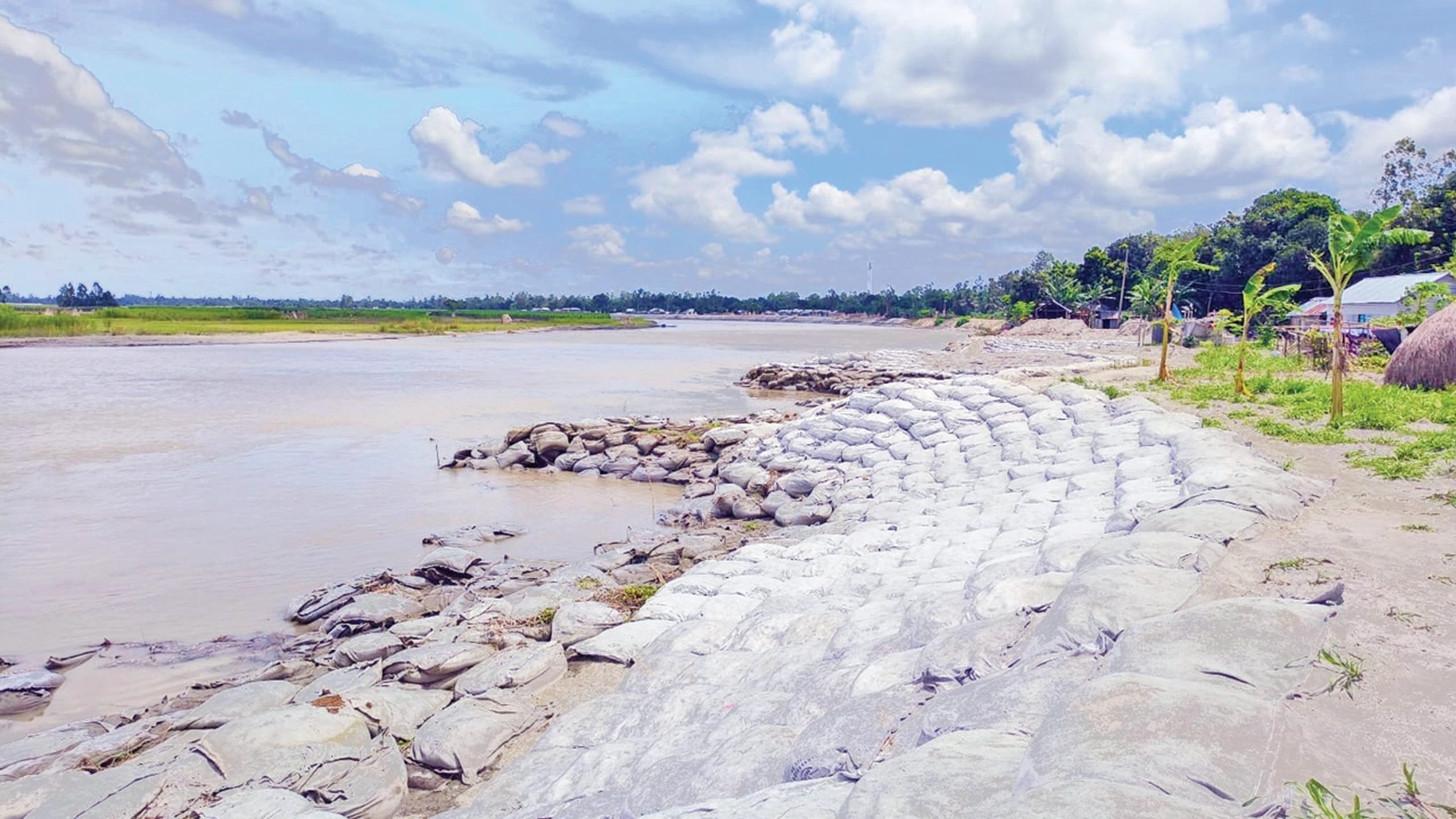
Despite spending 10 billion taka of a 27.63 billion taka dredging project, sandbars still emerge in the dry season and severe erosion still hits during the monsoon on the old Brahmaputra. This has raised questions about the project’s benefits, success and rationale. Local residents have demanded the project be halted and its corruption investigated. However, officials of the Bangladesh Inland Water Transport Authority (BIWTA), responding to these allegations found during an on-the-ground inquiry, say it would be wrong to evaluate the project’s success before it is fully completed.
The Brahmaputra originates near Kailash Peak in the Tibetan part of the Himalayas, at the Jima Yangzong glacier. After the Jamuna River was formed by the 1787 earthquake, the Brahmaputra began losing its once-mighty character. By the 21st century, the river had turned into a dead channel. Most of it can now be crossed on foot in the dry season, while erosion sets in during the monsoon.
As the navigability crisis grew severe, BIWTA launched a project to dredge 227 kilometers of waterway across Gaibandha, Jamalpur, Mymensingh, Sherpur and Kishoreganj districts. The project, which began in June 2019, was originally due to finish by June 2024. Since the work remains incomplete, its deadline has been extended to June 2027. Under the project, a channel 100 meters (300 feet) wide and three meters (about 10 feet) deep is being dug, with the goal of upgrading the Brahmaputra to a Class II waterway so vessels can navigate it year-round. The first phase covers 190 kilometers from the border to Jamalpur, with a further 37 kilometers to be dug later, from the Jamuna-Brahmaputra confluence at Dewanganj, Jamalpur, to Sannyasir Char in Erendabari union, Gaibandha. Work on the first of three planned dredging phases is under way. Even as dredging continues, severe erosion has struck this monsoon at Khalabari Mandal Bazar in Dewanganj and the Gaibandha area of Islampur. To combat the erosion, about 300 million taka from the project has been spent on 11 riverbank protection works in the Jamalpur and Gaibandha sections. After four bank-protection works were completed at Mandal Bazar, most of the embankment collapsed as soon as water levels rose. In Gaibandha, Islampur, homes and farmland have been swallowed by the river.
Abdul Haque of Mandal Bazar asked what the point of dredging is if sandbars still form in winter and erosion still occurs in the monsoon. College student Rakib questioned whether the project was undertaken simply to spend government money, and why its benefits aren’t visible. Farmer Swapan Mia of Char Jathartpur said he understands nothing except that government sand is being extracted from the river; local leaders buy that sand cheap and sell it at a higher price, pocketing the profit. Kamal, a trader at Narundi Bazar, said the government should abandon fruitless projects and spend the money on other work instead — and that work, once undertaken, should be done properly.
Jahangir Selim, general secretary of the Jamalpur Anti-Corruption Committee, has demanded the project be halted and its corruption investigated. He says 10 billion taka has essentially washed away into the Brahmaputra’s water, that there is no benefit beyond selling sand, and that the remaining funds could solve many of the country’s problems. He also demanded action against those responsible if irregularities are found.
Shahidullah Mazumder, the BIWTA engineer responsible for the Jamalpur section, said full transparency has been ensured in the project. He said engineers from the consulting firm work regularly on-site, and that with the Bangladesh Army involved, allegations of irregularities are unrealistic. The army has been assigned responsibility for dredging 70 kilometers from the source point.
Mohammad Mohsin Mia, the authority’s executive engineer, said that once dredging at the source point is successfully completed, water flow will increase, and the full benefits will be realized once the entire project is finished. He said about 1 billion taka has been spent on roughly 40% of the work, and that there is no room for doubt about irregularities or transparency in the project.