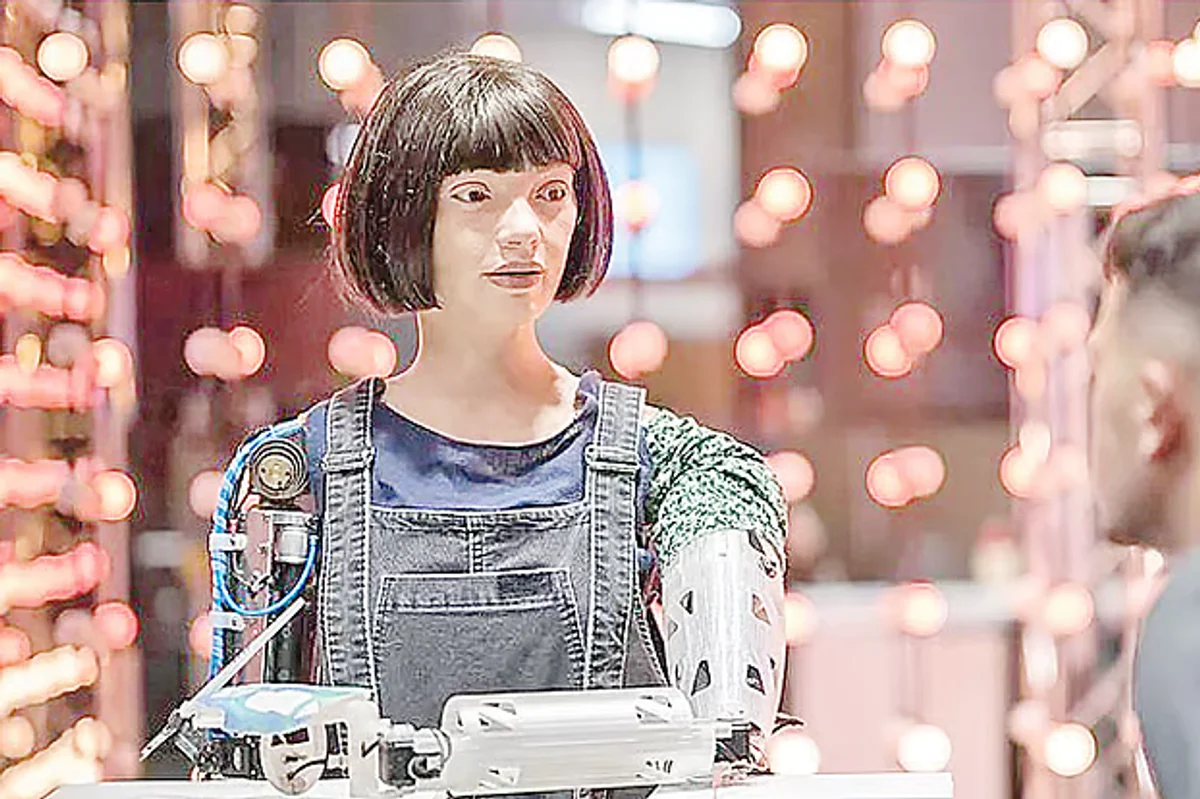
Unitree Robotics, the world’s largest humanoid robot maker, began trading on the Shanghai stock exchange on Wednesday. The company’s shares surged more than 600 percent as trading opened.
In the highly anticipated initial public offering (IPO), the Chinese company’s shares began trading at 1,100 yuan (£120.60 or $163.12). The price later eased somewhat, falling to around 900 yuan.
The listing is being described as an important milestone in China’s ambitious plan to advance its robotics industry. The STAR Market is often referred to as China’s “Nasdaq.”
Unitree’s stock market debut comes at a moment when the United States and China are going head-to-head in the race to dominate the global market for robots and the artificial intelligence (AI) models that power them.
This is not the first stock market listing for a Chinese humanoid-robot maker. But it is the first such listing on mainland China.
Robots are already widely used in a range of forms, from automated industrial machinery to smart vacuum cleaners at home. Now, massive investment is flowing into building robots that look human and can walk on two legs. Major companies including Tesla, BYD and Amazon are also building such robots, capable of performing many human-like tasks.
It appears that robots once confined to science fiction novels or films of that genre are now becoming reality. That day may not be far off when it is robots, not people, who serve as helpers in human homes. In the age of AI, that vision is not seen as far-fetched.
A new benchmark for the robotics industry
Unitree’s stock market debut carries particular significance. The industry is developing rapidly, and the listing is a strong sign of growing investor interest in robotics.
According to Jack Pearson of investment firm RoboStrategy, Unitree’s listing has created a rare opportunity for retail investors to invest in a humanoid-robot maker. At the same time, it could become a benchmark for others in the industry.
Pearson said Unitree’s success shows China’s robotics industry has reached “an inflection point.” At the same time, the United States is tightening restrictions on imports of foreign-made robots.
Roughly three years before Unitree’s IPO, a smaller Chinese company, UBTech Robotics, listed on the Hong Kong stock exchange.
UBTech drew global attention this past July after unveiling robots that Chinese state media described as “extremely lifelike.” The robots were said to be designed for emotionally supportive assistance and everyday interaction with people.
Following in the footsteps of UBTech and Unitree, several other robot makers — including Leju Robotics and AgiBot — may list on stock exchanges in the coming months.
Despite this optimism about the industry, however, there remains uncertainty over demand for robots outside factory and commercial use.
Harold So said it will still take several years before robots reach a stage where they can be used effectively for household chores. That will require solving issues including battery life, personal-data protection and reliability.
According to So, the biggest initial market for robots will be in settings such as factories and hospitals.
US-China tech rivalry
Robots and AI are now a new front in the US-China technology rivalry. Both countries consider the industry strategically important.
US President Donald Trump’s administration announced in July that it had banned imports of newly built Chinese humanoid and quadruped robots, citing national security and the protection of the US manufacturing sector.
Beijing has rejected the allegation, accusing Washington of “politicizing” trade issues. The United States has also imposed tough restrictions on other Chinese technologies, including AI models and electric vehicles.
According to Kristin Wan of the Peterson Institute for International Economics, China’s dominance in robotics has made one thing clear: Chinese companies are becoming deeply embedded in global manufacturing systems.
That means no matter how hard Washington tries, it will not be easy to keep China from moving ahead.
Wan added that as many countries try to reduce their reliance on Chinese suppliers, they risk disrupting their own manufacturing systems — meaning they, too, may not easily be able to turn away from China.
So far, Western-made robots have not been able to match the impact of Chinese robots in either factory production systems or consumer markets.
Boston Dynamics, one of the leading US robot makers, has said humanoid robots will begin operating in carmaker Hyundai’s factories within two years. Boston Dynamics is majority-owned by South Korea’s Hyundai.
Several other American companies, including Amazon and Tesla, have also said they plan to deploy humanoid robots.
Earlier this year, Elon Musk’s Tesla said it would use humanoid robots named Optimus in the manufacturing of its Model S and Model X vehicles at its California factory.
Amazon tested the use of humanoid robots in its warehouses in 2023. The company has said it continues to research next-generation robotics technology.
Robotics researcher David Sue said it is now clear that the United States has lost its leadership position in robotics technology. He said American robotics companies are rarely in the news anymore. Headlines are now dominated by Chinese robot makers.
In Sue’s words: “They are the ones who have now taken America’s place in the world of technology.”
বাংলায় মূল প্রতিবেদন পড়ুন · Read the original Bengali report