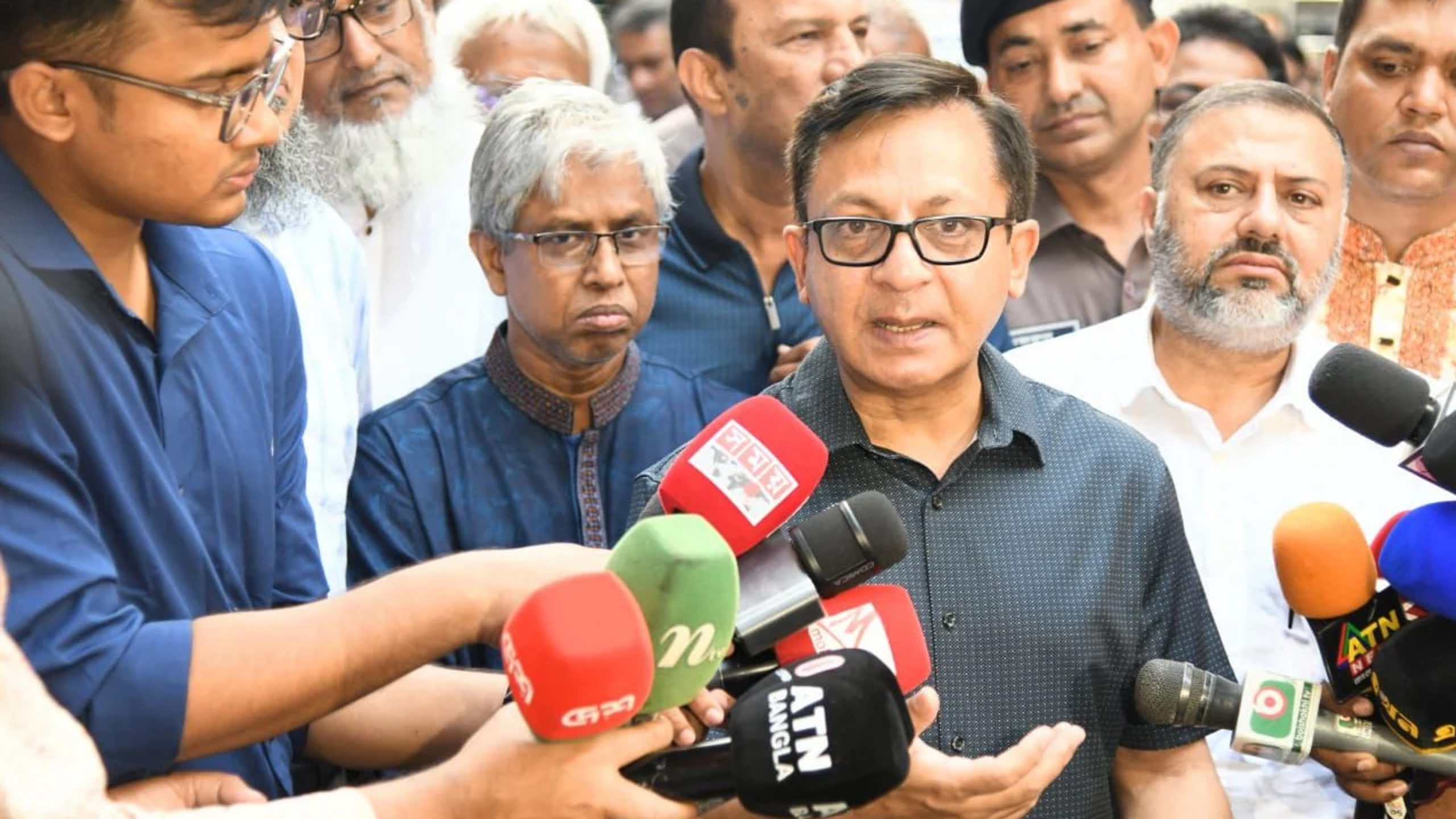
Commerce, Industries, and Textiles and Jute Minister Khandaker Abdul Muktadir has said the government’s goal is to make the country’s leather industry stronger and more export-oriented by ensuring the fullest use of sacrificial-animal hides.
He said an integrated, long-term plan to develop, preserve, process and boost the export capacity of the leather sector will be presented to the nation by July. He made the remarks to journalists on Friday afternoon after inspecting the buying and selling of raw sacrificial hides at Posta in the capital’s Lalbagh.
Muktadir said the government is hopeful that, thanks to its coordinated efforts, the active participation of traders and warehouse owners, and mosque- and madrasa-based preservation programmes, most of this year’s sacrificial hides can be collected in usable condition.
“Visiting the Aminbazar warehouses yesterday and the Posta and Hemayetpur (Savar) warehouses today, I saw that a huge quantity of hides has reached traders and that salting is under way,” the minister said. “Not all sacrificial hides come to Dhaka at once; normally the whole process takes two to three months. But this time, with the combined efforts of various government bodies, district administrations, city corporations, BSCIC and the traders concerned, I believe we can get close to our goal.”
Stressing the need to follow the correct preservation process, he said: “The situation is good at the moment because temperatures are relatively bearable. But at 38 to 40 degrees, hides risk spoiling within hours. If they are properly cleaned and salted within four to six hours of slaughter, they can be preserved for three to four months.”
He said: “Raw hide becomes wet blue, then crust leather and then finished leather, which is used to make shoes, sandals, belts and other products. So if they are not salted in time, the hides have no practical value.”
Answering a question on smuggling, the minister said: “Every year there are complaints of hides being smuggled. We do not want a single hide smuggled out of the country, and the relevant authorities have been instructed to keep strict watch on this.”
On the Savar leather industrial estate and the Central Effluent Treatment Plant (CETP), he said many tanneries had not been able to start full operations even after the move from Hazaribagh to Savar, and that the CETP has some limitations. Although its design capacity is 25,000 cubic metres a day, in practice it is limited to between 14,000 and 18,000, and necessary repairs and development will be undertaken to raise that capacity.
The minister also stressed modernising the slaughter and skinning process to improve hide quality. “If skinning is not done properly, the quality of the hide is ruined. We are planning to make the whole process modern and mechanised,” he said.
He said the market and exports of leather goods are currently worth about 12,000 to 15,000 crore taka, with a huge domestic market as well. The government has already supplied salt free of charge to madrasas and collection centres through BSCIC and district administrations so that the sacrificial hides can be properly preserved, he added.
Industries Ministry Secretary Md Obaidur Rahman, Commerce Ministry Secretary (routine duty) Md Abdur Rahim Khan, BSCIC Director General Md Saiful Islam and leaders of the Bangladesh Tanners Association were present.
বাংলায় মূল প্রতিবেদন পড়ুন · Read the original Bengali report