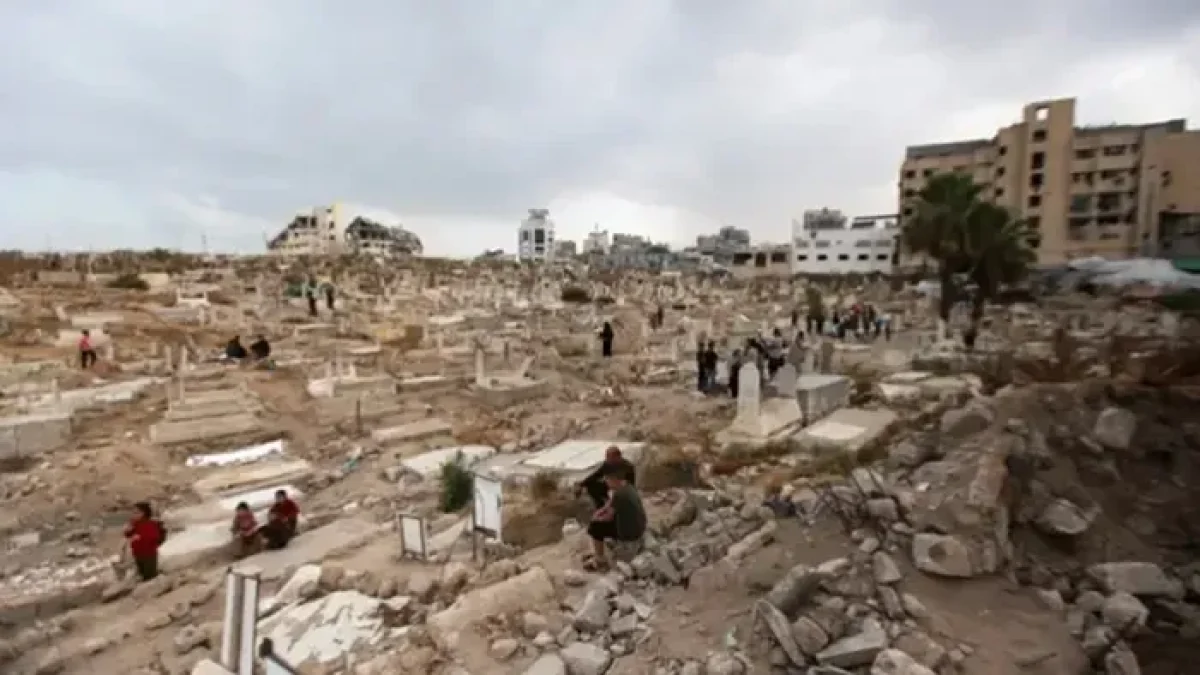
Israeli forces have continued their assault on Gaza since October 2023. Even though a “ceasefire” formally remains in place, Israel is carrying out strikes almost daily. The death toll has now surpassed 73,000, with more than 150,000 wounded. Alongside this, millions of Palestinians have been displaced from their homes.
A report by the Qatar-based news outlet Al Jazeera says a crisis has now emerged in Gaza in which Palestinians are struggling even to find space to bury their dead. Omar al-Sawahi, 20, of Gaza, is one such case. He now faces a difficult reality: where to bury his father, Mohammad?
Mohammad, 40, was selling tea and coffee at a small roadside shop in the Zeitoun area of Gaza City. On June 10, he was shot in the neck near Israel’s designated “yellow line.” He died almost instantly at the scene.
When Omar went to Zeitoun cemetery to bury his father’s body, he found that burial space there had nearly run out. Because of the ongoing war in Gaza and the massive loss of life, bodies are being buried in packed, tight rows in cemeteries.
Many graves have no permanent marker at all — just a stone, with a piece of paper bearing the deceased’s name attached to it. This situation has arisen because of the shortage of space caused by the war and a lack of construction materials.
Omar told Al Jazeera: “I stood in the middle of the cemetery and saw countless graves. Mounds of sand all around, and people buried beneath that sand.” He said in some places, only a stone with the martyr’s name written on paper has been placed. The way graves used to be dug and prepared before the war, he said, there is no longer any way to do that now.
Currently, digging a grave in Gaza costs about 500 shekels, or $167. Omar’s family could not afford that amount. On top of that, there was no space left to find for a new grave.
“There was no space for a new grave,” Omar said. “So in the end, we had to bury my father in our grandfather’s grave.”
The war in Gaza has caused the near-total collapse of services. At the same time, the risk of Israeli strikes has made it difficult to identify the dead and bury them properly. As a result, thousands of Palestinians have been counted as missing during the war.
Many have been buried temporarily in home courtyards, beside tents, inside displacement shelters, or in school or hospital grounds.
After a U.S.-mediated ceasefire was announced in October 2025, the intensity of Israeli strikes in Gaza eased somewhat. Families then began trying to recover the remains of relatives from under rubble or from temporary graves.
Even after the ceasefire was announced, at least 1,200 Palestinians have been killed in Israeli strikes. Each of them required a new burial site. Gaza authorities say 529 Palestinian bodies have been recovered from seven mass graves located on hospital grounds.
Al Jazeera says Gaza’s burial-space crisis is not only because of the more than 73,000 Palestinians killed in the war since October 2023. Many cemeteries have also been destroyed in Israeli strikes.
According to Gaza’s Ministry of Religious Affairs and Waqf, more than 40 cemeteries have been destroyed since the war began.
In addition, strict restrictions have been imposed on entry to cemeteries in areas under Israeli military control, further reducing burial space for families.
Ikrami al-Madalal, a media official at Gaza’s Waqf Ministry, said many of Gaza’s 60 cemeteries were already nearly full before the war began.
Tafesh Abu Hatab, 50, has worked as a gravedigger for the past 19 years. He says the ongoing war in Gaza has been the hardest period of his career.
The Khan Younis cemetery where he works held about 60 graves when the war began. Now, about 6,000 bodies have been buried there.
At one point during the war, Tafesh had to prepare as many as 35 graves a day.
বাংলায় মূল প্রতিবেদন পড়ুন · Read the original Bengali report