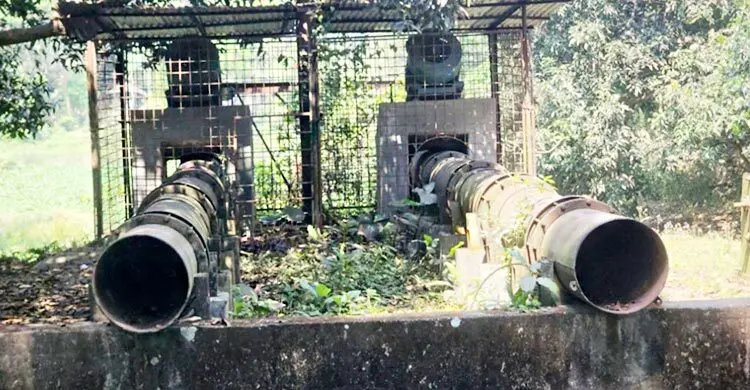
A multimillion-taka irrigation project run by the Bangladesh Water Development Board in Narail is now of no use to farmers. It has become little more than a memory. Two powerful irrigation pumps have sat broken for a full eight years, leaving more than 1,000 hectares of farmland without irrigation.
The project’s canals have also dried up, so water from the Chitra River no longer reaches the fields. As a result, farmers have been forced to buy diesel at high prices to run shallow pumps instead, straining their finances.
According to the Water Development Board, two irrigation pumps were installed in 1985 in Kamalapur and Gandhabbyakhali villages of Narail Sadar upazila, under the southwestern region’s water resources planning and management project. Under the project, an 8.5-kilometer irrigation canal was dug in the Kamalapur area.
A nine-kilometer irrigation canal was also dug in the Gandhabbyakhali area. Water flowed directly to farmers’ fields through the two canals. The project, which cost Tk 51.27 million, was intended to give farmers access to low-cost irrigation across 1,037 hectares of land. But the two irrigation pumps stopped working in 2018. A development project proposal worth Tk 350 million was then submitted in 2019 to repair the pumps, but it was never implemented because of the Covid-19 pandemic.
A visit to Kamalapur village found the irrigation project lying abandoned. The gate is broken, the office room is locked, and the entire area has become a haunt for drug users. Yamin Torofdar, an outsourced gate operator, said officials no longer visit since the pumps stopped working, and drug users have taken advantage of the isolation to gather there. “We don’t dare stop them,” he said.
Local farmers said it now costs Tk 100 to irrigate one kani (40 decimals) of land using a diesel-powered shallow pump. When the irrigation project was operational, however, rice, jute, and wheat fields could be watered at much lower cost. Now, they say, irrigating with shallow pumps costs them a great deal of money.
Farmer Soumen Kumar said the two irrigation pumps had been an easy, low-cost water source for them. Water was supplied directly to fields from the Chitra River through these pumps, allowing farmers to grow three crops a year at low cost. But with the pumps out of service for eight straight years, they now have to rely on diesel-powered shallow pumps for irrigation.
Milon Ghosh of Kamalapur village said: “We used to get free irrigation from the pumps. Later, the Water Development Board set up an association and began charging money on the pretext of covering the electricity bill. At the time, I paid Tk 9 for three decimals of land toward the electricity bill. Later, I learned that thousands of taka in unpaid electricity bills had piled up. After that, irrigation stopped. Now I hear the pumps are lying broken.”
Masum Khandaker of Nakshi village, Auria union, Sadar upazila, has cultivated rice on one acre of land this year. He was running a diesel-powered shallow pump to irrigate his own field. He said that when the irrigation pumps were working, farmers across three villages could irrigate their rice, jute, wheat, and other crops at low cost. With the pumps out of service, production costs for farmers in the three villages have risen sharply.
Abhijit Kumar Saha, executive engineer of the Narail Water Development Board (WDB), said the project had two irrigation pumps. After they broke down, a proposal was sent to Dhaka in 2018 to repair them, but it was never implemented because of various complications.
He said the project is extremely important. If it could be restarted, farmers in the area would once again have access to low-cost irrigation. A fresh request has been sent to the relevant ministry to repair the two non-functioning pumps.
বাংলায় মূল প্রতিবেদন পড়ুন · Read the original Bengali report