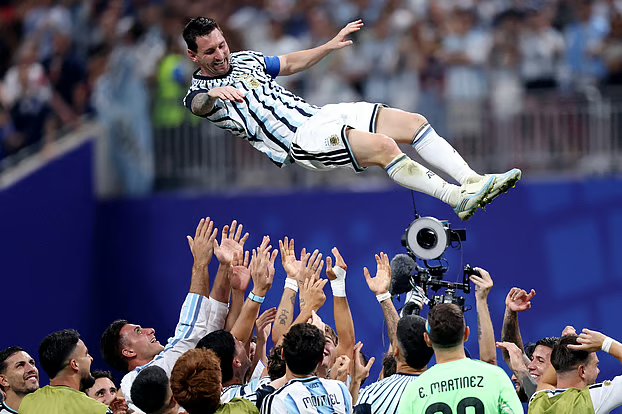
He was always going to have to leave the national team someday. He had turned 39. He had won everything there was to win in Argentina’s jersey. Still, for some, Lionel Messi’s announcement Monday night that he was retiring from Argentina’s national team came as a shock — no one had had the slightest inkling that the day had finally arrived.
Speculation hasn’t stopped since. Questions remain about why Messi chose this moment to retire. Argentine outlet La Nación reported that Messi actually decided to retire from the national team 43 days before the July 19 World Cup final — a detail that adds up once the pieces are put together.
In the closing part of his retirement message, Messi wrote: “I wrote these words on July 21, two days after the final. After what happened with my father, I feel more certain today than ever.”
The World Cup ran for 39 days, meaning Messi had already made up his mind before the tournament even began. The decision hardened further after the 1-0 final defeat to Spain, and became final after his father, Jorge Messi, died on August 8.
Even before the World Cup began, Messi had dropped hints about his future with the national team. After losing his father, he admitted his body was no longer responding the way it used to. His teammates, too, had recently signaled that Messi’s retirement was approaching. On August 25, national teammate Leandro Paredes indicated that Messi had already played his last match for Argentina — the World Cup final. “I think he had already decided that was going to be his last match for the national team,” Paredes said.
Putting Paredes’s words alongside parts of Messi’s retirement message makes things somewhat clearer. In his message, Messi said: “I don’t have anything left to give. Besides, there are excellent young players coming up who deserve their place in the team.”
The World Cup final is worth recalling. Argentina was thoroughly outplayed by Spain — with Messi on the pitch throughout, a rare occurrence in his career.
Standing at the end of his career and tasting that rare bitterness, did Messi feel he had nothing left to give? With young players like Nico Paz and Thiago Almada emerging, did that convince him the time was now? The question is worth asking, because in making that final his last match for the national team, Messi wrote in his retirement message: “I understand that this is the right time.”
FIFA’s first international break after the World Cup runs from September 21 to October 6, and Messi made his retirement announcement ahead of it. In other words, the legend judged this moment — just before the start of a new four-year World Cup cycle — as the right time to step away from the sky-blue-and-white jersey. National teams can play one to four matches during this break. La Nación reported that the Argentine Football Association (AFA) is planning a grand farewell tribute in Buenos Aires to honor the World Cup runners-up and Messi himself. That raises the possibility of seeing him in Argentina’s colors on the pitch at least once more.
La Nación also reported that his father’s death 23 days earlier influenced the decision. At the time, Messi had said: “I have my doubts now about how much longer I’ll keep playing football.” Another factor can be inferred: the generation of teammates he spent years alongside is beginning to break up. With the 2030 World Cup on the horizon, Argentina is now going through a transition — several of his teammates are nearing the end of their careers, and the squad will need rebuilding. There is even uncertainty over whether coach Lionel Scaloni will stay on past this December. Argentina, as co-host, has already secured its spot at the 2030 World Cup, meaning it won’t have to play a long qualifying campaign. That makes the 2028 Copa América Argentina’s next major tournament — and at 39, Messi apparently didn’t want to wait two more years, growing older still, for that.
Many at the AFA had hoped Messi would keep playing for the national team a while longer, so that his last memory in the jersey wouldn’t be a lost final. Some had hoped he would play at least through the Copa América. But for anyone who knows Messi, one thing follows naturally: he always believed he could give his absolute best for the national team. Did he doubt whether he could still deliver that two years from now at the Copa? His retirement message makes it clear. In it, he wrote: “I gave everything I had.”
In other words, was there nothing left to give? Perhaps that realization is exactly why Messi chose to step away.