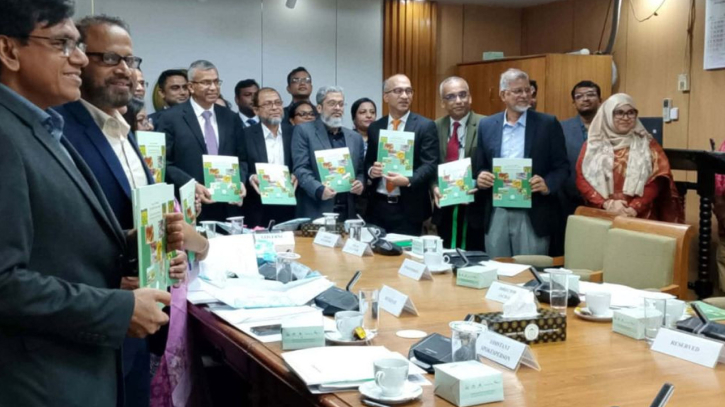
Bangladesh Bank has set a target of Tk 60,000 crore for agricultural and rural credit disbursement in the 2026-27 fiscal year, aiming to increase the flow of credit to the agriculture sector. The new target marks a 53.8 percent increase over the previous fiscal year’s target of Tk 39,000 crore. Banks have also been strictly directed to ensure that loans reach marginal and genuine farmers and that credit is used appropriately.
The information was disclosed at an event announcing the 2026-27 fiscal year’s agricultural and rural credit policy and program, held Monday, August 17, at Bangladesh Bank’s head office. Bangladesh Bank Deputy Governor Dr. Habibur Rahman outlined the reasons behind the higher agricultural credit target and various aspects of the new policy at the event.
Of the new target, Tk 20,845 crore has been set for state-owned commercial and specialized banks, and Tk 39,155 crore for private and foreign commercial banks. In other words, participation by private and foreign banks in agricultural credit disbursement is now being expanded alongside that of specialized banks.
Dr. Habibur Rahman said the agriculture sector’s share of total lending remains disproportionate given its contribution to national income. The share of agricultural loans has now been raised from 2.5 percent to 4 percent of total lending, with plans to increase this share further in the future. The goal, he said, is to align credit disbursement and other facilities with agriculture’s contribution to the economy.
He said the core objective of increasing agricultural credit is to make agriculture self-reliant and farmers economically capable. The scope and volume of agricultural credit are being expanded so that farmers, rather than waiting for loan waivers, can become self-reliant through regular loan repayment, increase production, and play a more significant role in the national economy.
Addressing various complaints about who actually benefits from agricultural loans, the deputy governor said two things matter most in agricultural lending: timeliness, and ensuring the loan reaches the genuine farmer. If someone who is not actually a farmer receives an agricultural loan, there is a risk the funds will be diverted to other purposes — misuse of this kind, he said, could also be viewed from the standpoint of money laundering.
He said lending to farmers who hold Department of Agricultural Extension farmer cards is comparatively safer. Where a farmer card is not available, banks must be certain the person receiving the loan is genuinely a farmer. If a bank disburses a loan without verifying the recipient is a genuine farmer, the bank itself will bear responsibility for that.
Responding to reporters’ questions at the event, Dr. Habibur Rahman acknowledged there have been complaints of middlemen and other irregularities in agricultural loan disbursement. He said Bangladesh Bank regularly conducts various surveys and monitoring to verify whether loans are reaching genuine farmers and being used appropriately, and pledged to further strengthen oversight in this area.
Questions were also raised about a tendency at Krishi Bank and Rajshahi Krishi Unnayan Bank to adjust old loans and reissue new ones. Dr. Habibur Rahman said this should not automatically be viewed negatively in every case. If a farmer’s loan amount is increased, in line with need and repayment capacity, after an earlier loan is settled, that can be seen as an expansion of new credit. However, he said, if the same loan is repeatedly renewed over a long period without verifying genuine need, that practice needs to be brought under control.
He said the most important consideration after disbursing a loan is whether the money is being used properly. Banks must also assess whether a farmer has used loan funds productively and built the capacity to repay. Monitoring of use and repayment capacity must begin from the very start of disbursement.
The new policy also emphasizes credit disbursement tailored to regional agricultural patterns and demand, with instructions to follow an “area approach” method. Banks may use data from the Bangladesh government’s crop zoning system, the “Khamari” app, and relevant agencies including the Bangladesh Bureau of Statistics, the Department of Agricultural Extension and the Department of Fisheries in disbursing agricultural credit. The policy also calls for using Bangladesh Agricultural Research Council crop-zoning data to determine region-specific agricultural production and credit demand.
Dr. Habibur Rahman said that where rice, potatoes, fish or other agricultural products are produced in greater volume in a given area, loan targets should be set accordingly. Loan ceilings have been determined based on production volume, land area, and the cost of fertilizer, seed, labor and other inputs. However, if production costs and market prices fall out of alignment, there will be scope to raise or lower loan ceilings as needed.
The new policy also calls for expanding access to collateral-free loans and alternative collateral options for women and marginal farmers. Credit disbursement has also been expanded in the fisheries and livestock sectors. For loan applications up to Tk 500,000, banks have been instructed not to require any charge documents beyond a specific set. The policy also emphasizes allowing personal, social and group collateral, rather than conventional land or immovable property, for loans to women and marginal farmers.
The policy also stresses ensuring that agricultural credit is used for its designated purpose. In the fisheries and livestock sectors, banks may lend to individual or group farmers and breeders. Sectors including poultry-chick production, hatcheries and fish-fry production have been brought under the scope of lending. The policy also emphasizes addressing the impact of climate change, contract farming, production of various new crops, and post-harvest management of agricultural produce.
A Tk 10,000 crore refinancing scheme and a summary of policy related to a Tk 3,000 crore refinancing fund have also been added to the new program. It calls for expanding various opportunities to bring small-capital farmers, new entrepreneurs and specific production sectors under credit coverage.
At the event, the deputy governor said the agricultural and rural credit target has been raised by Tk 21,000 crore from last year to Tk 60,000 crore. The goal, he said, is not simply to increase the loan amount, but to ensure credit reaches genuine farmers and is used productively. Greater emphasis is now being placed on ensuring farmers can increase production with the credit they receive and build the capacity, through timely repayment, to access larger loans in the future.
He added that banks have been instructed to ensure there is no lapse in agricultural credit disbursement, and that Bangladesh Bank’s own team will also monitor the matter. Central bank oversight will be further strengthened to ensure genuine farmers are identified, credit is used correctly, and loans are disbursed on time.
বাংলায় মূল প্রতিবেদন পড়ুন · Read the original Bengali report