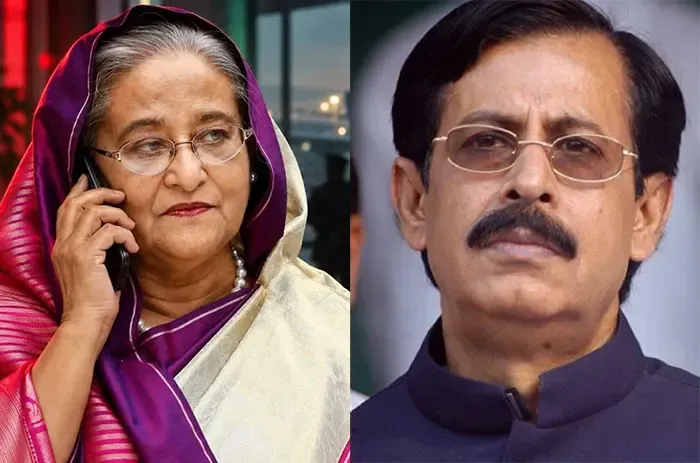
Sheikh Fazlul Karim Selim will act as president of the currently banned Awami League in the absence of former Prime Minister Sheikh Hasina. In an interview with India’s The Wall, Hasina said, “Sheikh Selim is now the senior-most presidium member. In my absence, he will carry out the responsibilities of president.” On her younger sister, Sheikh Rehana, she said, “Rehana is not directly involved in politics.” In a lengthy conversation with The Wall’s executive editor, Amal Sarkar, Hasina made a series of pointed remarks on her return to the country, personal security, the current situation in Bangladesh, India-Bangladesh relations, and the future leadership of the Awami League. In the interview, she reiterated her plan to return to the country in December, while expressing concern that she could be killed at the airport if she did. “Everyone’s life is at risk. I don’t want to put anyone in danger by instructing them to bring me back,” she said.
India will pay a price too
Hasina alleged that extremist forces are on the rise in Bangladesh, and warned that its effects will not stay confined within Bangladesh’s borders. “India, too, will have to pay a price for the rise of extremism in Bangladesh,” she said. Her argument was that instability in neighboring Bangladesh and the spread of fundamentalist forces could also affect India’s security and regional stability. For that reason, she said, relations and mutual understanding between the two countries are extremely important. She also questioned New Delhi’s position on India’s support for Bangladesh’s election and the return of Prime Minister Tareque Rahman to the country. “Only the Indian government can properly explain what it was thinking when it supported Bangladesh’s election and brought (Prime Minister) Tareque back,” she said.
Building regional understanding between the two neighbors is essential for the future
Hasina’s remarks on India’s position in Bangladesh’s internal political developments are significant. But she also suggested that building regional understanding between the two neighboring countries is essential for the future. In her words, rather than any military alliance, emphasis should be placed on regional cooperation and building relations based on mutual interest. She also criticized current Prime Minister Tareque Rahman, saying he engaged in politics while living abroad. “I never stopped him. Is it wrong for me to simply speak from Delhi?” she said, adding that bargaining over Tareque Rahman’s visit to India amounts to belittling his own country.
Hasina grew emotional while discussing the current situation in Bangladesh. Describing how deeply the country’s condition personally pains her, she said, “My heart bleeds when I see my country being destroyed.” She also spoke in the interview of her wish to return to the country, though she repeatedly voiced concern that her return should not endanger anyone else’s life given the security situation.
This country is mine
Asked how she could return to the country if the government does not issue her travel documents, Hasina said, “This country is mine. My father won its independence. We grew up in this country since childhood. And I’ve been in politics since my school days. My question is why I wouldn’t be allowed to return to my own country. What is the BNP government saying? They are asking the Indian government to hand me over. If they’re talking about handing me over, why hand me over — I’ll go myself. That’s why I said I will leave. Now why would they stop me, and why would I need permission?” Asked what she would do if not granted permission to return — whether she would enter some other way — she said that would depend on the circumstances at the time. She said the current situation in Bangladesh is not conducive to a favorable outcome. “People are being persecuted. It cannot be described in words,” she said. She also criticized the interim government, calling it a “meticulous design,” and spoke about the deteriorating law-and-order situation.
I will go to the people
Hasina said, “I will go to the people of this country, because people are suffering now. I have to stand by them. Even if it costs me my life, I want to stand by the people.”
I thought they were taking me to our village home
Sheikh Hasina left Ganabhaban for India on Aug. 5, 2024. Discussing that, she said, “I never wanted to leave the country. I didn’t even know I was leaving. I was forced to leave under a certain set of circumstances, and I only learned the details of it much later. When the helicopter crossed the border, I was told we were coming here, to India. Until then, I believed I was going to my village home. I worked to improve people’s standard of living. Why should I have to stay in power by leaving bodies behind! In that situation, I said I don’t need to stay, I’ll leave. Where would I go? I said I would go to our village home in Tungipara. It was only once I was on the aircraft that I realized I had come here, to India.”
She said, “Six hundred thousand cases have been filed against my party workers. Meanwhile, they released every militant and terrorist there was. During my time in power, there was only a single such incident. Under this government, 460 police stations were looted and burned. People were tied by the feet and hung from flyovers. They carried out horrific acts against the Awami League, the Jubo League and other organizations, and against the police.”
I’m speaking with the grassroots
Asked whether she would return before December if the situation allowed, she said, “I chose December because it’s our Victory Month. Also, I am currently in touch with our grassroots workers. They are being hacked, beaten, tortured and persecuted. This is ongoing. Even so, people still speak with us. I’ve decided I will go in December, not before. I’m preparing accordingly.”