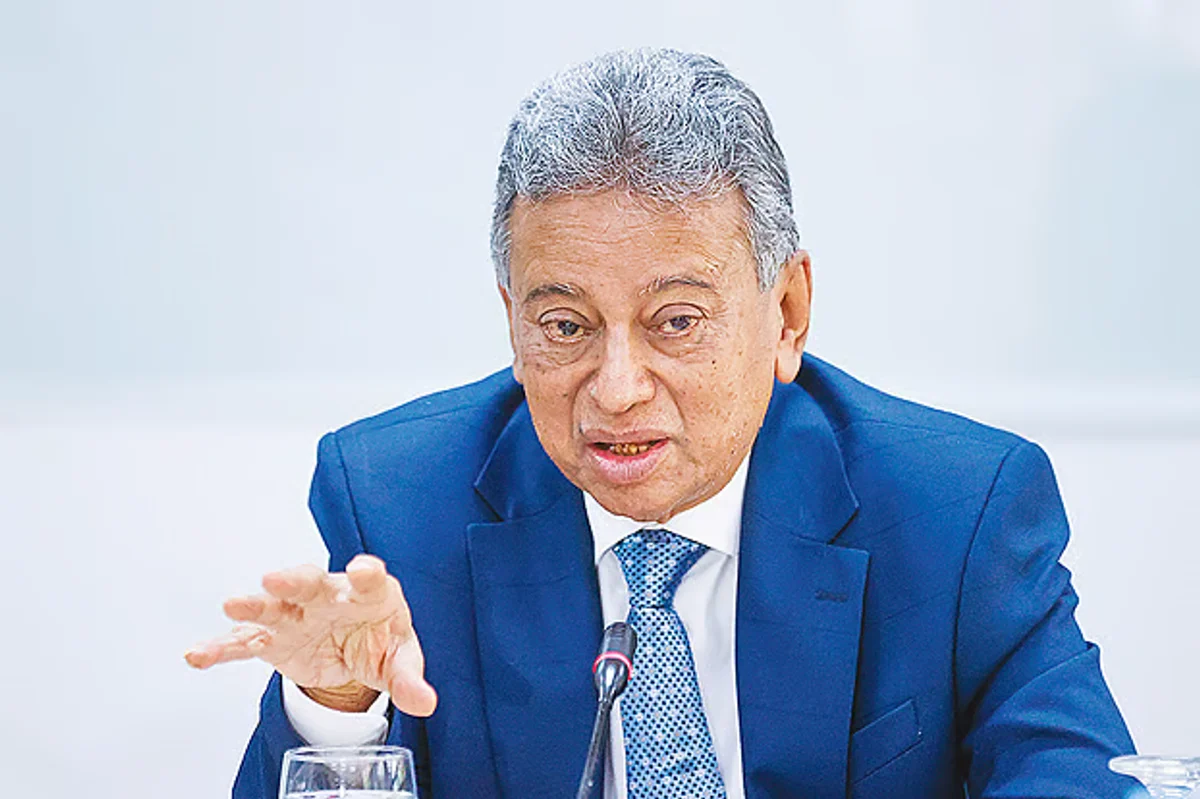
The finance and planning minister, Amir Khasru Mahmud Chowdhury, has called the loan program the previous government took from the International Monetary Fund (IMF) “entirely against the public interest.” He said any new loan program with the IMF would be pursued while protecting the economic interests of the country’s people.
The finance minister made the remarks to journalists at the Secretariat on Sunday. At the time, a 12-member IMF mission was holding meetings at the finance ministry as part of talks on the new loan program. The mission is to meet various government offices throughout the week.
The mission had eight scheduled meetings during the day, one of them with the finance minister at 1 p.m., but that meeting was cancelled as he went to attend the funeral of former Jatiya Sangsad speaker and former acting president Barrister Jamir Uddin Sarkar, according to finance ministry sources.
The day’s first meeting, led by the IMF’s Bangladesh mission chief, Ivo Krznar, was with Finance Secretary Md. Khairuzzaman Majumder. The IMF mission then presented its policy plans to finance division officials and representatives of Bangladesh Bank.
Answering journalists’ questions as he left the finance ministry, Amir Khasru Mahmud Chowdhury said: “Our main concern is not getting money, but protecting the country’s interest. The government will not enter any program with the IMF that harms the interests of the country’s people.”
Describing the previous government’s IMF loan program as “entirely against the public interest,” the finance minister said: “As an elected government, protecting the interests of the people of Bangladesh and of the country’s economy is our top priority. We are entering a new program with the IMF that ensures the public’s economic interest. Whatever the program may be, the interest of the people of Bangladesh will be 100 percent protected.”
Under the new program, the government is hopeful of receiving a loan of US$4 billion to $4.5 billion over three years. If the money is obtained, Bangladesh will use it to maintain macroeconomic stability and cope with pressure on external financing. The finance minister formally wrote to the IMF for the loan on June 9, saying the economic and policy realities of the time the earlier program was taken no longer existed, and that domestic political economy, global uncertainty and new challenges had made some reforms difficult to implement. The government did not, however, wish to step back from the reform program, but rather to implement it in phases in keeping with the country’s realities.
In 2023 the Awami League government signed a US$4.7 billion loan agreement with the IMF. In June 2025, under the interim government, the size of that loan was raised to US$5.5 billion. Under the approved loan program, Bangladesh received a total of US$3.64 billion in five installments. But although talks over the disbursement of the sixth installment went on for about a year, it was ultimately not received, and the two sides have since cancelled the program.
Work under way on a new visa policy. The finance minister also spoke about a new visa policy, saying the existing visa policy would be modernized to make the economy more dynamic and to increase Bangladesh’s acceptance on the international stage. Work on it was under way, he said, and it would make it easier for foreign tourists, investors and skilled manpower to come to Bangladesh and would increase foreign investment.
The new visa policy was announced from a cabinet meeting chaired by Prime Minister Tarique Rahman on July 2. At that meeting, a draft of the new policy, amending the 2006 visa policy, was presented. After the meeting, cabinet secretary Nasimul Gani said that day that a cabinet committee led by the finance minister had been formed to refine the draft, with the home ministry providing secretarial support. The new visa policy aims to ease foreigners’ entry to and departure from Bangladesh, encourage foreign investment and business, develop the tourism sector, ensure technology and knowledge transfer, maintain national security and diplomatic balance, and build a modern, service-oriented migration system.
One of the most important issues in Sunday’s meetings was a possible second Resilience and Sustainability Facility (RSF) program. According to finance division sources, the preparation, possible framework and conditions of the program were discussed from 2 p.m. to 3 p.m., and the progress of reform implementation under the first RSF program, taken during the previous government, was also reviewed. Meetings from the afternoon into the evening were due to cover the 2026-27 budget and the medium-term budget framework, the GDP growth target, revenue-collection plans, subsidies and social-safety programs, the Annual Development Programme (ADP), implementation plans for large development projects and their financing sources.
বাংলায় মূল প্রতিবেদন পড়ুন · Read the original Bengali report