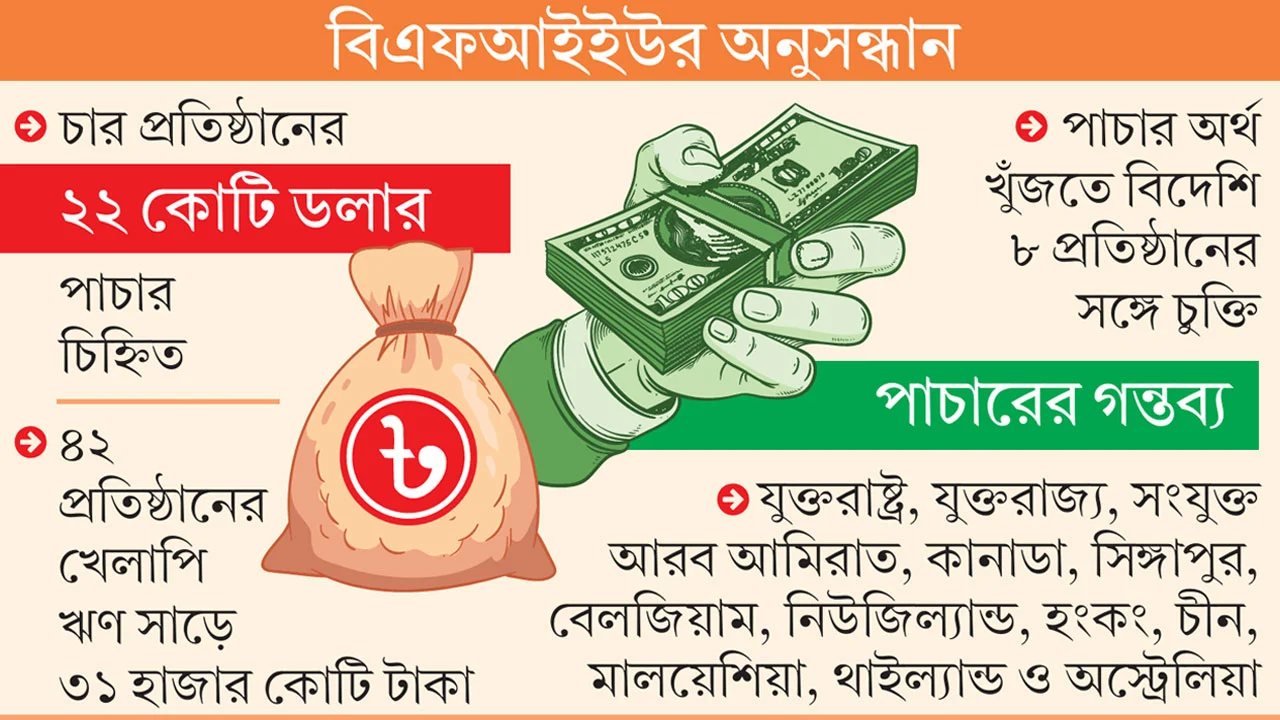
The Bangladesh Financial Intelligence Unit (BFIU) has identified 42 loan-defaulter groups that took bank loans and laundered money abroad. Laundering of about US$221.9 million by four of these has been traced, and the banks concerned have begun efforts to recover the laundered money and assets. Contracts have already been signed with eight international legal and professional advisory firms to identify and freeze assets held abroad. The 42 groups’ total defaulted loans amount to $2.549 billion — about 31,557 crore taka at 123.80 taka to the dollar.
Among the 42 groups are SB Exim Group, Habib Group, Yasir Group, AWR Group, Liberty Group, Premier Group, Laskar Group and Sad Musa Group. Laundering of $26.8 million by SB Exim, $134.1 million by Habib Group, about $40 million by Yasir Group and about $20 million by AWR Group has been traced — the four firms’ total laundered money being about $221.9 million. Earlier, the interim government formed a joint investigation team to uncover the bank looting, money laundering, tax evasion and other irregularities of the top 11 groups. Assets worth a total of 76,000 crore taka, at home and abroad, belonging to the family of fugitive prime minister Sheikh Hasina and 10 much-discussed industrial groups, have been frozen. These groups are S Alam Group, Beximco Group, Nabil Group, Summit Group, Orion Group, Nassa Group, Bashundhara Group, Premier Group, Sikder Group and Aramit Group. The action was taken on the basis of a joint investigation by the Anti-Corruption Commission (ACC), the police Criminal Investigation Department (CID) and the National Board of Revenue’s Central Intelligence Cell (CIC). International firms such as Grant Thornton, Baker McKenzie, PwC and Deloitte are assisting in recovering the foreign assets.
In the second phase, 42 firms with defaulted loans exceeding 200 crore taka were identified from the database of Bangladesh Bank’s Credit Information Bureau (CIB). Eight foreign firms have been tasked with tracing their laundered assets abroad — Grant Thornton, RI Consortium, Baker McKenzie and PwC, DLA Piper and Kroll, EY and Dentons, Rahman Ravelli and Interpath, BCG and HHR, and Animus Associates. On the basis of information from the banks, these firms are identifying the location, type and amount of the defaulters’ assets abroad and, in line with the relevant countries’ laws, trying to recover them. The foreign legal firms will take no advance fee or cost; if they identify and recover assets abroad, they will receive a fixed share of the recovered money as remuneration — that is, they will work on a “no win, no pay” basis. Bangladesh Bank sources say preliminary information on the 42 firms’ laundering has been found in the United States, United Kingdom, UAE, Canada, Singapore, Belgium, New Zealand, Hong Kong, China, Malaysia, Thailand and Australia, and efforts are under way to recover the money from these countries.
Asked about it, a senior Bangladesh Bank official said the BFIU had earlier been working on 11 firms over allegations of laundering money abroad, and 42 more have now been added; many are loan defaulters not repaying their loans, so it is being examined whether a part of their money is held abroad. Foreign agencies have been asked to investigate whether the firms have any links or money trail with entities abroad; if money is found, steps will be taken to freeze it and bring it home. Progress was discussed at a meeting of the managing directors of 38 banks, chaired by Bangladesh Bank governor Mostakur Rahman, on Sunday afternoon, where the governor urged banks to step up efforts to recover laundered money. After the meeting, Mutual Trust Bank managing director Syed Mahbubur Rahman told journalists that huge sums had left the country and banks were working to bring the money back, with steps also being taken to prevent such incidents in future. How much of the laundered money can be recovered is a secondary matter, he said, but it is essential to ensure that those involved in laundering are punished, and to that end moves are under way to freeze their money abroad. Bangladesh Bank spokesperson and executive director Arif Hossain Khan said international investigative and legal firms were, on the basis of the banks’ information, working to identify the location, type and value of assets held abroad; once identified, they would first be frozen or seized through legal process under the relevant country’s law, and later, on court orders, sold or disposed of, with the proceeds brought back to Bangladesh through due legal process. The initiative would both create scope to recover laundered national wealth and make it possible to recover banks’ long-outstanding large defaulted loans, he said.
বাংলায় মূল প্রতিবেদন পড়ুন · Read the original Bengali report