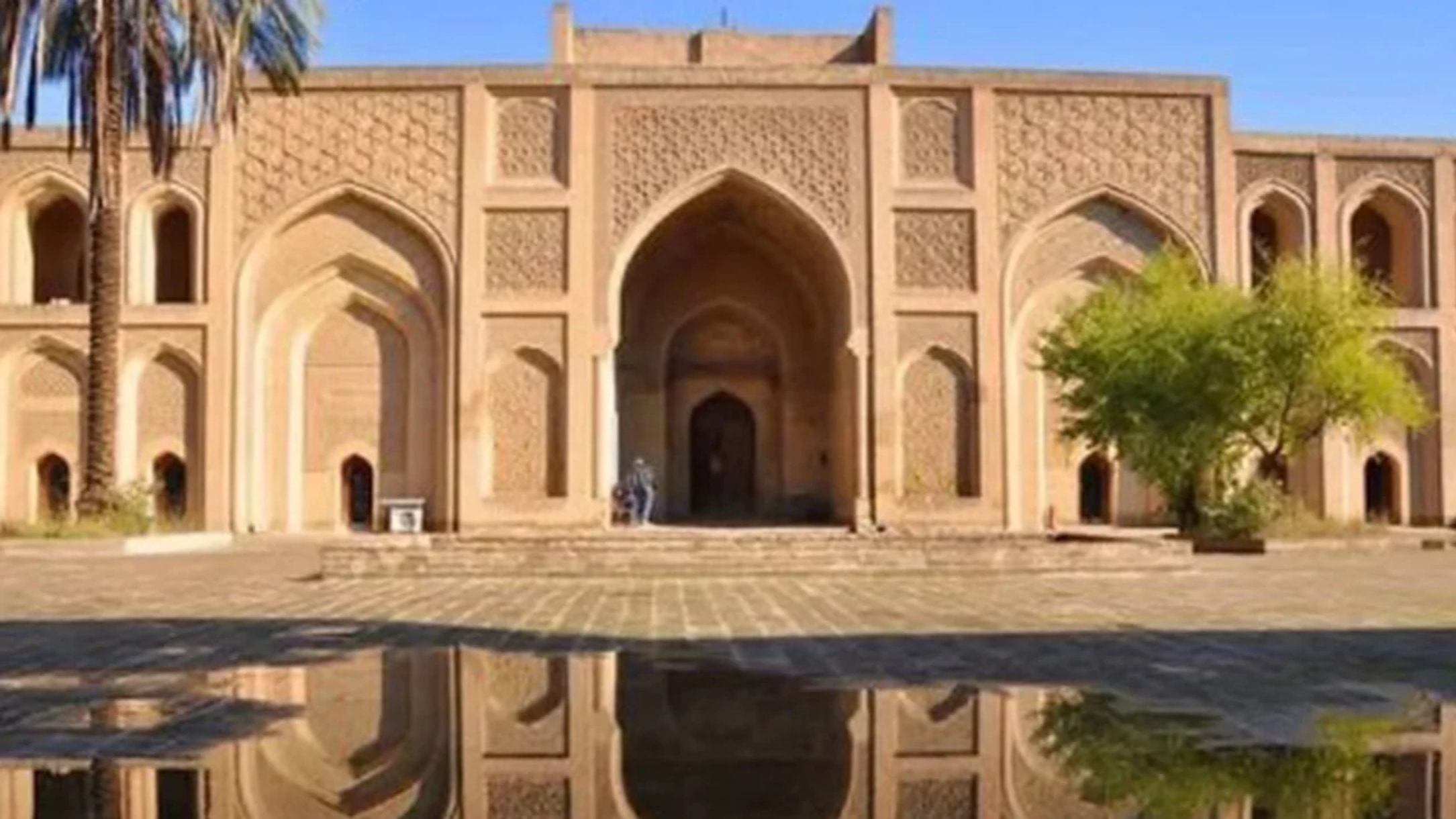
BAGHDAD — Baghdad reads like a city from a fable on history’s dusty pages. The city on the banks of the Tigris River was once the heart of world civilization. While Europe lay in the abyss of darkness, China’s grandeur was hidden from the world and Muslim rule was just being established in India, the Abbasid caliphate in Baghdad lit a glowing flame of knowledge. The brightest pillar of that flame was the Mustansiriya Madrasa. It was not merely an educational institution — it was the Arab world’s first comprehensive residential university.
Founding background
In the early 7th century Hijri, the Abbasid caliphate was in its twilight, but in cultural and intellectual heritage, Baghdad was still unique in the world. After assuming the caliphate in 623 AH, Caliph Al-Mustansir Billah realized that consolidating knowledge, science and educational activities required a fully equipped institution. He aimed to build one that would coordinate all branches of scholarship and schools of thought, where religious instruction would coexist with modern science.
Construction began in 625 AH (1227 AD) on the eastern bank of the Tigris River and was completed in 631 AH (1234 AD). The madrasa opened with a grand ceremony. Rare manuscripts and books were brought to its library on the backs of 160 camels.
Diverse curriculum
One of Mustansiriya Madrasa’s main features was its modern, balanced curriculum. It was not only a religious learning center but also a full university structure. It nurtured competent judges, diplomats, doctors, mathematicians and other accomplished personalities.
Religious sciences and language-literature: Quranic exegesis, Hadith study and Fiqh (Islamic jurisprudence) were the core religious subjects. The institution’s unique distinction was teaching all four schools of Islamic jurisprudence (madhhabs). Arabic grammar and higher rhetoric were also part of the curriculum.
Natural and mathematical sciences: Arithmetic, geometry and astronomy were major subjects of Mustansiriya Madrasa’s curriculum.
Medicine: A specialized medical department was set up at the madrasa’s southeastern end, called the “Bimaristan” or hospital. Students were taught medical practices there.
Many other subjects were included in the madrasa’s curriculum.
Residential arrangements
The residential system at Mustansiriya Madrasa was disciplined and well-regulated. It bore notable resemblance to the scholarship programs of modern world universities. Under Caliph Al-Mustansir Billah’s patronage, full facilities were ensured for students and teachers, and the learning environment was extremely pleasant.
Each discipline had separate blocks and well-furnished rooms for students. Every student was provided an assigned room, mat and rug. High-quality food was served daily in the madrasa kitchen.
Students received one dinar per month as stipend. They were also provided soap, oil, writing paper and other necessary supplies. Round-the-clock medical care was available for the sick.
Mustansiriya Madrasa was a model orphan-friendly institution. There was a separate “Darul Quran” for orphan children. Students’ sole responsibility was to engage in pursuit of knowledge without worrying about livelihood.
Mustansiriya’s guiding spirit
Mustansiriya Madrasa was not just a structure of brick and stone — its true soul lay in its distinguished teachers. Director Muhiuddin Abul Mahasin Yusuf Ibn al-Jawzi was the most celebrated and brilliant figure. Egypt’s Sultan Al-Kamil said of his knowledge and wisdom: “Even if the world’s people lacked intellect, Muhiuddin’s intellect was so great that even if it were less, it would still be enough.”
Final fate
In 656 AH (1258 AD), when Mongol commander Hulagu Khan besieged Baghdad, Ibn al-Jawzi went to the Mongol camp as the caliph’s envoy and tried to broker peace. But fate was cruel. The Tatars entered the city and threw the Mustansiriya library’s nearly 80,000 rare manuscripts into the Tigris River. In that destruction, Ibn al-Jawzi and his three sons were brutally martyred.
Today, the worn walls of Mustansiriya on the Tigris stand as silent witnesses to that lost glory and grandeur. It reminds us: civilizations rise on the foundation of knowledge, and they fall when the strength and unity of the state can no longer protect that knowledge.
বাংলায় মূল প্রতিবেদন পড়ুন · Read the original Bengali report