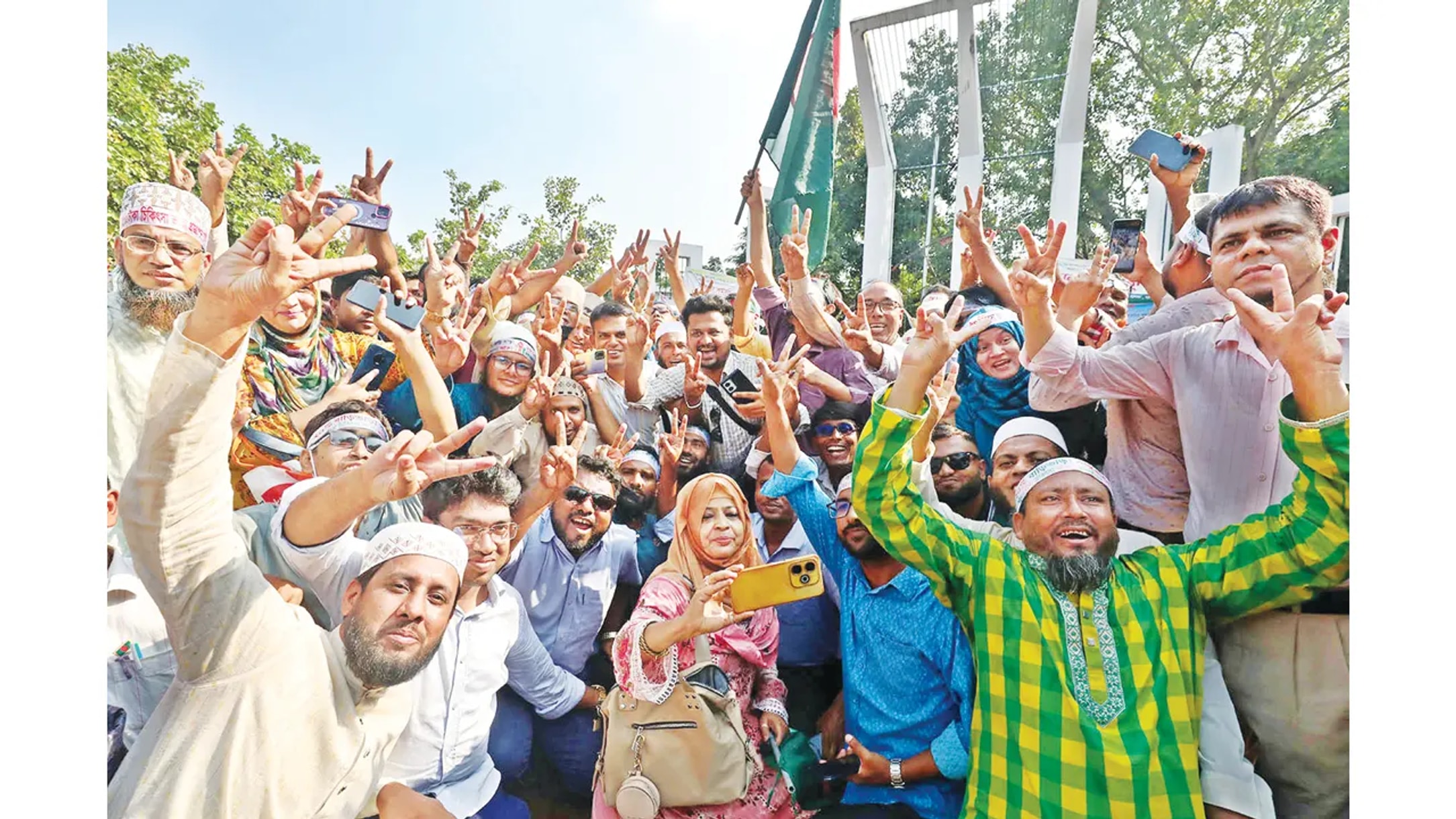
DHAKA — Bangladesh’s teachers lag far behind global benchmarks on pay and benefits, and those at private institutions are the most deprived. They have long faced disparity compared with government teachers, a gap that grew wider after the eighth national pay scale in 2015. Teachers launched four rounds of protests after that, but each time political coloring kept their demands from being met.
After a decade and a half of struggle, however, they have achieved partial success for the first time. They say it is not just a victory on pay and allowances but an initial win to restore the dignity of teachers. Their next goal, they say, is to push for nationalization.
According to teacher leaders, one of the main reasons earlier protests failed was opposition from pro-government teachers. At times, the protests were diverted by being labeled with the colors of rival political parties. This time, although a teachers’ group affiliated with one political party opposed the movement, the protest did not take on a political tone, and success followed.
They said that from the start of the protest, Jamaat-e-Islami, NCP, Islami Andolan, a former DUCSU vice president, Chhatra Shibir and other political organizations expressed solidarity. In the end, with open support from the BNP, the government came under pressure and agreed to raise teachers’ house-rent allowance to 15 percent in two phases.
According to teacher leaders, the first major protest for nationalization of education began in 2013, when teachers held a continuous sit-in in Dhaka. The government dispersed the protest with police using batons, branding it a campaign to topple the government. In January 2018, an 11-day sit-in strike in front of the National Press Club met the same fate.
The largest and longest teachers’ protest in recent times was held in July 2023. Organized by the Bangladesh Teachers Association (BTA) and other groups, the 17-day demonstration in front of the National Press Club was met with pressure from then-Education Minister Dr. Dipu Moni through various channels. At one point, teacher leader Kawsar Ali was picked up by members of an intelligence agency. He was released after pressure from teachers, but his MPO listing was later suspended, and he was dismissed from his school.
“Teachers have now reaped the fruit of that protest,” Kawsar Ali said. “The harassment I faced then cannot be fully described. The pro-government teachers were more guilty than the government itself. Their opposition is why the big past protests failed.”
In the current movement, the government announced the increase to 15 percent after 11 days of demonstrations. From the start, a teachers’ group affiliated with a major political party opposed the movement and branded the protesters as Awami League and Jamaat sympathizers. At an Oct. 16 news conference, Selim Bhuiyan said: “Those running programs in the streets are disrupting students’ studies. Their leader is an Awami associate, and there is evidence of that.” He further alleged that “the protesters took money from the Awami League to take to the field.”
Principal Md. Selim Bhuiyan, BNP organizing secretary and chairman of the Teachers and Employees United Front, said: “I did not oppose the movement. We said it should not be 15 percent; we are in favor of nationalization. Those protesting on small demands have taken to the field on behalf of the Awami League and Jamaat.” Following those remarks, Principal Delowar Hossain Azizi called for Bhuiyan’s expulsion from the party.
Speaking about the overall protest, Delowar Hossain Azizi said: “The government and various political parties and organizations stood by us, which is why we succeeded. The opposition from BNP-aligned teachers’ groups is unfortunate. In the past too, their opposition has caused many movements to fail at the threshold of success.”
Under sustained protest, the government decided to raise the house-rent allowance to 15 percent, though the benefit will be applied in two phases. The decision came after a meeting between Education Adviser Prof. C.R. Abrar and the protesting teacher leaders. The Finance Ministry then issued a letter of consent with six conditions.
According to the letter, MPO-listed teachers and staff will receive house rent at 7.5 percent of basic pay (a minimum of 2,000 taka) from Nov. 1. In the second phase, from July 1, 2026, another 7.5 percent will be added, bringing the total to 15 percent. Teachers expressed elation at the announcement, and teacher leader Delowar Hossain Azizi declared the protest suspended and announced a return to the classroom.
Chief Adviser Dr. Muhammad Yunus called on teachers to return to the classroom, saying their demands were legitimate but the economy was not in a position to provide a 20 percent house-rent allowance right now. “The government has taken the decision based on reality,” he said. He thanked the relevant advisers and said he hoped teachers would return to teaching with renewed enthusiasm.
Education Adviser Prof. C.R. Abrar said in a statement: “This is a historic achievement for the education sector. The teachers have received their fair due. We know they deserve more.” He said the decision was reached through discussions with the chief adviser and other advisers.
বাংলায় মূল প্রতিবেদন পড়ুন · Read the original Bengali report