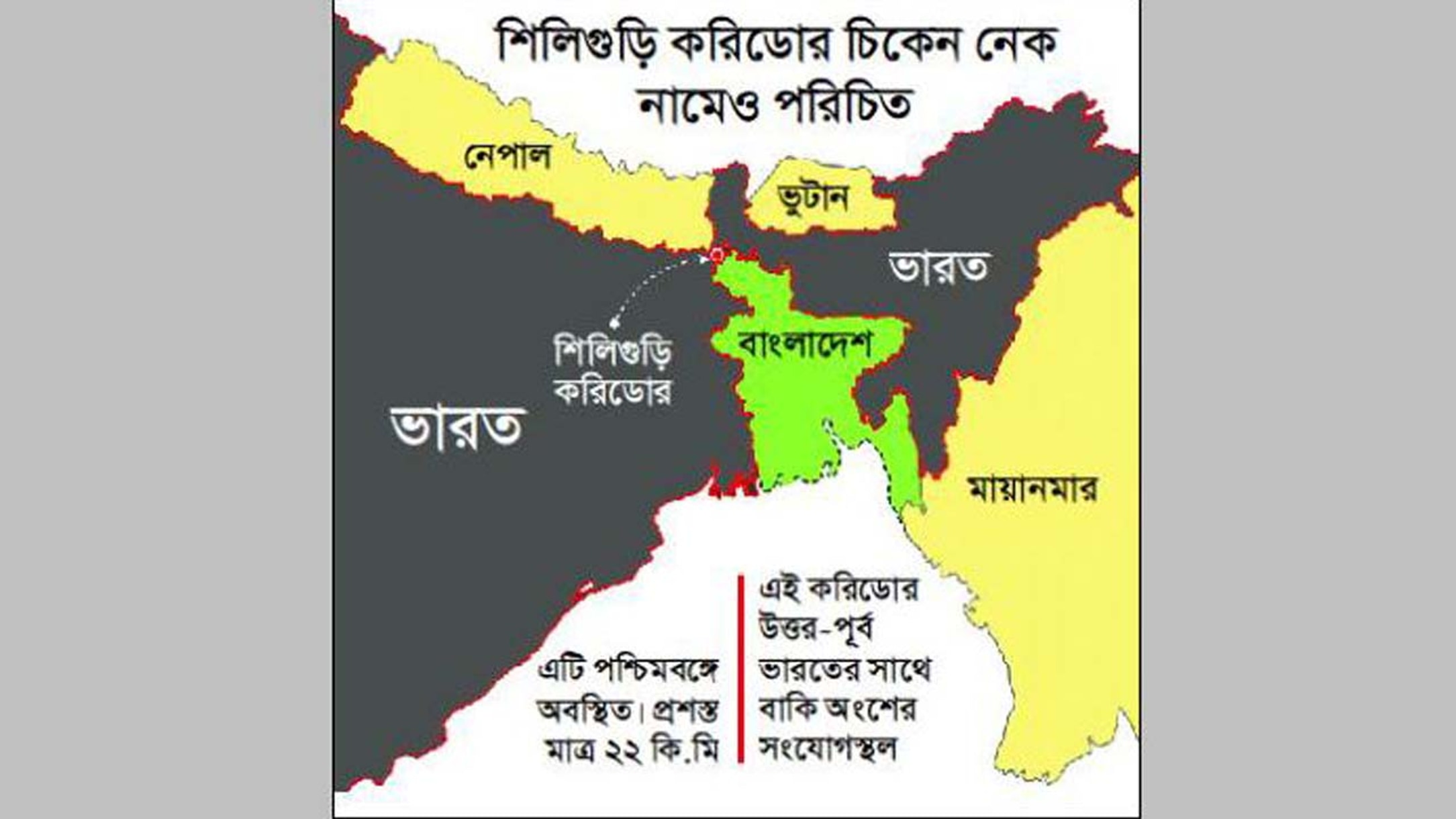
SILIGURI — Top officials from India’s military, intelligence and security agencies recently held a high-level inter-services meeting in Siliguri, in West Bengal, to tighten security around the strategically sensitive Siliguri Corridor, also known as Chicken’s Neck, the gateway to northeast India.
The meeting was held under the banner of the State Subsidiary Multi-Agency Centre (the state branch of SMAC) and was attended by senior officials from nearly all of India’s major security and intelligence agencies.
Among those present were officials from the Indian Army, Army Intelligence, the Indian Air Force (IAF), Border Security Force (BSF), Sashastra Seema Bal (SSB), Central Industrial Security Force (CISF), Indo-Tibetan Border Police (ITBP), Railway Protection Force (RPF), Government Railway Police (GRP), the state police intelligence wing, and several central and state-level agencies. The main agenda included security challenges in the Chicken’s Neck region, border surveillance, illegal infiltration, monitoring of terror networks, and strengthening inter-agency intelligence sharing.
Significance against Delhi blast, regional instability: According to a report by Indian news outlet ETV Bharat, the strategic corridor in northeast India has come under fresh security focus after the car blast near Delhi’s Red Fort. Political instability in neighboring countries — particularly Bangladesh and Nepal — and the situation along the Bhutan-China border have added to the meeting’s importance.
Siliguri Police Commissioner C. Sudhakar described the meeting as routine. “Nothing can be said publicly about security meetings — this is part of our regular process,” he said. A large section of security analysts, however, believe the meeting carries far more symbolic weight than a routine session, given current regional geopolitics.
Special vigilance on rail, road and air security: Several key decisions have been put into action after the meeting. Security at Bagdogra Airport has been multiplied. Artificial intelligence is now being used for passenger data verification and behavioral screening. Heightened surveillance has begun at New Jalpaiguri, Siliguri Junction, Alipurduar and Cooch Behar stations. Armed security personnel have been deployed on key trains including the Rajdhani Express and Vande Bharat. Additional police patrols have been deployed on national highways and the Asian Highway.
Surveillance stepped up on Bangladesh, Nepal, Bhutan borders: The Indian government has decided to step up surveillance along three borders simultaneously — India-Nepal, India-Bhutan and India-Bangladesh. Installation of automatic number plate readers (ANPR) along the India-Bangladesh border is moving ahead quickly. The devices will help collect real-time data on vehicles crossing the border.
Rafale jets and a modern combat posture: According to various sources, Rafale fighter jets and advanced air defense and surveillance systems have been kept ready at air bases near the Chicken’s Neck. Military analysts say this is not only for internal security but is also a clear geopolitical signal — particularly to China and South Asian neighbors.
Why Chicken’s Neck matters: The Chicken’s Neck, or Siliguri Corridor, is a strip of land just 22 kilometers wide that connects the seven northeastern states with the Indian mainland. The narrow corridor is bordered by Nepal to the west, Bangladesh to the south, and Bhutan and China to the north. Control or security of this single corridor is therefore a vital artery for India’s national unity and military security.
Bangladesh’s political backdrop and Indian concerns: Analysts say a major unspoken backdrop to the meeting is the situation in Bangladesh — including the announcement of a death sentence for former Prime Minister Sheikh Hasina after her conviction for crimes against humanity, the temperature of the coming national elections, and the prospect of political instability in border-adjacent areas. From India’s perspective, these issues have made security in the Chicken’s Neck region even more sensitive.
Merely routine, or strategic preparation: While the government describes it as a “routine meeting,” defense and geopolitics analysts say the reality is different. They say it could be preparation for a new security balance in South Asia, a strategic signal from India over the depth of Bangladesh-China relations, and a blueprint for future military readiness in the northeast.
According to geopolitical experts, the Chicken’s Neck is no longer just a geography — it has become the focal point of South Asia’s future power equation.
‘India wants to seize Bangladeshi territory to turn Chicken’s Neck into a rhino’s neck’: Dr. Shahiduzzaman
International security analyst M. Shahiduzzaman said it is clear that the Chicken’s Neck has begun sending new signals on regional tensions and South Asian geopolitics. “An airbase is being developed in Lalmonirhat in Bangladesh, military construction is taking place, hangars are being built, and there is talk that fighter jets bought from China or Pakistan may be deployed there. Lalmonirhat is certainly being turned into a major military base. China will be involved there, but India cannot accept that in any way,” he said.
“Indian security experts are saying again and again that they want to turn the 22-kilometer Chicken’s Neck into a rhino’s neck. India, disregarding international norms, wants to push significantly inside the territory of Rangpur in Bangladesh. They want to extend the 22-kilometer stretch of the Chicken’s Neck to at least 50 kilometers. The three garrisons India has strategically set up and the troops it has deployed there were placed with these plans in mind. They are arranging their military formation and deployments so that they can seize the Chicken’s Neck within hours. India is doing all this out of fear of China and to put psychological pressure on Bangladesh.”
Shahiduzzaman said: “It is clear from India’s signals that to seize the Chicken’s Neck or expand it, they will take Bangladeshi land if needed. That is why they are deploying troops at three garrisons. If India is finally determined to break international border laws and other laws, that is what it will do. Normally we believe India is putting pressure on Bangladesh. But if India wants to act, it will expand the Chicken’s Neck by striking at Bangladesh. India is putting psychological pressure on Bangladesh to stop the Lalmonirhat airport development work.”
Driven by fear of China
Brigadier General (retired) Rokon Uddin said: “India has built three army bases near the Chicken’s Neck, and several recent high-level meetings of security officials are mainly driven by fear of China. India fears that China could at any time seize areas near the Chicken’s Neck. That is why both military and civilian activity around the Chicken’s Neck has increased. India is also doing this as part of psychological pressure on Bangladesh. For example, across from Lalmonirhat, India has deployed Rafale jets and troops, and it has deployed missiles.”
He said: “Bangladesh’s friendship with China is strengthening, and Chinese investment in Bangladesh is rising. Bangladesh’s relations with Pakistan are improving. China and India have long been hostile along the Tibet border. India is also conducting push-ins inside Bangladesh. In the Chittagong Hill Tracts, India is again inciting several armed groups, who are becoming active once more. India is doing all this as part of pressure on Bangladesh. India is using the KNF with bait and the long-supported group led by Santu Larma to destabilize the Chittagong Hill Tracts. During the interim government, such Indian mischief has only increased. Whatever government comes to power in Bangladesh, India wants to keep it under pressure, and is using the Chittagong Hill Tracts as a pressure point.” (Source: Naya Diganta)
বাংলায় মূল প্রতিবেদন পড়ুন · Read the original Bengali report