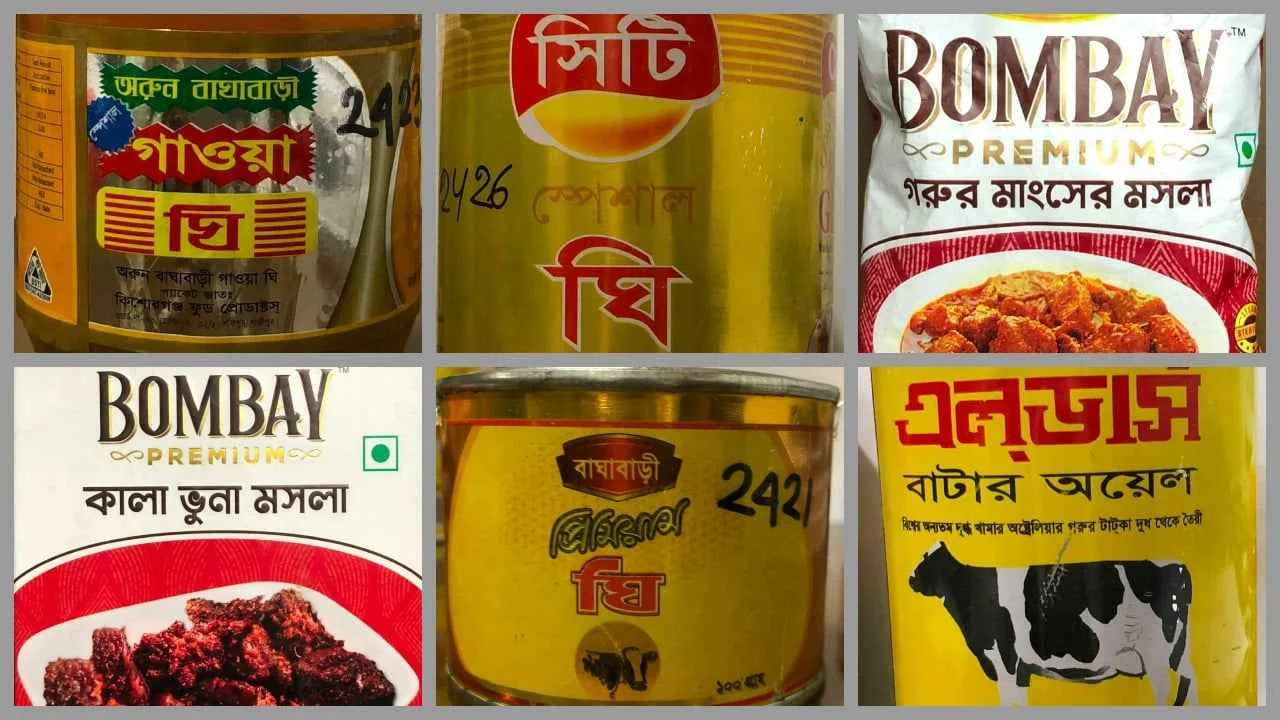
The Bangladesh Standards and Testing Institution (BSTI), the country’s product-standards body, has ordered 10 products withdrawn from the market after laboratory tests found they failed to meet standards set under the Bangladesh Standard (BDS) — including spice mixes from Bombay Sweets and Baghabari ghee.
The information was disclosed in a notice signed by BSTI editor Moinuddin Mia on Wednesday.
The notice said cause-shown notices have been issued to the companies asking why their BSTI-issued licenses for these products should not be revoked. BSTI has advised consumers to refrain from buying these products after they were found substandard in testing.
As part of its regular surveillance, BSTI recently collected various companies’ products from the market and tested them in its own internationally accredited, state-of-the-art laboratory. Several products were found to meet standards. However, some brands of ghee, butter oil and spice mixes failed the quality tests. Laboratory testing found that the “ghee” sold under the Baghabari brand contained no actual ghee (milk fat) — instead, it was made using palm olein and vanaspati and marketed as “ghee.” Separately, spice mixes from Bombay Sweets were found substandard on several parameters against the Bangladesh Standard.
According to BSTI’s laboratory test results, curry powder for duck-meat spice mix (batch no. 141224), tehari spice mix (batch no. 140226), kala bhuna spice mix (batch no. 260927), beef spice mix (batch A), and fish spice mix (batch A) — all produced by Bombay Sweets & Co. Ltd — failed to meet the Bangladesh Standard due to excessive total ash and salt content.
Among the companies found producing ghee and butter oil below the Bangladesh Standard: Baghabari Premium Ghee Company’s “Baghabari” brand ghee (batch dated production July 1, 2026, expiry July 30, 2028); Kishoreganj Food Products’ “Arun Baghabari” brand ghee (batch dated production July 17, 2026, expiry December 24, 2027); Messrs Mamun Food Product’s “New Radhuni” brand ghee (batch dated production April 15, 2025, expiry April 14, 2027); Messrs Mamun Food Product’s “City” brand ghee (batch dated production January 10, 2026, expiry December 10, 2028); and Elders Food Products and Packaging Industries’ “Elders” brand butter oil (batch no. 022026). All these ghee products failed on various parameters against the Bangladesh Standard. Testing found refractive index, iodine value, saponification value and Polenske value outside the specified limits.
BSTI Director General (Secretary) Kazi Imdadul Haque said maintaining product quality under the national standard is both a legal and an ethical duty for every licensed company. Any company that fails in that duty, he said, BSTI is committed to taking the necessary legal action against. Alongside issuing quality certifications, he said BSTI continues to maintain strict surveillance against counterfeiting and adulteration. He advised consumers to check BSTI’s quality mark, license number, production date, expiry date, product ingredients and other necessary information before purchasing a product. He also urged the public to report any complaints regarding a product’s quality, adulteration, fraud or misuse of the BSTI quality mark promptly, either by calling the hotline 16119 or by emailing dg@bsti.gov.bd.
বাংলায় মূল প্রতিবেদন পড়ুন · Read the original Bengali report