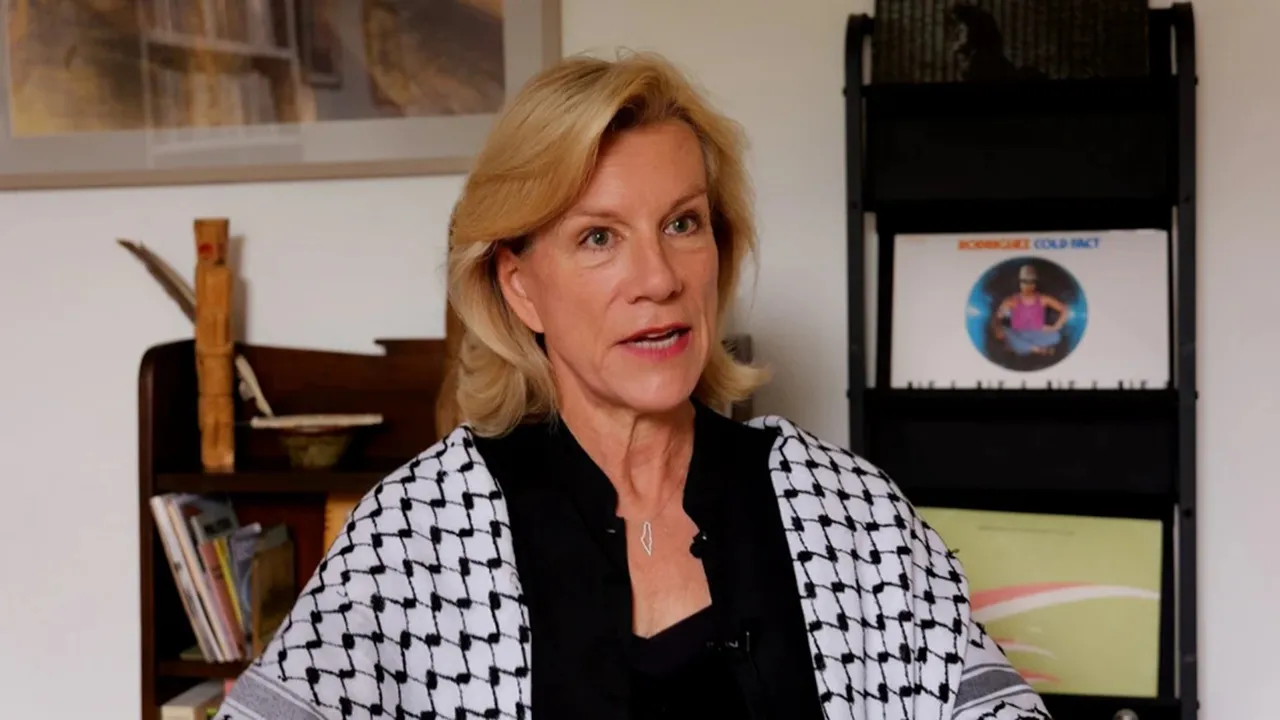
British actor Juliet Stevenson does not consider her acting career in any way more important than the lives of Palestinian children. Highlighting the suffering of children in Israel’s military campaign in Gaza, she said she does not mind if people refuse to work with her because she speaks up for Palestinians.
The 69-year-old actor said this in an interview with the Qatar-based broadcaster Al Jazeera, titled “Juliet Stevenson on Gaza: I am disappointed by the silence in my industry”.
Asked about the effect on her working life of taking a stand for Palestine, Stevenson said that anyone who did not like what she said was free not to work with her. If she were punished professionally for her beliefs, she did not feel she needed to be in that place.
“The most important thing is that I don’t think my career is more important than the lives of Palestinian children. Really, I don’t think that at all,” she said.
Her hope, she said, is to be able to look back at the end of her life and say she tried to do the right thing at the right time.
Stevenson has no plans to give up acting, however. She loves acting and wants to carry on working, she said, and her profile and standing are also important in getting her message to people. She does not feel she has so far been punished professionally for speaking up for Palestine; in fact, she worked more last year than ever before.
Concern over the suffering of Gaza’s children
In the interview Stevenson voiced deep concern about the situation of children in Gaza. All parents in the world love their children equally, she said, and Palestinian parents love theirs just as parents in other countries do. She cannot understand how politicians stay silent while such terrible suffering falls on their children.
According to her, countless children in Gaza have lost their whole families, and many parents have lost children. Pregnant women are malnourished, and many are giving birth to premature and very low-weight babies who struggle to survive.
She added that most of Gaza’s health system has been destroyed. Hospitals still treating patients lack essential equipment and medicines, and care for mothers and newborns has become limited.
Any mother in the world seeing the situation in Gaza should be horrified and distressed, the actor said.
A call to stand with Palestinian mothers
In the interview Stevenson also described an initiative by British mothers to show solidarity with Palestinian parents.
As part of it, she and more than a hundred cultural figures, including actors Judi Dench, Meera Syal and Sienna Miller, wrote to Justine Roberts, founder of the popular UK online parenting platform Mumsnet.
The letter asked her to press the UK government to let maternity clinics held up outside Gaza enter from Egypt and to ensure access for non-governmental organisations running humanitarian aid. The supply of essential health and hygiene items for women and girls was given particular weight.
Stevenson said the initiative aims to organise British mothers and encourage them to stand with the mothers of Gaza. Many people seeing the suffering of Gaza’s people want to do something but do not know how, and the initiative could give them a way, she said.
Her ties to a Jewish family
Explaining her long-standing stand for Palestine, Stevenson spoke about her own family background. The issue moved her from the time she learned about the Palestinians’ situation many years ago, she said; to her it is an example of extreme injustice.
Stevenson’s husband, Hugh Brody, is Jewish. Her mother-in-law escaped from Vienna, Austria, as a refugee during Hitler’s Nazi rule.
Stevenson said she understands the horror of the Holocaust and the need for Jewish safety and security, and is aware of the horror of antisemitism. But she opposes equating criticism of the Israeli government’s actions with antisemitism.
She said she is also concerned about the safety of Israeli citizens, but the violence in Gaza and the occupied Palestinian territories is good for no one in the region.
Disappointment at the arts world’s silence
Stevenson expressed disappointment at the silence of Britain’s artists, actors and well-known cultural figures on Gaza. The silence in her own industry and elsewhere has deeply disappointed her, she said, and she is concerned about the tendency to silence people through fear.
“At this point, silence is not a passive position. It is an active decision, a decision to collaborate with injustice,” she said.
In Stevenson’s view, artists and cultural institutions have a duty to portray people’s lives, experiences and realities, and they should fulfil that duty in the case of Palestine too.
She added that history judges harshly those who did not speak out against injustice in Nazi Germany, yet many hold back from taking the same moral stand on the injustices of today.
Praise for Vanessa Redgrave
Stevenson praised the role of British actor Vanessa Redgrave, an outspoken advocate of Palestinian rights. Redgrave’s long-standing stand and protests in defence of human rights are an inspiration to people in the arts, she said.
She also praised young artists without fame or stardom who are involved in the anti-war movement and humanitarian work.
Explaining why she keeps campaigning for Palestine, she said it is vital to keep Palestine in people’s attention. Her aim is to keep the media discussing the situation and keep the movement for peace and justice active.
Sharing a personal principle, Stevenson said: “Despair is a luxury we cannot afford.”
Juliet Stevenson is a well-known actor of the British stage, film and television. Alongside her long acting career she has worked on human rights and refugee rights. In December 2023 she took part in a pro-Palestine protest in London, speaking out against the deaths of children and the humanitarian disaster in Gaza.
বাংলায় মূল প্রতিবেদন পড়ুন · Read the original Bengali report