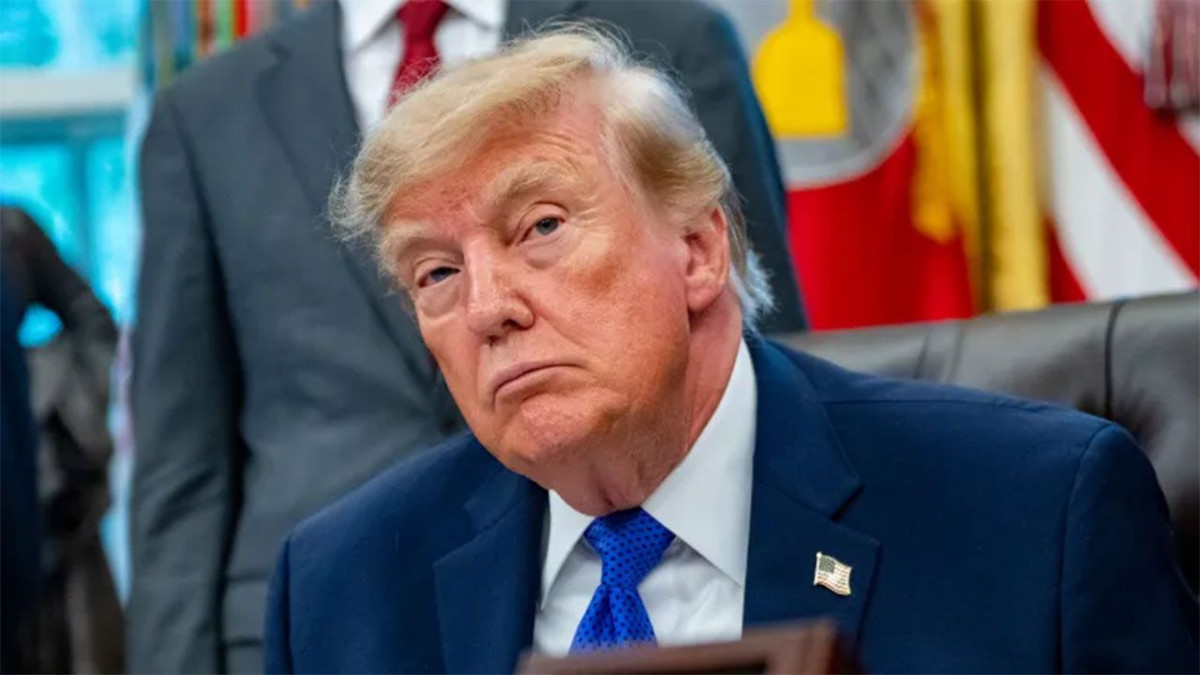
After a meeting with Qatar’s prime minister, US President Donald Trump said the US and Israeli war against Iran was militarily “practically over”. At the same time, he said the situation would for now be kept as it is. Iranian officials dismissed his remarks as “fake news”.
Al Jazeera reported on Tuesday (10 November) that Trump made the remarks at an impromptu press conference at the White House after meeting Qatar’s prime minister, Sheikh Mohammed bin Abdulrahman bin Jassim Al Thani, in Washington DC on Monday. He again claimed that the United States had destroyed Iran’s military capability. But his remarks also hinted at pressure from Middle Eastern allies to end the war.
“Militarily, Iran is practically finished,” Trump said. “We’re just keeping things the way they are. We’re doing that mainly at the request of Iran’s neighbours.”
The meeting took place in the presence of Vice President JD Vance and the Qatari prime minister. In a social media post, Sheikh Mohammed described the meeting as positive. “We discussed the regional situation and ways to move the US-Iran talks forward,” he wrote. “I am grateful for the positive discussion on reaching an agreement and bringing peace to the region.”
What Trump calls “keeping things the way they are”, however, means continuing the US naval blockade of Iran’s ports. The recently announced “Task Force Iron Gate”, set up to stop Iran’s trade by land and across the Caspian Sea, will also continue its work.
“Qatar, Saudi Arabia, the United Arab Emirates, Bahrain, Kuwait and other countries want things to stay this way,” Trump said. “That means the biggest naval blockade in the history of our country, probably in the history of the world, continues.”
He said the United States was ready to resume military operations if needed. “Right now there doesn’t seem to be much need for military action,” Trump said. “But if the situation changes, we are fully ready for any action.”
“Israel and the whole Middle East are now safe from the danger and threat of Iran,” he added. “Progress is being made towards ending this conflict. I think the war will end very soon.”
Iranian officials, however, are not willing to take Trump’s words seriously. Mohsen Rezaei, secretary of Iran’s Supreme National Security Council, wrote on social media: “The war against Iran has already crippled the US government, yet Washington is thrashing about like a desperate gambler. Fold your bets. Stop spreading fake news about imaginary talks.”
Iran’s President Masoud Pezeshkian, meanwhile, said the country’s Supreme Leader Mojtaba Khamenei had ordered an end to the state of “neither war nor peace”. According to Iranian media, Pezeshkian also said Iran had no objection to sitting down for talks, but could not be forced into an agreement. “We will not surrender to force and bullying,” he said.
After the war against Iran began on 28 February, the conflict spread to neighbouring countries and unsettled international trade. Almost as soon as the United States and Israel began their attacks, Iran closed the Strait of Hormuz, a vital route for shipping oil, gas, fertiliser and other goods.
In response to the US and Israeli attacks, Tehran launched missile and drone strikes on Qatar, Bahrain, Kuwait and the United Arab Emirates in the Gulf. Many of these strikes targeted US military installations in those countries.
The conflict has since spread to other fronts as well. Saudi Arabia has resumed fighting against the Iran-backed Houthis. Israel has begun an occupation of southern Lebanon and has carried out deadly air strikes there.
Nearly nine months into the war, US military operations against Iran have become sporadic, with occasional exchanges of strikes between the two sides. In recent days the Trump administration has announced “limited strikes” on Iran’s Qeshm Island, and has offered a $20 million reward for information on Iran’s nuclear programme, its facilities, equipment and the people involved.
After the 12-day war in June 2025, Trump claimed that Iran’s uranium enrichment programme had been completely destroyed. Since then, however, his administration has named curbing Iran’s nuclear programme as one of the main aims of the current war. Iran has long denied trying to build nuclear weapons, saying its uranium enrichment programme is for civilian energy.
Iran has demanded that the United States accept seven conditions to end the war. They include lifting US sanctions, releasing frozen Iranian funds, recognising a new shipping route through the Strait of Hormuz based on an understanding with Oman, and ending the war on all fronts, including Israel’s attacks on Lebanon.
Qatar is one of the mediators in the conflict. Its prime minister, Sheikh Mohammed, is also foreign minister and acts as a mediator between Washington and Tehran. Reports say that at Monday’s closed-door meeting he presented Trump with a two-day proposal from Iran to end the war.
At the press conference after the meeting, reporters asked Trump: “Why not declare the conflict over and end it here?”
Trump replied that the US blockade had to continue for the sake of regional security. He said he wanted a “long-term solution” rather than a short-term one.
“We have some wonderful allies there,” Trump said. “Their security has to be ensured. Otherwise they will be harmed.”
“They are much safer now than they were six months ago, because Iran’s leadership and military structure have been largely destroyed,” he added. “But Iran is still showing some bullying in the Middle East.”
বাংলায় মূল প্রতিবেদন পড়ুন · Read the original Bengali report