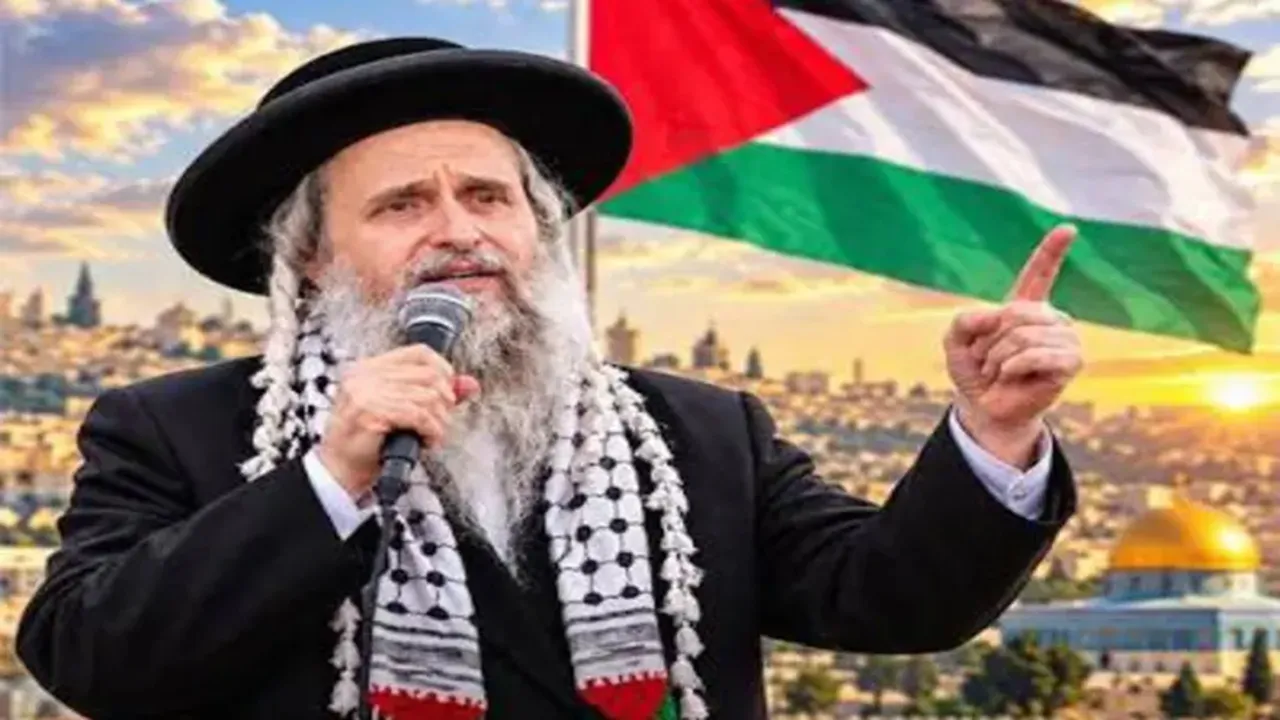
Though not a Muslim, Rabbi Haim Sofer, a UK-based Orthodox Jewish religious leader, has spoken in favour of restoring the caliphate. In his view, there are historical examples of long coexistence and mutual cooperation between Jews and Muslims, and of the protection of religious minorities, under Muslim rule.
Recalling his family’s life in Baghdad, he said Muslim neighbours used to help Jews with their religious festivals. Haim Sofer is known as an anti-Zionist and a supporter of Palestine.
The UK-based website Islam21c has published an article on his views and experiences titled “Rabbi gives an Islamic history lesson”. Earlier, Leaders MENA reported on a video of his published on the Narrative House YouTube channel.
Muslim neighbours brought gifts for religious festivals
Describing his family’s experience, Sofer said his family lived in Baghdad and had warm relations with their Muslim neighbours. For Passover, or Pesach, an important Jewish religious festival, the neighbouring Muslims would bring a sheep for his family.
Jews celebrate Passover to commemorate the liberation of the Israelites from Egypt. The festival centres on special food and family gatherings. According to Sofer, although the festival was expensive, the Muslim neighbours on their own initiative gave his family sheep, vegetables and other food as gifts.
The Leaders MENA report also mentions this memory. It says that for Passover the Muslim neighbours gave potatoes, dates, cucumbers and tomatoes as well as sheep.
Jizya waived for poor Jews
Sofer also gave his view on the collection of the jizya tax under the caliphate. By his account, the tax was not taken from poor Jews. Those who could not afford it had the tax waived, and were sometimes given financial help as well.
Under Islamic rule, the jizya was a tax imposed on non-Muslim subjects. In return, the state provided for the protection of their lives and property. The rules, amount and application of the jizya varied, however, from region to region and ruler to ruler over time.
What was Jewish life like under the caliphate?
Sofer’s remarks touch on various aspects of Jewish religious and social life under Muslim rule. In his view, at various times under Muslim rule Jews were able to take part in trade, education and social life while keeping their religious identity.
During the Abbasid caliphate in particular, Baghdad became an important centre of Jewish religious learning and scholarship. Baghdad had close ties with Jewish centres of learning such as Sura and Pumbedita, and leaders of the Jewish community kept in contact with the caliphs’ court. The Jewish community of Baghdad flourished in this period, and the city became one of the most important centres of Jewish religious learning and scholarship.
Why he supports a caliphate
Besides recalling the past, Sofer also spoke about the political unity of the Muslim world. According to the Leaders MENA report, he supports the establishment of a united Islamic authority, or caliphate, stretching from Morocco to Afghanistan. In his view, such a system could help bring regional stability and protect Palestinians.
He also criticised the Sykes-Picot Agreement of the First World War era. In Sofer’s view, the end of the Ottoman caliphate and the division of the Middle East by decision of the colonial powers weakened the unity of the Muslim world.
He also spoke in favour of a Muslim-led peacekeeping force to protect Palestinians in Gaza, and called for rebuilding the historical relationship between Muslims and Jews.
A member of the anti-Zionist Neturei Karta
Haim Sofer is an Orthodox Jewish rabbi living in the United Kingdom. He is a member of Neturei Karta, an anti-Zionist movement founded in Jerusalem in 1938 that opposes the Zionist idea of a Jewish state.
Sofer’s parents were born in Iraq. They had to move to Palestine in the early 1950s because of Zionist violence. Sofer was born in Palestine, though the Leaders MENA report describes him as a rabbi of Iraqi origin.
Haim Sofer has also appeared in an episode of Al Jazeera’s “Deja Vu” programme. In that episode, titled “Jews and Muslims lived together for centuries. Did Zionism tear them apart?”, he discussed Jewish identity, exile, the historical life of Jews in Muslim societies and the position of the anti-Zionist movement Neturei Karta.
The positive and negative sides of history
Sofer’s remarks on Jewish life under Muslim rule mainly stress the positive side of coexistence and mutual cooperation. But on the jizya and other historical matters, practice differed by region and period. His remarks can therefore be seen as a personal experience and political view of Muslim-Jewish coexistence.
His memories reflect the warmth of Muslim neighbours, cooperation at religious festivals and an experience of social security. At the same time, the position of religious minorities changed at various points in history as rulers and policies changed.
বাংলায় মূল প্রতিবেদন পড়ুন · Read the original Bengali report