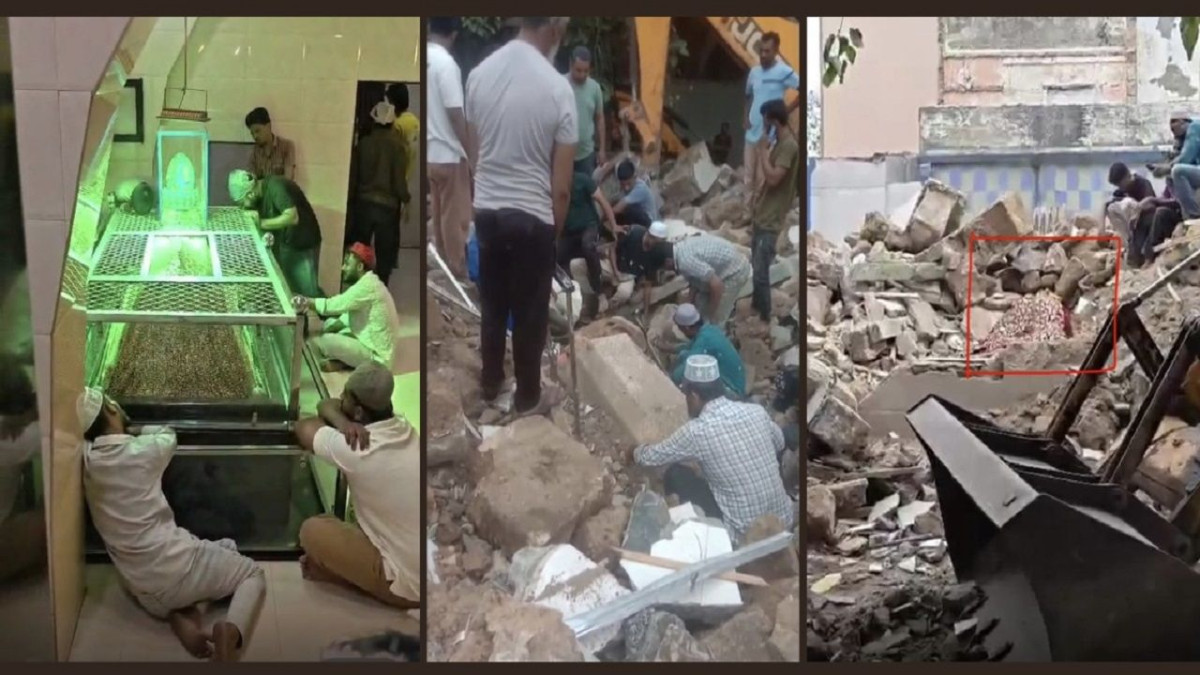
On 3 and 4 November the Gujarat High Court heard a writ petition filed by eight Muslim residents of Gir Somnath challenging the demolition of the Pir Ahmed Shah dargah.
Roshan Banu’s despair seemed to know no bounds. “Another dargah has been turned to rubble,” said the elderly, visually impaired resident of the district’s Prabhas Patan area. “They want to squeeze out of Gir Somnath the Muslims and everything connected with Islam.”
Banu has lost her sight to old age. She said she felt a kind of relief that she did not have to see the dargah being torn down with her own eyes.
Local Muslims who worshipped there regularly say a 14th-century Persian inscription attached to the dargah and an ancient gate were razed without following any legal rules. Under the Somnath Corridor project, the shrine’s historical and religious existence is being erased and the site repurposed for Hindu pilgrims.
Arguing for the petitioners, senior advocate Anand Yagnik said the historic religious site had been demolished without following the legal procedures on waqf property, land acquisition and protected monuments.
A series of shrine demolitions
The petition also questions the district collector’s appointment of an interim mutawalli (custodian). That mutawalli issued a no-objection certificate (NOC) for the transfer of the land without consulting the dargah’s trustees.
“The mutawalli alone signed a proposal allowing the state government to acquire the property in return for a fixed amount of compensation,” Yagnik submitted to the High Court. “His application to sell the property was immediately approved by the state Waqf Board. The whole process was a gross violation of the acquisition law and the Waqf Act, because the Waqf Act strictly prohibits the sale of any waqf property.”
The petitioners also note that since 1904 the inscription and the site had been a protected monument of the Archaeological Survey of India (ASI) under various laws. “The ancient structure was demolished without the ASI’s permission, and local people recovered the inscription from the rubble,” Yagnik told the court. “The ASI issued a notice to the district collector over the unauthorised demolition.”
Besides the Pir Ahmed Shah dargah, Gir Somnath district has seen several dargah demolitions recently.
In September 2024, bulldozers and excavators entered Prabhas Patan near the Somnath temple with a large police force. By the end of the operation, nine Islamic religious structures and 47 homes, mostly owned by Muslims, had been demolished in the Veraval area of Gir Somnath district.
The administration described the operation as an “eviction drive” to free government land, which the district administration put at about 102 acres. Residents strongly disputed the authorities’ claim to the land and the legality of the demolitions. Families who had lived there for generations and devotees who visited the shrines were badly hurt by the drive.
Several historic shrines, including the Haji Mangrol dargah, Pir Silar Shah dargah, Garib Shah dargah and Jafar Muzaffar dargah, were bulldozed. Local people told The Wire that the Haji Mangrol Shah dargah had been part of the revenue records of the then Junagadh State since the beginning of 1924.
A ground report by The Wire in 2025 documented the impact of the demolitions on local Muslims, including the displacement of families and the loss of access to shrines that were part of their religious life.
Method, pattern and the petition
According to the petition filed by Malang Ismail Hossain and others, the latest dispute over the Pir Ahmed Shah dargah in Prabhas Patan began with a demolition carried out at about 3am on 19 August 2026. They describe the dargah as a religious site several hundred years old with a Persian stone inscription from the time of Sultan Ahmed Shah in 1543.
The petition describes several events before the demolition. After the death of trustee Salimsha Dada Shah in 2024, the petitioners allege, the district administration pressured his son Dada Shah Salimsha to take a post in the trust and help transfer the property to the state government for the Somnath Corridor project. They also allege that a meeting was held on 14 August 2026 and an application made for permission to transfer the property without the consent of all the trustees and stakeholders concerned.
According to the petition, the Gujarat State Waqf Board approved the project on 18 August 2026. The next day, 19 August, the dargah was demolished before dawn.
The petitioners allege that the sub-divisional magistrate, the mamlatdar (a taluka-level administrative officer) and local police were present during the operation. They say the historic inscription was later recovered by members of the community, but the sanctity of the graves and other structures attached to the dargah was violated.
An additional affidavit filed by Gohel Basir Kasem on 22 October 2026 questions the authority of those who supposedly consented to the transfer of the dargah’s property. The affidavit also refers to correspondence with the Gujarat State Archaeology Department.
Speaking to The Wire, Basir said that in a reply dated 8 September 2026 the archaeology department indicated it had received no papers from the collector about the demolition of the dargah or the site of the inscription.
“The situation created around the historic shrine of Pir Ahmed Shah raises some serious questions. If this shrine is a site of historical and religious importance, it is the government’s duty to follow the existing laws and rules to protect it. My question is: is it right to destroy historical heritage in the name of development? Were all legal procedures followed in this matter?” Basir asked.
He added that the petitioners do not want to make baseless accusations about the government’s intentions, but they clearly demand a transparent inquiry into the whole affair, the release of the relevant documents and accountability for the destruction of the dargah. “Our fight is not against any particular government or religion. It is a fight to protect historical heritage, for justice and for the rule of law,” he said.
Basir said legal action had been taken against him because of his involvement in the matter. “But filing a petition is a constitutional right, and seeking justice through the courts should never be treated as a crime. We believe every citizen has the right to express concern about protecting historical and religious heritage. Our aim has always been to seek justice by legal means,” he said.
Muslim heritage amid a Hindu pilgrimage site
The Somnath temple was not always the great pilgrimage site and tourist centre it is today; in recent decades there has been a drive to build it up as a major Hindu pilgrimage site. The area’s political and administrative importance was raised even before the recent Somnath Corridor project.
On 14 August 2012, Narendra Modi, then chief minister of Gujarat and now prime minister of India, announced the creation of a new district called Gir Somnath, carved out of Junagadh. A year later, on 15 August 2013, the district formally came into being with the coastal talukas of Veraval, Sutrapada, Talala, Una and Kodinar. The government presented the move as an administrative measure that would bring government services to coastal residents.
But it also gave the Somnath temple and its surroundings a distinct administrative and predominantly Hindu identity.
In February 2017, the Gujarat government asked the Union tourism ministry for Rs 262 crore under the PRASAD scheme for infrastructure development in and around Somnath. The first-phase proposal of Rs 102 crore included plans for parking, water treatment, sewerage, waste management and other tourist facilities.
Yagnik, the lawyer representing the Pir Ahmed Shah dargah, believes the whole upheaval serves only one purpose: to erase every kind of dargah from around the Somnath temple.
“They are planning to wipe them out completely. I am Anand Yagnik, a Hindu. The Somnath temple is an important temple for me because I am a Shaivite. I have been going to this temple regularly for years. They say the Somnath Corridor will help pilgrims strengthen their faith. But my devotion to Lord Somnath cannot come at the cost of someone else’s devotion,” Yagnik told The Wire.
“I am absolutely clear about this. They are using the machinery of the state to revive their [political] agenda, and corporate houses are helping them,” he said, adding that the same hidden agenda is visible in the cases of Babri, Mathura and Somnath.
“The Archaeological Survey of India has issued notice after notice saying you cannot demolish these without prior permission. I have two or three such notices,” he added.
Yagnik also pointed out how the Gujarat Waqf Board has sold out to the state government and is turning a blind eye to how Islamic sites across Gujarat are being emptied and converted.
The demolitions in Gir Somnath are part of a wider campaign openly backed by the Gujarat government. On 21 February 2024, then minister of state for home Harsh Sanghavi told the Gujarat Assembly that the state government had demolished 108 Islamic shrines across Gujarat. He added that the “eviction drive” had reached Gir Somnath along with other districts.
On 28 March 2023, Chief Minister Bhupendra Patel also defended demolitions in Bet Dwarka and Gandhvi, where many of those affected were Muslim fishermen. He said the government would not tolerate any “illegal activity” along Gujarat’s 1,600-kilometre coastline and that demolitions would continue in the name of security and public welfare.
These statements show that the demolitions along Gujarat’s coast were not isolated drives to free land. Top political leaders have openly made them part of a larger government campaign.
Under the pretext of development directives, they often brand Muslim homes and Islamic shrines as “illegal encroachments”, and in this BJP-ruled state they are sending in bulldozers to raze mosques, shrines and Muslim homes to give heritage and history a one-sided Hindutva shape.
বাংলায় মূল প্রতিবেদন পড়ুন · Read the original Bengali report