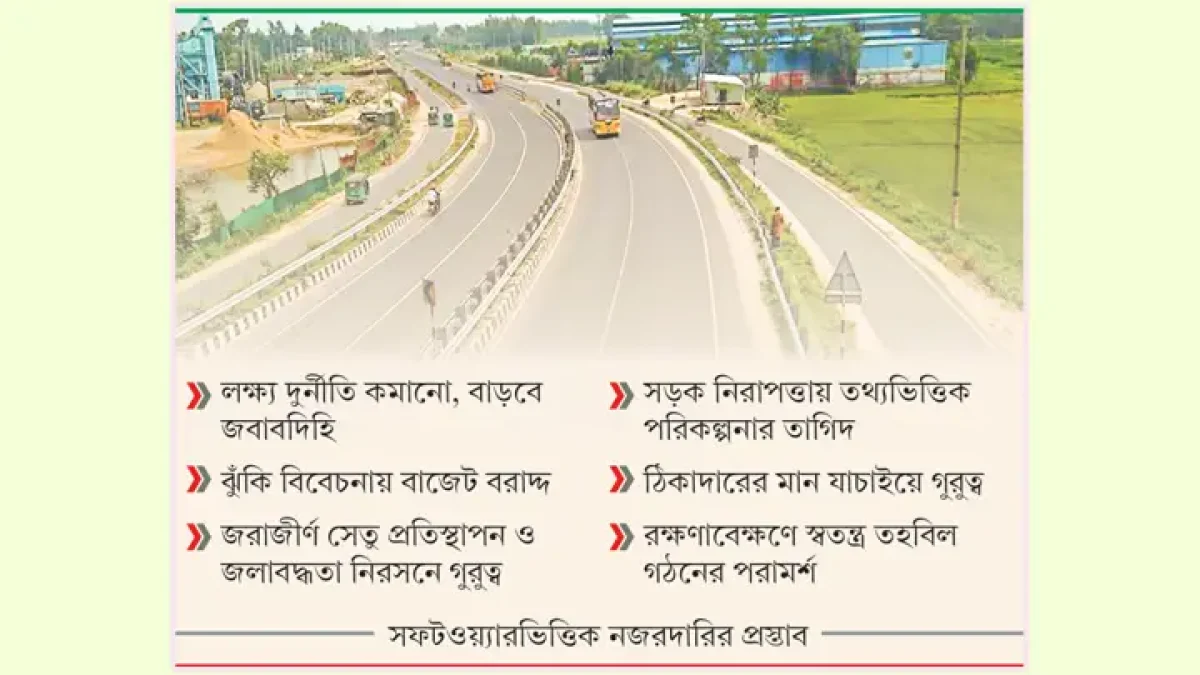
The government has begun drafting a new policy to bring transparency to spending on highway maintenance, ensure the quality of the work and reduce the risk of irregularities. Under the proposed “Highway Maintenance Policy, 2026”, road repair planning, budget allocation, tenders, progress and spending would be brought under software-based monitoring.
The draft divides road maintenance into four kinds: routine, periodic, special and emergency. It also stresses allocating budgets according to road condition, traffic load, rainfall, flood and climate risk, replacing dangerous bridges, building effective drainage and ensuring road safety.
The policy’s main aim is to improve the performance, safety and durability of the highways run by the Roads and Highways Department (RHD) under the Road Transport and Highways Division. It is meant to lower repair costs, reduce the risk of accidents and ensure that public money is properly used.
The Road Transport and Bridges Division recently met the Finance Division to discuss the draft in detail, according to sources involved.
Under the draft, every step of highway maintenance, from planning and approval to budget allocation, tenders, progress and spending, would be stored and monitored in a software system, to which the ministry concerned would have direct access. It also proposes holding the executive engineer of the road division concerned responsible for the accuracy of the information on each job.
Each job’s type, location, estimated cost, approving authority, work order, deadline and physical and financial progress would have to be entered in the software. Geo-tagged photos would also have to be kept from before, during and after the work. The draft says this would reduce the risk of the same stretch of road being funded more than once and make it easier to check actual progress.
Four kinds of maintenance
The draft proposes a separate framework for each kind of maintenance work. Routine maintenance would cover repairing potholes and cracks, restoring shoulders, cleaning drains, drainage, repairing road markings and safety fittings, and regular care of bridges and culverts.
Periodic maintenance would cover resurfacing at set intervals, overlays, pavement strengthening and repairs to parts of bridges. Such large jobs would have to be finished within nine months of the work order and before the end of the financial year concerned.
Larger jobs or structural improvements that cannot be finished within one financial year would come under special maintenance. These include widening highways, deep pavement reconstruction, building large drainage networks, new interchanges, underpasses and overpasses, and replacing decrepit bridges.
When road links are cut by floods, landslides, accidents or other sudden disasters, emergency maintenance would be used to restore them quickly. The draft mentions temporary bridges, diversion roads and urgent measures against road collapse.
Budgets by risk
The draft proposes that maintenance budgets be shared out not only on road length or past allocations but on damage, traffic load and natural hazards. It names road condition, the International Roughness Index (IRI), the share of roads not repaired in the previous three years, rainfall, and flood and climate risk as key measures for setting budgets.
It also proposes deciding repair needs and drawing up priority lists from the technical analysis of the road asset management system (HDM-4/RAMS) and the Bridge Management System (BMS). An annual maintenance needs report would be published each year to show which roads and bridges need work first. To reduce the long backlog of maintenance, the draft also says funding may be sought from local and foreign development partners or other sources alongside the regular budget, where needed.
Checking contractors
The draft proposes following the Public Procurement Act and other applicable rules in tendering and signing maintenance contracts. It also covers grading contractors by technical and institutional capacity, assessing their performance regularly and keeping the list up to date.
To keep major highways and expressways at a set standard of service, it proposes performance-based maintenance contracts (PBMC). Under this method a contractor would be judged not only on how much work was done but on whether the set standard of service was kept. Such contracts could run for up to five years.
The draft also stresses greater use of modern equipment and technology, effective drainage, phased replacement of dangerous Bailey bridges and decrepit bridges and culverts, and climate-resilient infrastructure.
Road safety planning based on data
Separately, Sheikh Rabiul Alam, minister for road transport and bridges, shipping and railways, has stressed identifying weaknesses in the management of the road network and basing future plans on real data.
Speaking recently at a workshop titled “From Data to Decision: Advancing Road Safety and Asset Management in Bangladesh”, the minister said road safety must be given priority in road construction and design, not just transport convenience. In future, decisions on building and maintaining roads should be based on collecting, analysing and assessing data on damaged roads and accident-prone areas, the minister said.
Call for a separate fund
Transport expert Dr Shamsul Haque, a professor of civil engineering at Bangladesh University of Engineering and Technology (BUET), told the daily Amar Desh that road maintenance is an important part of development. Many roads are being built in the country, but without proper maintenance they fall apart within a few years. If repairs are not made on time, people suffer more and the cost of repair rises sharply. That is a big problem. In many cases there is money for building roads but not enough for maintaining them. That is why a separate road maintenance fund has long been needed, Haque said.
The government’s allocation for road maintenance and repair falls short of what is needed, Haque said. A fund raised from its own sources could play an effective part in road maintenance.
Such a fund could be built from part of the registration fees collected by the Bangladesh Road Transport Authority (BRTA), a set share of allocations for large development projects and a road maintenance levy on fuel, Haque said. A fund of this kind was meant to be started during the BNP’s earlier term in government, and now is the right time to do it.
Setting up the fund is the urgent first step, Haque added. Once people see its benefits, they will not object to paying more for better, lasting roads. But the approach must be long-term and sustainable. Rather than repairing roads after they are completely ruined, a “preventive maintenance” approach that spots damage early and acts on it must be brought in.
বাংলায় মূল প্রতিবেদন পড়ুন · Read the original Bengali report