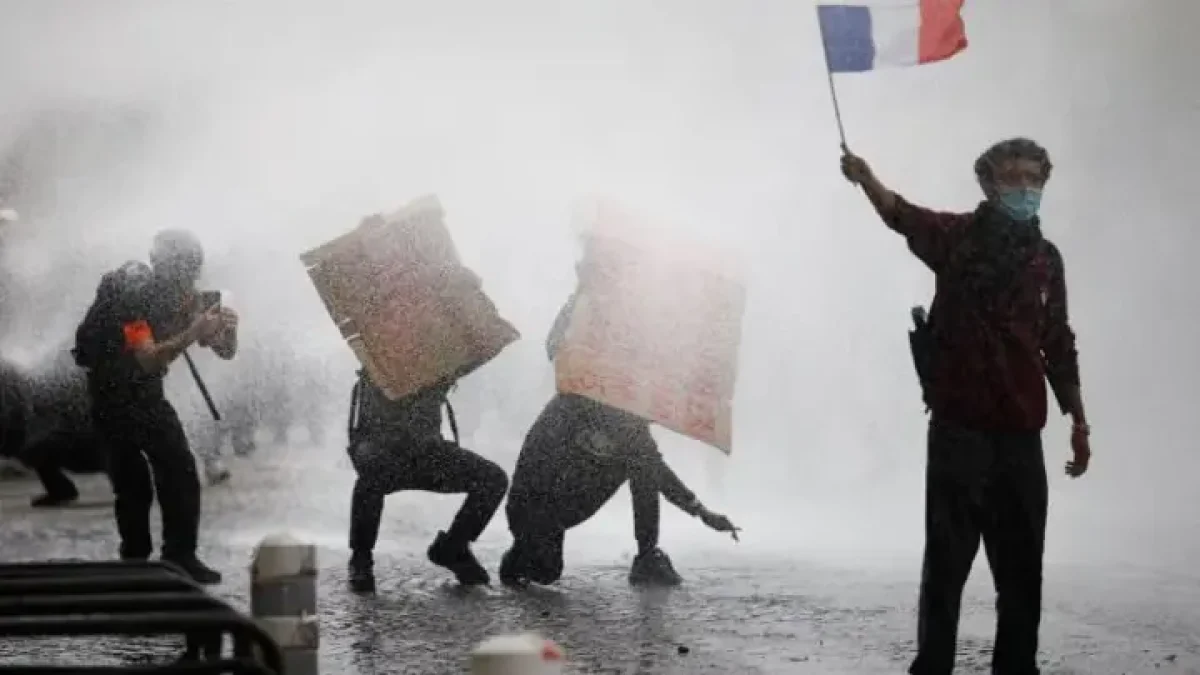
School occupations in Rome, a tent camp in Madrid and street protests in France: across Europe, young people are venting their anger at political leaders through all kinds of action. Their complaint is that politicians are not listening to them and are not taking their needs and problems seriously.
That is the picture drawn in a report by the news agency AFP. The young protesters’ demands vary from place to place, but they are united on one point: they want their voices, so often ignored in politics and society, to count. At times they have turned to hard-line action to press their demands.
Protesters also say tough police measures are inflaming the situation.
“We are fighting and taking our future into our own hands,” said Damiano Fusa, an 18-year-old student at the Cavour high school in Rome.
The Cavour was the first school to be occupied in a series of student occupations in the Italian capital.
“There is no one to represent us,” Fusa told AFP. He criticised Prime Minister Giorgia Meloni’s hard-right coalition as well as earlier centre-left governments, saying they had cut education spending and ignored the needs of the young.
In recent weeks, hundreds of thousands of school and university students have held protests and rallies in France, Italy, Spain and other European countries. Some of the protests have turned violent.
Governments have focused mainly on keeping law and order. Partial curfews have been imposed in some parts of France, and soldiers have been deployed in Italy. Protesters say such measures obscure their core demands and could make things worse.
“Politicians are completely disconnected from reality and are responding in a totally irrational way,” said Luis Marques, a 19-year-old psychology student in Lisbon, the Portuguese capital.
The students’ demands include controls on runaway rents, more spending on education instead of defence, and more job opportunities for young people.
Experts say a deeper crisis lies behind the protests. Many young Europeans feel they have been pushed away from the political process and have no real role in decision-making.
“These young people don’t just feel that they have no place in politics; they feel they are not being heard at all,” said Geoffrey Pleyers, president of the International Sociological Association.
Rosario Forlenza, a professor at LUISS University in Rome, described the movement as “a generational revolt across Europe”. At its root, he said, is a social and economic crisis that politicians are failing to solve.
“Young people are a shrinking share of the population,” he said. “So their weight is steadily falling in social, economic, cultural, political and electoral terms.”
‘We are inspiring others’
Youth anger is showing most clearly in France and Italy, where new protests are planned for Saturday.
“People are very angry, they can’t take it any more. You work hard all day and still can’t afford to fill your shopping basket,” Eddy, a 20-year-old student who joined a protest in the French city of Bordeaux last weekend, told AFP.
“Will smashing everything change anything? I think it might wake the politicians up. We don’t know what else we can do to make ourselves heard. Change through voting? We don’t believe in that any more.”
Protest movements across Europe are increasingly drawing inspiration from one another. They are also trying to learn from youth-led movements in Bangladesh, India and Nepal.
One student slogan in Italy last week read “Do it like France”. Shared symbols, among them the Jolly Roger pirate flag, are appearing at youth rallies across Europe.
Marcos Navarro, a 22-year-old laboratory quality-control technician in Madrid, said activists in different European countries were contacting one another to swap methods and experience.
“They came to us and asked, ‘How did you protest? How do you organise yourselves?’ We have already exchanged a lot of ideas,” Navarro said.
Since September, Navarro has been camping with hundreds of others in Madrid’s central Puerta del Sol square in protest at rising housing costs and evictions.
“Knowing that we are inspiring others is inspiring for us. Our movement is not staying here,” said Aila Herrero, a 26-year-old anthropologist who volunteers at the camp’s medical post.
‘This is not acceptable’
Rising military spending in many European countries since Russia’s invasion of Ukraine has also become one of the drivers of the youth protests.
Nikos Mavroudis, a 17-year-old high school student in the Exarchia district of Athens, said money spent on his school would do more good than higher military spending. Plaster is falling from the school’s ceiling and walls, he said.
“It is in no way acceptable for classrooms to be in a dangerous state,” Mavroudis said. The student, who dreams of becoming a chef, wants to move to another European country, one “where things are better”.
At the occupied Morgagni high school in Rome, students have barricaded the entrance with tables. Protesters there point to the school’s crumbling buildings as proof of the authorities’ neglect.
An 18-year-old student who asked not to be named said Italian media and politicians were giving too much weight to looting and vandalism by some protesters.
“As a result, hatred is spreading against the very students who are the victims of this system,” the student said.
On the violence at protests, Sabrina Brizzola, 24, coordinator of an Italian university students’ union, said organisations like hers should organise this “generational anger” and channel it in a constructive direction.
“Our concerns are the same, even if our methods of protest differ,” she said.
বাংলায় মূল প্রতিবেদন পড়ুন · Read the original Bengali report