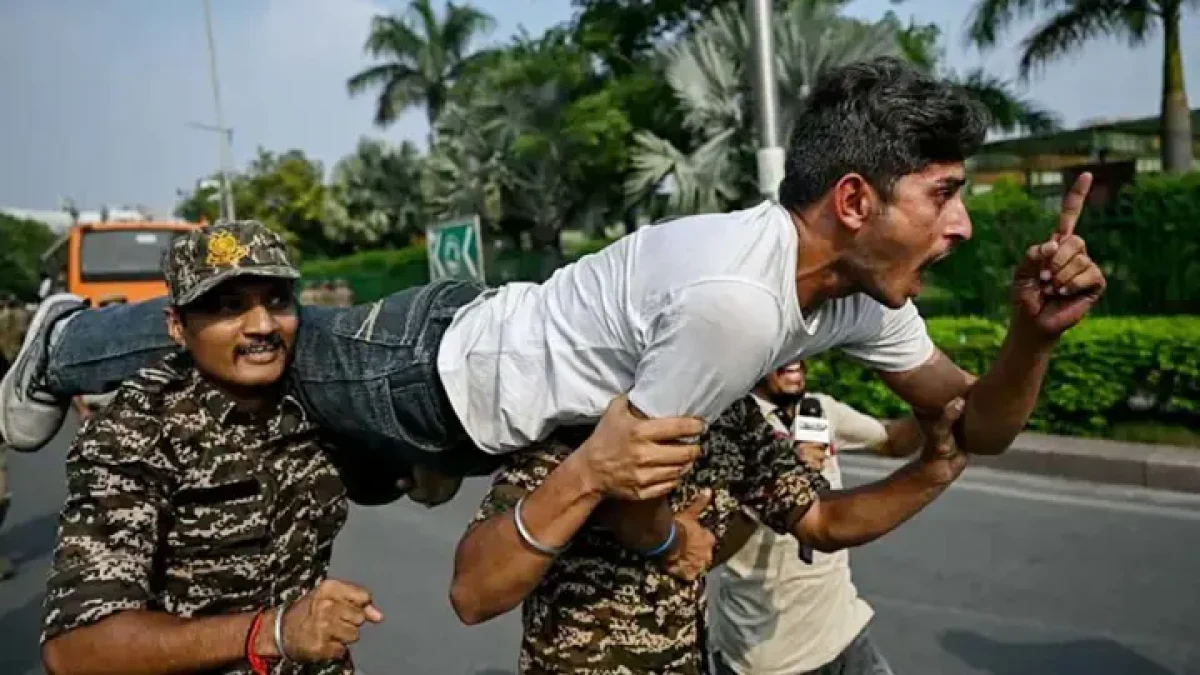
Delhi police have removed Jantar Mantar, known for about three and a half decades as one of the main centres of movements, demonstrations and protests in the Indian capital, New Delhi, from the list of places designated for protests.
Protest programmes are to be held at three alternative places in the capital instead. The government’s decision has created fresh controversy. Opposition political parties, student organisations and rights activists say it risks narrowing the right to peaceful protest and assembly.
Under the Delhi police’s new directive, the places designated for demonstrations and rallies in the capital from now on are Ramlila Maidan, Burari Maidan in north-west Delhi and the CBD ground in east Delhi. As a result, there will no longer be scope to hold protests as before at Jantar Mantar, which is close to India’s parliament and the central administrative area.
The Delhi police announced the removal of Jantar Mantar from the list of designated protest sites in a statement published on Monday. The new places had been named in a standing order issued on 11 October by Delhi police commissioner Anurag Kumar.
The directive says the decision was taken on the recommendation of a committee formed by the union home ministry to review alternative places for protest programmes. Detailed and revised rules, or a standard operating procedure (SOP), for holding protests at the three new places will be issued later.
The matter came up for discussion afresh after the Cockroach Janta Party (CJP) approached Parliament Street police station on Monday seeking permission to protest at Jantar Mantar. The party demands that permission be given to hold protest programmes there.
After the new directive, the CJP called it unacceptable. The party’s spokesman, Sourav Das, has given the police a 24-hour deadline to allow protests at Jantar Mantar. In his words, the decision is a blow to people’s fundamental right to assemble peacefully and to protest.
The CJP’s founder, Abhijeet Dipke, has also criticised the government’s decision. He alleges that the space for protest is being narrowed by removing Jantar Mantar from the designated sites.
Neha Bora, a leader of the left-wing student organisation AISA, also wrote on the social media platform X that Jantar Mantar is not only a place; it is a symbol of people’s voice. She said they would carry on their movement to keep it.
According to an analysis by the senior journalist Tribhuvan, from the late 1960s to the 1980s Delhi’s Boat Club was the main centre of mass protest. Later, after 1993, moves were made to shift protest programmes away from what was then Rajpath, now Kartavya Path, on grounds of political tension and security. Against that background Jantar Mantar began to gain importance as an in-between alternative.
বাংলায় মূল প্রতিবেদন পড়ুন · Read the original Bengali report