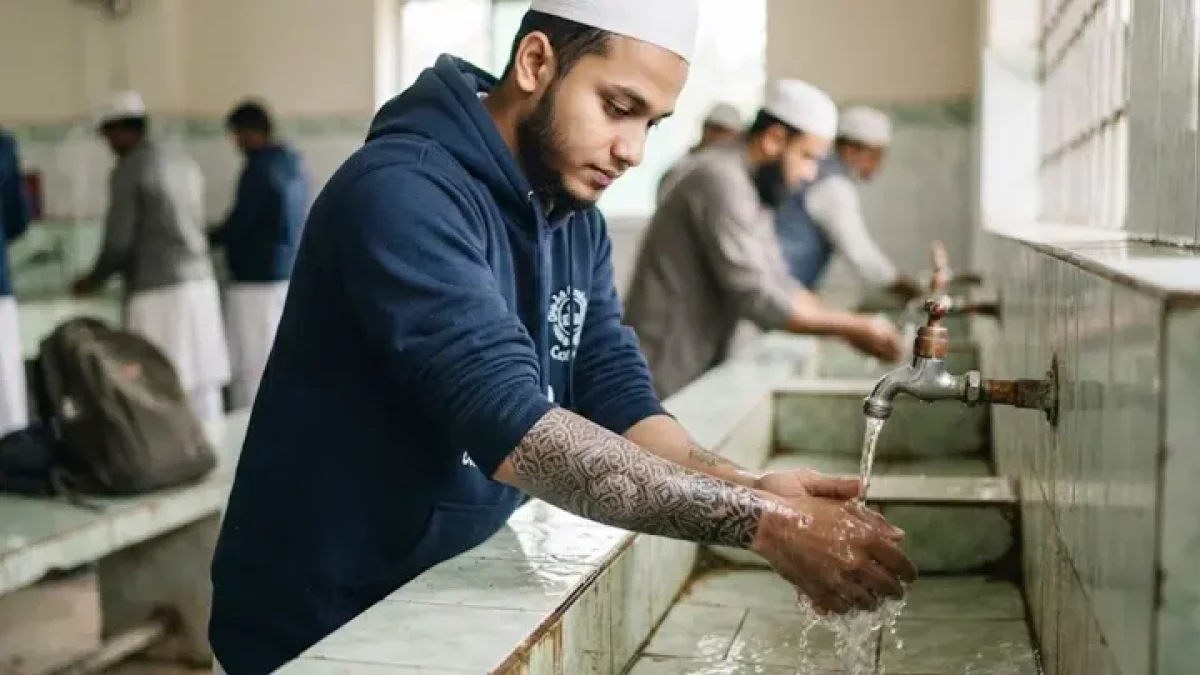
Islam clearly prohibits tattooing the body, and hadith carry strong warnings against giving or receiving tattoos. But many people ask whether ablution and prayer are valid for someone who already has a tattoo.
In Islamic law, tattooing the body is not permitted. Abu Hurairah (may Allah be pleased with him) reported that the Prophet (peace be upon him) forbade tattooing (Sahih al-Bukhari, 5408). Abu Juhayfah (may Allah be pleased with him) reported that the Prophet cursed the woman who tattoos, the woman who is tattooed, and the one who takes and the one who gives interest (Sahih al-Bukhari, 5347). In light of these hadith, tattooing is considered forbidden and a major sin.
For someone who already has a tattoo, however, the validity of ablution and ritual bathing depends on the type of tattoo and whether water reaches the skin. A tattoo is usually made by putting colour under the skin, so if it creates no coating on the skin that stops water reaching it, ablution and bathing are valid; colour under the skin alone does not invalidate them. If there is a coating over the tattoo that stops water reaching the skin, it must be removed before ablution or bathing.
Whether getting a tattoo is forbidden and whether ablution is valid are separate questions. Anyone who fears harm to their body from removing an existing tattoo should consult scholars, and sincere repentance to Allah is also necessary.
Hadith also warn about making images and altering the body. Sa’id bin Abul Hasan said a man came to Ibn Abbas (may Allah be pleased with him) and asked about the ruling on drawing pictures; Ibn Abbas related what he had heard from the Prophet about image-makers and advised him, if he had to draw, to draw trees and things without souls (Sahih Muslim, 5662). The Quran says: “We have certainly created man in the best of stature” (Surah At-Tin, 4), and refers to those who would “change the creation of Allah” (Surah An-Nisa, 119).
So one should avoid getting a tattoo deliberately. But an existing tattoo does not by itself invalidate ablution or bathing; what matters is whether anything on the skin stops water reaching it. If water reaches the skin, ablution and bathing are valid and prayers must be performed accordingly.
বাংলায় মূল প্রতিবেদন পড়ুন · Read the original Bengali report