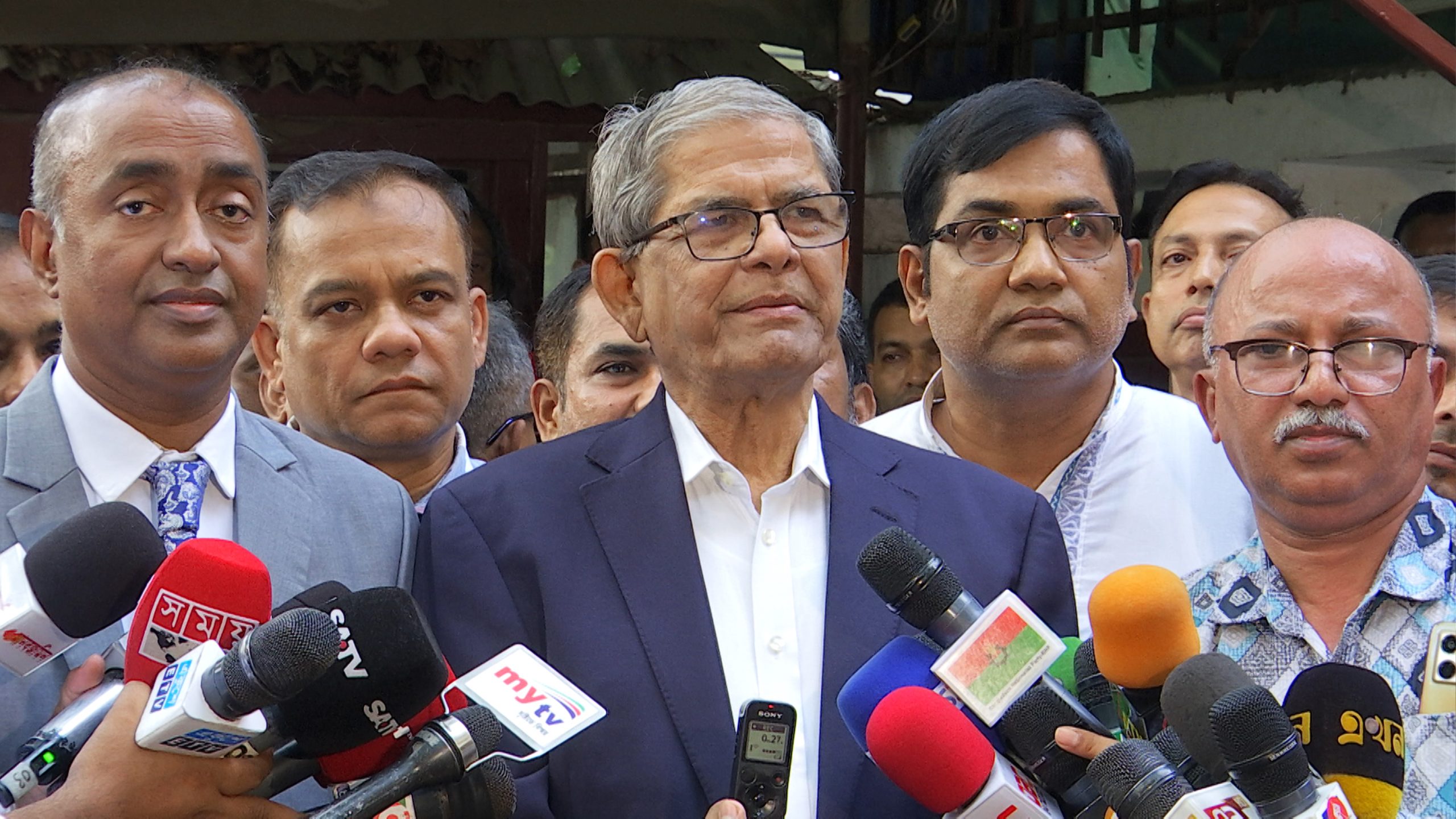
The government itself will implement every letter of the July Charter, local government minister Mirza Fakhrul Islam Alamgir said, adding: “The opposition wants to use this July only to come to power. We do not want July to become just another tool for gaining power.” He was speaking on Friday at a memorial meeting at the National Press Club marking the sixth death anniversary of Professor Emajuddin Ahmed, organised by the Professor Emajuddin Research Centre.
Mirza Fakhrul said the opposition was demanding implementation of the July Charter and saying “if reforms are not achieved, it will be settled on the streets,” yet “we signed the July Charter together — all the parties that took part in the movement signed it together. We are saying again and again that we ourselves will implement every letter of the July Charter.” On the referendum, he said no discussion had taken place with his party over one part of it, that they had never agreed to proportional representation in the upper house, and that he had himself issued a statement saying the nation was being deceived when the reform commission brought such matters forward without their consent. He said the July Charter document states that each party will implement the manifesto on which it is elected: “We are as committed to the July Charter as to our 31-point programme — but in the way we sought. It is being completely misrepresented that we do not want to implement the July Charter.”
On the opposition, he said some were now trying to inflame people with provocative talk, but “the people understand best and will make the best decision.” He said his party had always spoken of amending the constitution, never of “reforming” it, and that the people’s vote had given the BNP a two-thirds majority to run the state, leaving no room for confusion. Mirza Fakhrul said the July movement was not the work of a single month but the outcome of nearly 18 years of struggle against fascism. Paying tribute to the late Professor Emajuddin Ahmed, he called him “a lighthouse of our liberal democracy” who had shown the way in the fight for democracy and against autocracy without expecting any reward, and said building a united democratic Bangladesh in the spirit of 1971 and 2024 would be the highest tribute to him. The meeting, chaired by former Dhaka University vice-chancellor Professor Anwar Ullah Chowdhury, was also addressed by DU vice-chancellor Professor Obaidul Islam, JU vice-chancellor Professor Kamrul Hasan, Jugantor editor Abdul Hai Sikder, Bangladesh Association of Journalists president and Amar Desh joint editor M Abdullah, National Press Club president Hasan Hafiz and industrialist Abul Kashem Haidar; it was conducted by the research centre’s convener Abdul Latif Masum.
বাংলায় মূল প্রতিবেদন পড়ুন · Read the original Bengali report