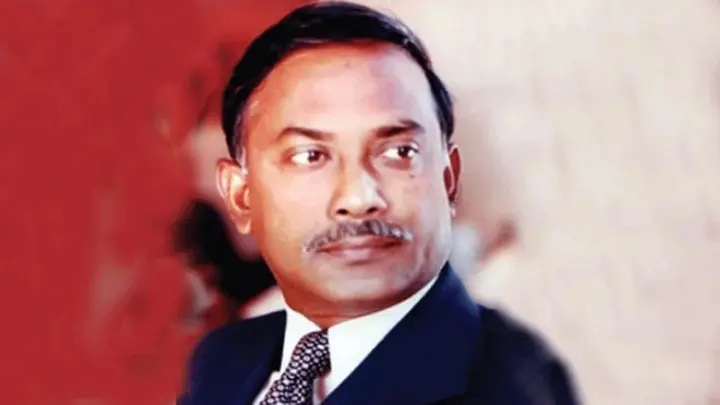
An article written by martyred president Ziaur Rahman, titled “Memories of the Liberation War,” is being added to next academic year’s textbooks. The National Curriculum and Textbook Board (NCTB) has also taken the initiative to include a photograph of one of his historic diaries from that period in the book.
The NCTB said the piece will feature as a new chapter in the “Bangla Sahitya” (Bangla Literature) textbook for classes nine and ten for the 2027 academic year. The National Curriculum Coordination Committee (NCCC) has given final approval to include this widely discussed document, one of the notable memoirs from the history of the great Liberation War, in the syllabus.
Confirming the matter, NCTB chairman Professor Mohammad Fakhrul Maula told the Bangladesh Sangbad Sangstha (BSS): “The NCCC has given final approval to include Ziaur Rahman’s article ‘Memories of the Liberation War’ in the class nine-ten ‘Bangla Sahitya’ textbook from next year’s academic session. The government has taken this initiative to present his contribution in the textbook in a fair and objective way, to whatever extent it exists.”
Educators and experts say including the article will let students learn, in an unbiased way, the first-hand account of the historic “we revolt” declaration that came out of Chattogram and the declaration of independence from Kalurghat — a major milestone, they say, in presenting an objective history of the Liberation War. On this, noted educationist and national professor Dr Mahbub Ullah told BSS: “This article written by Ziaur Rahman has historical value. Through it, young students will be able to become aware of the independence struggle. Including it in the textbook is reasonable.”
Professor Shah Shamim Ahmed of Dhaka University’s Institute of Education and Research told BSS: “By including this article, future generations will get the chance to learn the true and objective facts about the Liberation War. In the past, history has been taught one-sidedly through various political changes; the current government’s approach of presenting an unbiased and neutral history will put an end to that mindset.”
The education ministry said the decision was taken at a meeting of the National Curriculum Coordination Committee on August 24, chaired by the secretary of the ministry’s secondary and higher education division. Those involved in NCTB’s curriculum work said that in the author’s-introduction section of the 22nd prose piece in the class nine-ten “Bangla Sahitya” textbook, Ziaur Rahman is described as the great proclaimer of independence, former president, army chief, commander of Z Force, commander of Sector 1, and a “Bir Uttom” recipient. In this context, the Liberation War is described as an all-out “people’s war,” and the article notes that after Sheikh Mujibur Rahman’s arrest following the genocide of March 25, then-Major Ziaur Rahman’s declaration of independence was “like a clarion call” for the freedom-seeking people.
The NCTB said some explanatory notes precede the main text of the article. The notes describe two pieces — “The Birth of a Nation,” published in the “Dainik Bangla” in 1972, and “Memories of the Liberation War,” published in the now-defunct “Dainik Desh” in 1980 — as unique documents of the Liberation War, and state that Bangladesh’s independence is not the credit of any single individual or party. The notes recognise Hussain Shaheed Suhrawardy, the mental architect of democracy; Sher-e-Bangla A K Fazlul Huq; the oppressed people’s leader Maulana Bhashani; Bangabandhu Sheikh Mujibur Rahman; the proclaimer of independence, martyred president Ziaur Rahman; and Tajuddin Ahmad, independent Bangladesh’s first prime minister, as indispensable names in the country’s history.
Those involved in the curriculum said the prose piece also depicts, in a unique account, the start of the war of independence through an armed uprising from Chattogram in March 1971, the declaration of independence from Kalurghat radio station, and the sacrifices made in direct combat.
Describing his feelings on taking up armed responsibility in the Liberation War, Ziaur Rahman wrote in the article: “We all fought — soldiers and the people alike. At a nation’s moment of gravest crisis, someone has to step forward. Someone has to take responsibility. I simply carried out that responsibility. When the leaders vanished and no one was left to give a decision, I had to announce, on the nation’s behalf, the biggest decision of all… In the first hours of the night of March 26, that final moment arrived, the one we had spent the whole month waiting for, breathless.
Describing his sense of the Pakistani forces’ conspiracy in Chattogram and the suspicious movements that began from March 1, Major Zia wrote: “From March 1, we could clearly sense what was about to happen from the mysterious movements of the 20th Baluch Regiment… On March 13, Yahya’s round-table talks with the leaders began. In the midst of that, Pakistani generals kept arriving one flight after another… It was a frightening sign of an all-out assault to come… That night of the twenty-fifth into the twenty-sixth arrived swiftly. At 11pm, the battalion’s commanding officer sent word for me to report to General Ansari at Chattogram port. A navy truck was sent to escort me there…”
Zia further wrote in the article: “The truck stopped in front of a barricade in Agrabad… Right at that moment, Major Khalequzzaman came to meet me there. In a low voice, he said: they’ve begun attacking the cantonment. They’ve carried out operations in the city too. Many innocent people have been killed and wounded. The time we had been waiting for all this while has arrived. I immediately said, ‘we revolt.’ I gave the order: rush to Sholoshahar. Detain the Pakistani officers. Get everyone in the battalion ready for war.”
Ziaur Rahman wrote: “Arriving at Sholoshahar, I instantly snatched a rifle from one of them… I came to the East Bengal Regiment Centre. I tried to reach Lieutenant Colonel Chowdhury and Captain Rafiq by telephone but failed. I managed to reach an operator with the civil telephone service. I told him: the East Bengal Regiment’s eighth battalion has declared the war of independence — please inform the DC, the commissioner, the DIG of police and the political leaders of Chattogram of this news, because I could not reach any of them by phone. The telephone operator expressed great joy at my words and, deep into that night, tried to reach everyone.”
He further wrote: “That moment was the most significant moment in the nation’s history. I gathered all the battalion’s officers and jawans together and gave a brief address. I said we have entered the war of independence. They had been waiting eagerly for exactly that declaration. Everyone responded at once with cheers. Moments later, the armed war of independence began. It was then 2:15am, March 26, 1971 — an unforgettable moment for the nation.”
Describing the formation of the first liberated zone in the hills of Patiya and the military strategy that followed, Major Zia wrote: “At 4am, we set out along the railway line toward the hills of Patiya. Along the way, a hundred EPR members joined us… By March 26, a force of three hundred members had been sent to Chattogram to confront the occupying forces. A fierce battle began. That was the first direct combat, and panic set in at the Pakistani camp. They suffered heavy losses.”
Recalling the historic declaration of independence from the Kalurghat Swadhin Bangla Betar Kendra, Ziaur Rahman wrote in the article: “The day was March 27… I arrived at the radio station at 6:30pm. An exercise notebook was found close at hand. On one of its pages, I quickly wrote the first declaration of the war of independence — it also stated that I had taken up the responsibility of provisional head of state of the independent, sovereign government of Bangladesh… That declaration, carried on radio waves, was picked up on nearly every radio set in the world. And the world heard, for the first time, that Bangladesh had entered the war with a declaration of an independent, sovereign state against the occupying Pakistani forces… The moment that declaration was spoken into the ether at 6:30pm on March 27, the words ‘independent Bangladesh’ were, in an instant, etched onto the map of the world. It truly was a miraculous thing!”
Abdul Khalek, secretary of the education ministry’s secondary and higher education division, told BSS: “The article was unanimously approved at the NCCC meeting. Through it, the new generation will get to know the correct and unbiased history of the Liberation War.”