Although there is growing demand in the international market for the high-yield, low-cost “vannamei” shrimp, Bangladesh still relies on the traditional “bagda” (black tiger) shrimp. As a result, the country’s shrimp exports have fallen by about 62 percent over 14 years.
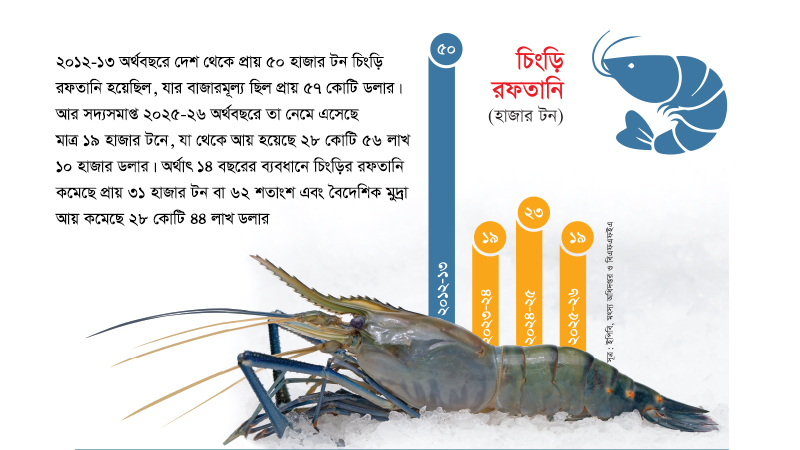
According to the Export Promotion Bureau (EPB), the Department of Fisheries and the Bangladesh Frozen Foods Exporters Association (BFFEA), about 50,000 tons of shrimp worth about $570 million were exported in the 2012-13 fiscal year. In the just-ended 2025-26 fiscal year, this fell to just 19,000 tons, earning $285.61 million. In other words, over 14 years shrimp exports fell by about 31,000 tons, or 62 percent, and foreign-currency earnings by $284.4 million.
In the 2024-25 fiscal year, 23,238 tons of shrimp worth $296.29 million were exported — 4,007 tons and $48 million more than the previous 2023-24 fiscal year. But there was another big drop in the just-ended 2025-26 fiscal year: within a year, exports fell by 4,238 tons and earnings by $10.68 million.
In the just-ended fiscal year, frozen fish and fisheries products worth a total of $443.42 million were exported — just $1.84 million, or 0.42 percent, more than the $441.58 million of 2024-25. In this fiscal year, $285.61 million of frozen shrimp, $94.13 million of frozen fish and $63.68 million of fisheries products were exported. Excluding fisheries products, about 75.21 percent of frozen-fish export earnings came from shrimp.
Exporters say the country’s shrimp exports are mainly bagda-centred, but demand in the international market for shrimp other than vannamei is low. Countries such as China, the Netherlands, Belgium, the UK, France, Portugal, the US and Germany import bagda according to their limited demand, but bagda imports are falling every year against rising overall demand. As vannamei has a lower market price and higher per-hectare output, its demand — and consumer demand — is rising in the European market. Yet, though the opportunity exists in Bangladesh, traders remain stuck with the old bagda shrimp. Unless steps are taken to produce and export vannamei, the country’s shrimp export sector will be destroyed, they believe.
Shyamal Das, managing director of the exporter MU Sea Foods, said: “Bangladesh lost its dominance in global shrimp exports long ago. Although demand for vannamei is high in the international market, we could not seize that opportunity. Planning is still going on around bagda exports. The government has already taken several steps, but as they have not been applied in the field, the fisheries sector has not created much room for hope in exports.” Unless the government pays attention, shrimp — the fisheries sector’s main export product — would remain confined to the domestic market, he added.
Several countries have recently taken initiatives to produce vannamei, Indonesia among them. Its government has acquired about 2,150 hectares of land in East Sumba district of East Nusa Tenggara province for the state-run Waingapu integrated shrimp-farming project, which will produce about 52,000 tons of shrimp a year and employ 7,000 people. The government’s investment in it is set at 7.2 trillion rupiah (Indonesia’s currency), or $398.6 million. There is a plan to launch it by 2028, with a target of achieving about 4 trillion rupiah, or $221.4 million, in annual production value.
By contrast, no shrimp is produced on 7,000 acres of uncultivated land declared a shrimp zone in the Chakaria-Rampura mouza of Cox’s Bazar district under Bangladesh’s Department of Fisheries. If the land were leased long-term to exporters for shrimp farming, the country’s export picture would change completely, those involved believe.
BFFEA acting president Tariqul Islam Zahir said: “The bagda shrimp we export to the European market is expensive, so demand for vannamei is rising there and we are falling behind in exports. On the other hand, while India, Indonesia or Vietnam sell small chaka shrimp (30 pieces to a kg) at $4-5, it sells at more than $7 in our local market. Demand for local shrimp is high in the domestic market, so we have no option but to increase production.”
He said there had been recent discussions with the finance minister: “A fund of Tk 2,000 crore has been created for the fisheries sector through Bangladesh Bank. Discussions are now on about how and by what process the money will be allocated.”
The BFFEA acting president said: “We do not have the means to buy land and invest. So if the government leases land, we will invest there and work to increase production. Under the plan, traders will invest, providing all kinds of logistical support to field-level farmers, and farmers will be assured that traders will buy their produce. Without this, it is not possible to improve the shrimp sector.” Allocating the 7,000 acres declared for shrimp farming in Cox’s Bazar to genuine traders would help the sector recover, he also claimed.
It is learnt that while 122 firms were previously involved in exporting shrimp and fisheries products, the number has now fallen to 30-35; the rest have either closed or rented out their factories. These factories had an annual production capacity of more than 400,000 tons. Various kinds of shrimp are farmed on a total of 262,980 hectares of land in the country. Vannamei’s per-hectare output is 10-12 times that of bagda, yet vannamei production has not yet been possible in the country, so Bangladesh’s export sector depends largely on bagda exports. At the same time, per-hectare bagda output is also falling because of traditional farming methods. According to those in the sector, although domestic prices are good, to keep shrimp viable in the world market it is essential to move away from traditional farming, formulate large-scale government policy and ensure vannamei farming.
বাংলায় মূল প্রতিবেদন পড়ুন · Read the original Bengali report