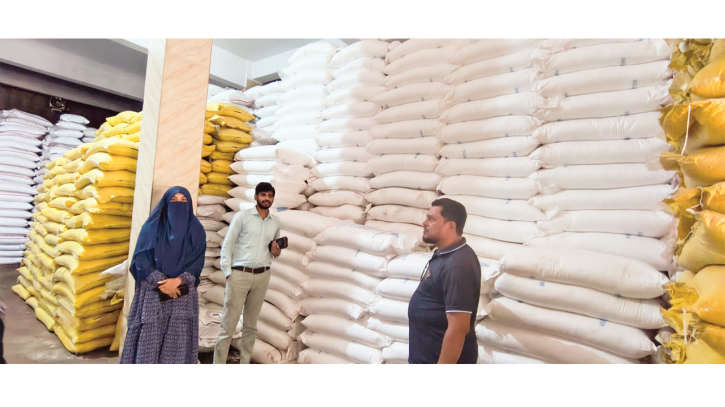
It is peak season for transplanting aman paddy. Yet in the fields of Jashore, farmers are scrambling for fertiliser. Official figures say warehouses hold ample stock. But in practice, dealers and sub-dealers cannot supply urea, DAP, TSP and MOP at government-set prices. Farmers are being forced to buy from unauthorised shops at nearly double the rate. The result is higher production costs and growing uncertainty over preparing land and transplanting paddy on time.
A tour of unions across eight upazilas of the district — including Chougachha, Sharsha and Sadar — found that although aman cultivation is in full swing, farmers cannot get the fertiliser they need. The shortage is most acute for DAP, TSP and MOP.
Ali Kadar, a farmer from Bariali village in Pashapol union of Chougachha upazila, said: “I went to the sub-dealer to buy DAP, MOP and TSP, but they couldn’t supply it. Yet at unauthorised shops the same fertiliser is available at double the price.”
Kamrul Islam, the sub-dealer for ward 3 of the same union, said there are 545 farmers in his area, but he received only 10 sacks of DAP, 10 of MOP, 55 of TSP and 100 of urea.
“This is the most crucial time for transplanting aman,” he said. “The allocation I received is far short of what farmers need. I can offer them no solution.”
Kingkor Halder, sub-dealer for wards 7 and 8, made the same complaint: “Farmers are coming with money but still can’t get fertiliser. With supply falling short of demand, we are in trouble.”
Shariful Islam, a farmer from Gokarna village in Dihi union of Sharsha upazila, said: “If fertiliser isn’t applied at the first tillage, the yield suffers. But right now there’s a shortage of everything — urea, DAP, TSP, MOP. What officials say bears no resemblance to the reality in the fields.”
Habibur Rahman, a farmer from Jaghati village in Churamankati union of Sadar upazila, said: “At government-set rates, urea should be 25 taka, DAP 19 taka, TSP 25 taka and MOP 18 taka a kilogram. But in reality MOP is selling at 25 to 30 taka, TSP at 30 to 40, DAP at 25 to 30, and urea in many places at up to 30 taka a kilogram.”
According to the Department of Agricultural Extension, Jashore has 162 dealers and sub-dealers approved by the BADC and 141 dealers approved by the BCIC.
BADC and agriculture department figures show the district’s nine warehouses have a total capacity of 13,500 metric tonnes. But they currently hold about 24,000 tonnes of non-urea fertiliser — nearly double capacity. Urea stocks, too, are well above requirement.
In June, dealers were supplied 2,010 tonnes of urea, 808 tonnes of TSP, 1,756 tonnes of DAP and 123 tonnes of MOP. Significant stock targets for DAP, TSP and MOP were also set for July.
In other words, government accounts show no fertiliser shortfall. But field-level sub-dealers say they are not receiving even 20 percent of what they need.
The government pays a large per-kilogram subsidy on fertiliser. Products that cost 80 to 100 taka a kilogram on the international market are meant to reach farmers at 20 to 27 taka. But farmers are not getting that benefit.
Farmers allege that government urea priced at 27 taka is selling at 35, DAP at 21 taka at 30, MOP at 20 taka at 30, and TSP at 25 taka at up to 40.
Asked about this, Mosharraf Hossain, deputy director of the Department of Agricultural Extension in Jashore, said: “We are regularly monitoring fertiliser and pesticide shops in the field. There is no fertiliser shortage at present. It has been distributed according to demand. If there is a problem anywhere, we will act immediately once informed.”
But farmers and sub-dealers say the monitoring exists only on paper. In reality, they say, fertiliser is not reaching the union level in the quantities needed.
Agriculture specialists say that if the necessary fertiliser cannot be applied during the first tillage and transplanting of aman paddy, yields could fall by 30 to 40 percent. Preparing a single bigha of land requires about 50 kilograms of fertiliser. If the current crisis drags on, they warn, meeting production targets will become difficult.
বাংলায় মূল প্রতিবেদন পড়ুন · Read the original Bengali report