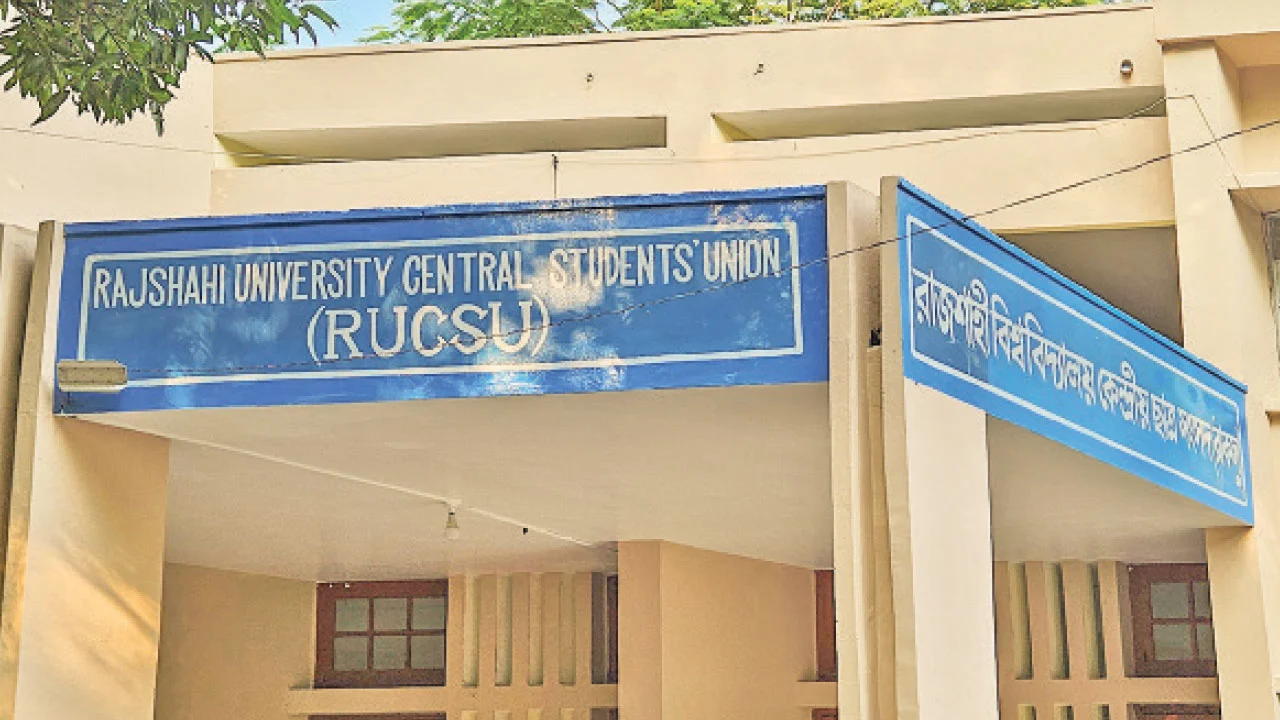
The election of the Rajshahi University Central Students’ Union (RAKSU) after a gap of 36 years opened a new chapter of democratic practice on campus. After years without an elected student leadership, students expected the new RAKSU to be a strong platform for winning their rights, an effective bridge between the administration and students, and an institution that would find realistic solutions to the campus’s long-standing problems.
The election campaign carried a range of pledges: resolving the accommodation crisis, improving transport and health services, digitalising the administration, supporting research, improving the quality of hall dining, a safe campus and student welfare. Almost nine months after taking office, an assessment of the implementation of those pledges has begun. Although there has been visible progress in some areas, students say many important commitments remain unfulfilled.
In the RAKSU election held on 16 October last year, the Chhatra Shibir-backed “United Students’ Alliance” won 20 of the 23 posts. The main themes of their campaign were “7 yeses, 7 noes” and “24 reforms in 12 months.” The manifesto of the independently elected general secretary (GS), Salauddin Ammar, pledged full residential accommodation, improved hall dining, a modern medical centre, administrative digitalisation and a full TSCC. Students expected that the implementation of these pledges would turn RAKSU into an effective and accountable students’ union.
Where there has been progress
In the nine months since taking office, RAKSU has implemented several visible initiatives. These include installing air conditioning in the central library and in reading rooms in various halls, installing water filters, opening a pharmacy on campus, a women entrepreneurs’ fair, thesis incentives and organising various seminars with the participation of foreign teachers.
Steps have also been taken to provide training in artificial intelligence (AI), digital security, fact-checking, app development, WordPress and research methods; free IELTS preparation; various sporting events; and reductions in the rent of several university venues.
The pledges left unfulfilled
Many of RAKSU’s much-discussed pledges are still awaiting implementation. There has been no significant progress on the students’ long-standing demand for an end to the accommodation crisis, or on introducing an allowance for non-resident students. Nor has any visible progress been seen in bus trip and route management, renovation of the medical centre, on-campus jobs or the implementation of a full TSCC.
Most of the other pledges — ensuring a safe campus, protecting the rights of women students, curbing crime, framing a policy on messes, modernising the library, increasing research grants and scholarships, appointing international-standard sports coaches, solving internet problems in the halls and administrative digitalisation — also remain at the stage of partial implementation.
Mixed reactions from students
Students have reacted in mixed fashion to RAKSU’s work. Ariful Islam, a student of the social work department, said students had many expectations because RAKSU had returned after 36 years. But in nine months there has been no visible change in transport, accommodation, health services or the quality of hall food. It seems many of the manifesto pledges have not been implemented, he said. There was at least a hope that the quality of hall food would improve, but even there we are disappointed.
Tushar Imran, a student of the mass communication and journalism department, said: “Looking at RAKSU’s work, it seems they are more focused on implementing a party agenda than the students’ manifesto. Even in nine months a significant part of the election pledges has not been implemented.”
Administrative and financial limits are also a big challenge
Asked about the overall picture, the RAKSU general secretary, Salauddin Ammar, said much of the work cannot be done on schedule because of red tape. We had moved many matters forward during the previous vice-chancellor’s time, he said. After the new vice-chancellor took office, those had to be started again from the beginning.
He said: “Most of the pledges in my manifesto are long-term. Matters such as accommodation, improving medical services and the evaluation of teachers have been worked on separately. In coordination with the administration, a budget of three thousand 375 crore taka has been approved for the university, which includes a proposal to build seven new halls. If the project is implemented, many of the university’s problems will be solved.”
On implementing the manifesto he said: “I made no unrealistic pledges. Had all the university’s bodies and offices worked in a coordinated way, it would have been possible to implement the pledges within the set time.”
The RAKSU assistant general secretary (AGS), S M Salman Sabbir, elected from the Shibir-backed United Students’ Alliance, said that because the election was held after 36 years it took several months simply to understand the administrative process. Even now we have to go to various offices repeatedly on the same matter, he said. Alongside that, we are not receiving full cooperation on the financial side either.
He added that because of complications over budget and sponsorship, the bigger initiatives — the allowance for non-resident students, a full TSCC, the overhaul of medical services and making the university fully residential — have still not been started.
বাংলায় মূল প্রতিবেদন পড়ুন · Read the original Bengali report