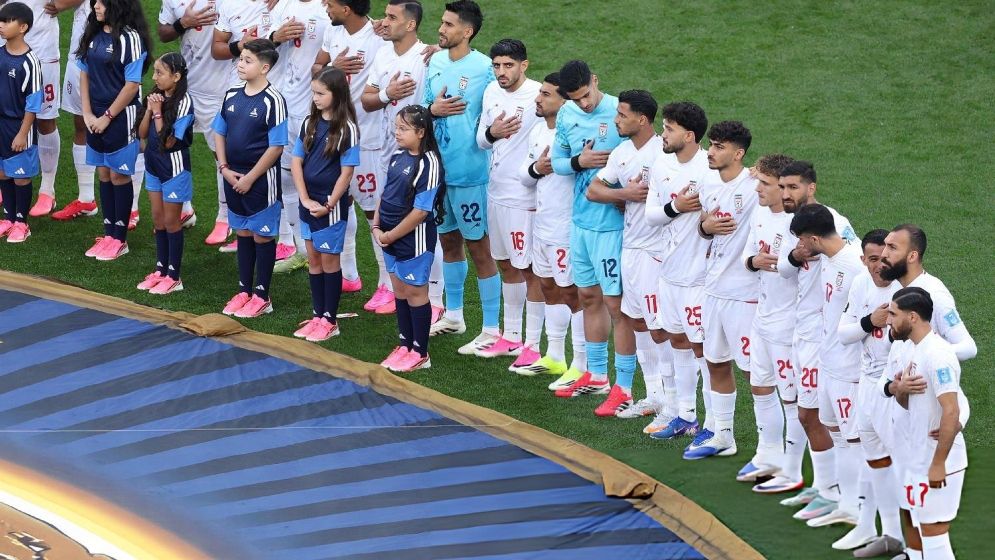
“When you want something with all your heart, the whole universe conspires to help you achieve it” — this line from Paulo Coelho’s The Alchemist is world-famous, to say the least. But Iran might today question the Brazilian novelist’s words. They too wanted to reach the knockout threshold, wanted it with all their heart; so why did the opposite happen to them? The whole universe did conspire, but the conspiracy went against them.
Iran might well ask: “Is this how dreams break?” Once would have been enough; twice could be accepted; but three times? The equation in front of Iran was clear. If they could beat Egypt in their last match, the West Asian side would reach the last 32 — and make history, having never played in the knockout stage.
They even began to dream, through the feet of Shoja Khalilzadeh. He put the ball into Egypt’s net in added time. But VAR intervened, with a rule rarely seen. It is usually thought that beating a defender while receiving a pass means beating the offside; this scene seemed to arise precisely to show that this idea is wrong and that the actual rule says otherwise.
When Khalilzadeh received the ball, one Egyptian defender stood in front of him at the goal, the Egyptian goalkeeper far behind, and — by a fraction — forward Hamza Abdelkarim behind him too. With a defender in front, there should be no offside problem; so when his shot hit the net, celebrations began from Seattle to Tehran. Of course they did — it was qualification for a first World Cup knockout.
Just then VAR intervened. Offside! Why? The offside rule requires two defenders to be in front; because the goalkeeper is almost always in front, that number often drops to one. That is where the mistake is made. Had Iran fallen into the same trap? Either way, the error came at exactly the wrong moment, leaving their fate hanging. They had many chances; just one going their way would have done it.
So their wait went on to Sunday morning. Croatia had to lose — but Croatia won, as expected. Then, when Uzbekistan surprised DR Congo by scoring first, Iran’s hopes rose. But Congo scored three to reach the last 32, and Iran’s wait came down to the Austria-Algeria match: if either side lost, Iran would go through on 3 points as the eighth team.
Austria’s Marko Arnautovic first gave them hope, putting Austria ahead. Then Rafik Belghali equalised for Algeria. In the 55th minute Marcel Sabitzer scored, and Iran saw a glimmer — only for it to vanish five minutes later when Riyad Mahrez scored.
The deadlock broke again in the fourth minute of added time, when Riyad Mahrez scored once more to put Algeria ahead. With the fourth official having added just 5 minutes, how could a 94th-minute goal be answered? From the Iran camp to Tehran, the celebration had probably already begun in earnest.
But fate intervened again. In the 96th minute, Sasa Kalajdzic equalised for Austria. Algeria suffered no harm either, and both teams went through to the last 32. In between, Iran’s luck ran out: a first World Cup knockout, almost within reach, slipped away at the last.
Yet Iran can, if they choose, set their jaw and look at their achievement. They played three matches and lost none, against sides like New Zealand, Belgium and Egypt. You will count these draws as equal to wins when you recall the context.
Because of the US-Iran war, the Iran football team faced major difficulties. A number of officials were not granted visas. Then, even when US visas were granted, the whole squad was not given permission to stay. Iran played all three matches by flying into the United States from another country. Teams are usually allowed to visit the stadium the day before a match; Iran did not even get that, since they were not allowed into the United States the day before. They flew in on the day, played, and flew back to Mexico the same day. Recovery after a match is very important for players; Iran had to manage that important task only after enduring yet another flight.
The mental strain of playing in an “enemy” country, plus the physical strain of such air travel — with all these obstacles in front of them, Iran still performed. They came within touching distance of the knockout. Would you not call that an achievement?
Iran’s journey, then, is by no means a failure — because they return home from US soil unbeaten and, above all, with their heads held high.
বাংলায় মূল প্রতিবেদন পড়ুন · Read the original Bengali report