The Padma Barrage is a masterstroke project that will benefit at least 70 million people across 24 districts of the country, Water Resources Minister Md Shahiduddin Chowdhury Annie has said. Prime Minister Tareque Rahman will inaugurate the Padma Barrage project on a set date between January and March next year.
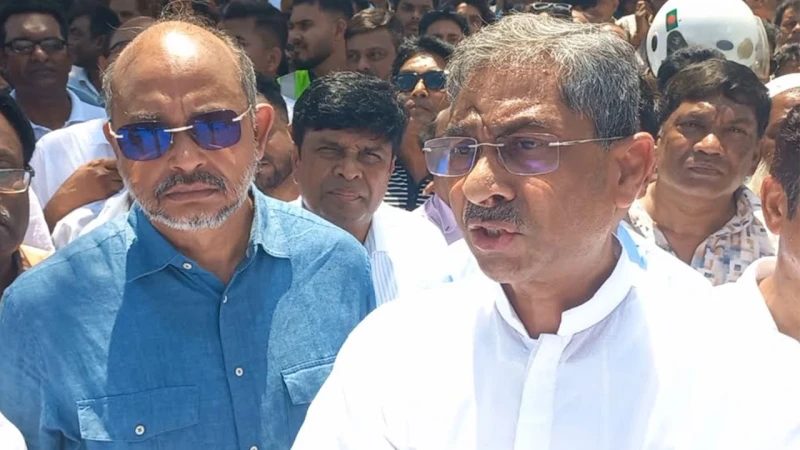
He made the comments Friday morning after inspecting the site of the Padma Barrage project in the Charjhikuri area of Habaspur union, Pangsha upazila, Rajbari.
The water resources minister said the government is set to implement the 2.1-kilometre Padma Barrage project at Habaspur in Pangsha upazila, Rajbari, aimed at ensuring dry-season water supply, reviving river flow, protecting navigability, and strengthening water security for the south-western region.
Shahiduddin Chowdhury Annie said: “This barrage has been a long-held dream. It was a long-cherished dream of 70 million people across 24 districts of Bangladesh. Through the implementation of the Padma Barrage, we are working to realise that dream. On behalf of the people of this area, I extend my thanks to Prime Minister Tareque Rahman.”
He said: “Bangladesh’s mega project, the Padma Barrage, will bring about a revolutionary transformation in the economy of these 24 districts, in power generation, agricultural production and fisheries production. This is a modern project. In 2004, former prime minister Begum Khaleda Zia commissioned a technical feasibility study for the Padma Barrage project. And through its inauguration by Prime Minister Tareque Rahman, it will play a role in development. We want to build a self-reliant Bangladesh by excavating 20,000 kilometres of canals across the country. Once implemented, the Padma Barrage will play a role in the country’s water, power, fisheries and agricultural development.”
The prime minister’s finance and planning adviser, Dr Rashed Al Mahmud Titumir, said at the event that former president Ziaur Rahman had secured a water agreement at the United Nations in Bangladesh’s interest. In the same spirit, he said, the late Begum Khaleda Zia had worked to bring about a revolutionary change in water management. Continuing that legacy, as part of the election manifesto, the government is working to bring about a revolutionary transformation in water resource management across Bangladesh. Alongside this, canals are being excavated to restore the country’s ecology.
He said the barrage project was undertaken to overcome the damage to agriculture, fisheries and biodiversity in the country’s south-western region caused by the severe decline in dry-season flow of the Padma due to the Farakka Barrage. The project’s main objective is to store the Padma’s surplus water during the monsoon and release it in a controlled manner during the dry season.
Guests later spoke at a public rally at Habaspur Keraj High School ground. Also present during the inspection were Water Resources Deputy Minister Farhad Hossain Azad, Rajbari-1 MP and Culture Deputy Minister Ali Newaz Mahmud Khaiyum, Rajbari-2 MP Harun Or Rashid, Central Krishak Dal Vice-President Aslam Mia, district BNP convener Liakat Ali Babu, Rajbari Deputy Commissioner Afroza Parveen, Superintendent of Police Mohammad Monzur Morshed, and senior officials of the Water Development Board.
The Padma Barrage project was approved at an ECNEC meeting chaired by Prime Minister Tareque Rahman on May 13. The barrage, which will feature 78 spillways, 18 under-sluice gates, two fish passes and a navigation lock, is designed to store 2.9 billion cubic metres of water. It will also include a 113-megawatt hydropower generation facility. Costing 34,497.25 crore taka, the Padma Barrage is scheduled to begin construction in July 2026 and be completed by June 2033, with the government providing full financing.