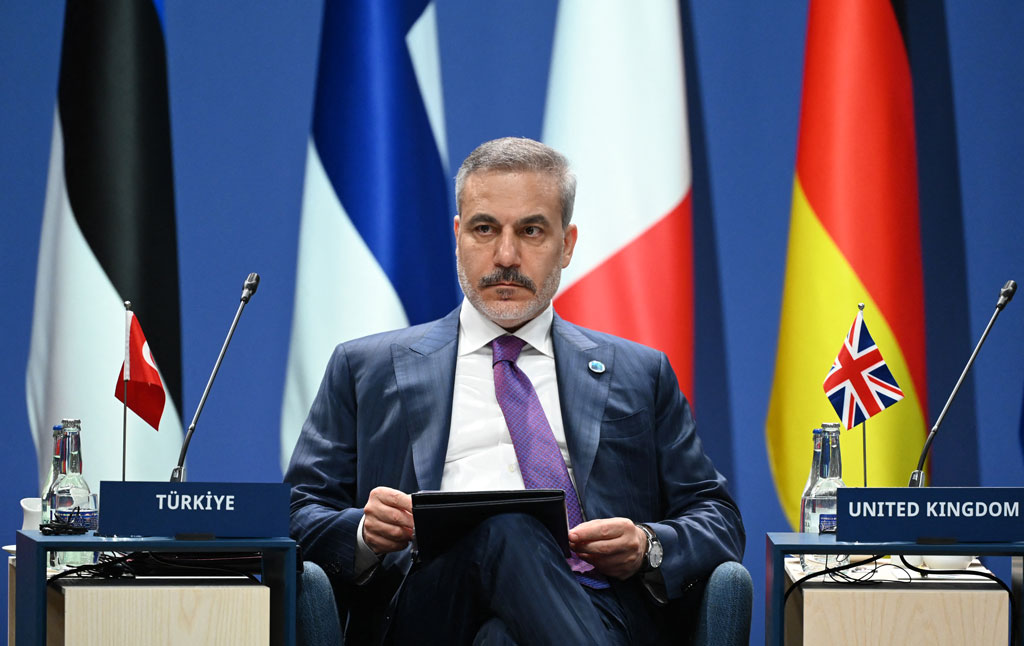
Turkey has made clear that its recent trilateral defence pact with Saudi Arabia and Pakistan was not drawn up to target Iran or any other country.
In an interview with Turkey’s state news agency Anadolu on Saturday, Turkish Foreign Minister Hakan Fidan said the “Mecca Joint Defence Pact” did not identify Iran or any other specific country as a common threat or enemy. “We did not name any specific country in the pact. Countries that do not attack the three signatory states will not be its target,” he said.
Turkish President Recep Tayyip Erdogan, Saudi Crown Prince Mohammed bin Salman and Pakistani Prime Minister Shehbaz Sharif signed the historic pact in the holy Saudi city of Mecca on Friday (7 August). Under its terms, an armed attack on any one of the three countries will be treated as an attack on all three.
Fidan described the pact as technically similar to “Article 5” of the Western military alliance NATO, though how it is implemented or how a response is decided would depend on the situation and the request of the attacked country. He explained that an attacked country would have to formally seek help and specify what it needed — intelligence, logistical support, ammunition or the direct deployment of troops. To put the arrangement into effect, a joint political and military committee of the three countries’ foreign ministers, defence ministers and military chiefs would be formed, and a permanent secretariat set up in Saudi Arabia.
Fidan said mutual cooperation in the defence industry was a key foundation of the pact, with the three countries’ top leaders holding long talks on joint training, intelligence-sharing and sharing military technology. He said preparations for the pact had been under way for the past two years and eight months, so it was not an immediate reaction to the recent tensions around Iran.
Despite Ankara’s reassurances, Iran views the pact with suspicion. Iranian officials have questioned its effectiveness and advised Saudi Arabia not to rely entirely on other countries’ military help. Mahmoud Nababian, a member of the Iranian parliament’s national security and foreign policy committee, said Saudi leaders should understand that such a pact with Turkey and Pakistan would not guarantee their security, while another member of the committee, Ibrahim Rezaei, called it a “paper agreement.” Iranian Foreign Minister Abbas Araghchi, without naming the pact directly, urged regional countries on the social platform X to rely on their own capabilities and build “true brotherhood,” reiterating the strength and readiness of Iran’s armed forces.
Fidan said Middle Eastern and South Asian countries should take their own responsibility for regional security. “The arrival of superpowers in this region solves no problem; rather it makes the situation more complicated,” he said. He indicated the three-country alliance would not stop there and that Ankara aimed to expand it, saying many countries had already shown interest in joining. After agreement is reached on some technical matters, Egypt — which Fidan described as a “natural partner” — could join. Although many specific military details are still being worked out, the plans for a permanent secretariat and joint technology development make clear that Ankara, Riyadh and Islamabad do not intend to leave it a mere paper declaration.
বাংলায় মূল প্রতিবেদন পড়ুন · Read the original Bengali report