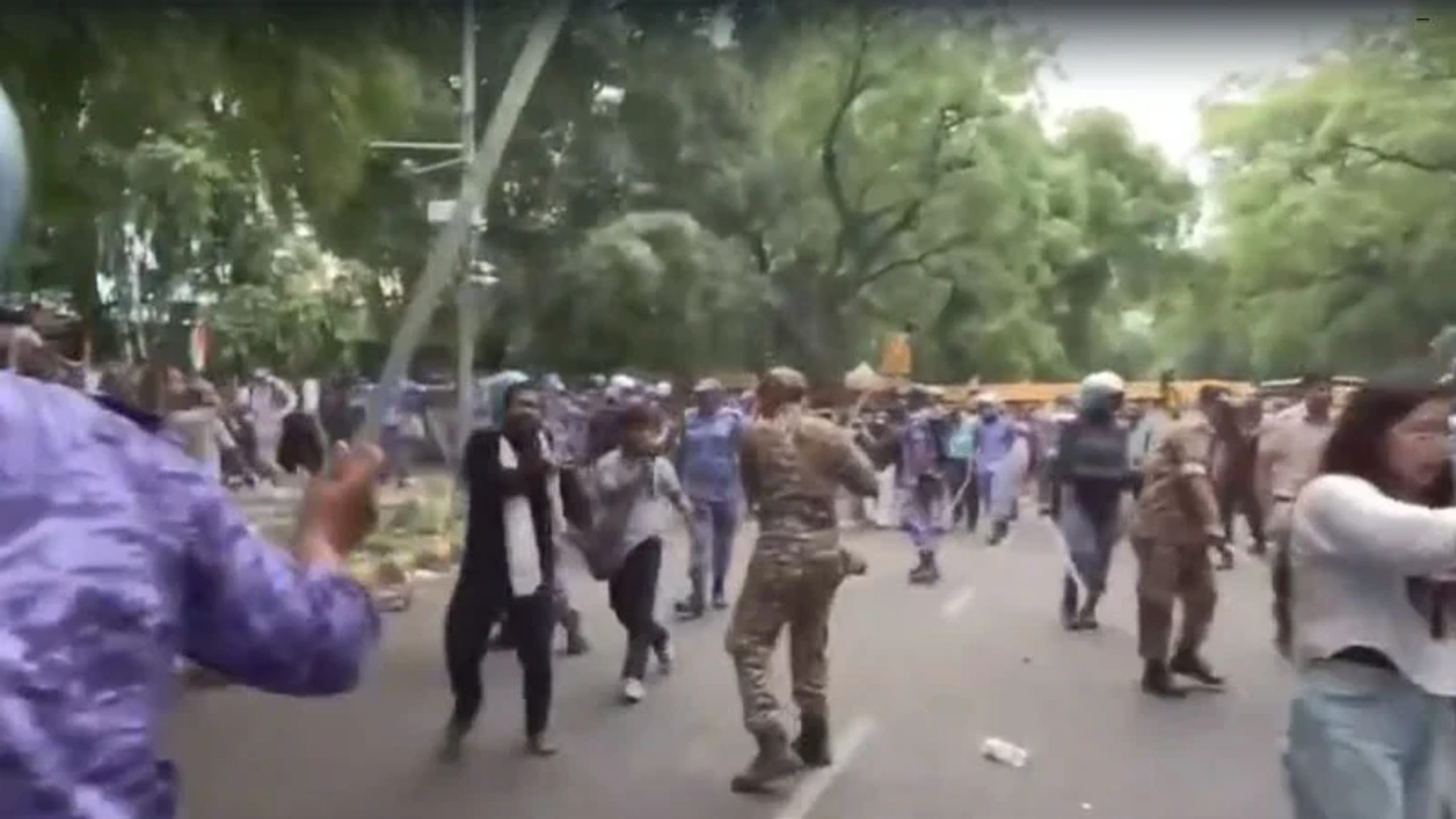
New Delhi grew tense on the first day of the monsoon session of India’s parliament over the “Chalo Sansad” (March to Parliament) programme of a group known as CJP. Tension spread across the capital through the day amid scuffles between protesters and police, detentions, and allegations of a lathi charge around a march heading toward the Parliament building. Delhi police denied the lathi-charge allegation.
On Monday, CJP began marching toward Parliament without police permission. Protesters alleged that police used a lathi charge, water cannon and tear-gas shells to stop the march, and claimed that mobile networks were temporarily restricted in parts of Delhi. Anticipating possible unrest, tight security had been stepped up in the capital from the previous day. Section 163 of the Bharatiya Nyaya Sanhita (BNS) was imposed in the New Delhi area, banning all gatherings.
Delhi police said CJP had taken no permission for the march on Parliament, and that permission would not have been granted even if sought; gatherings were allowed only at Jantar Mantar. Police also called on social media for people not to join any illegal gathering or march. For security, the Rajiv Chowk, Janpath, Patel Chowk, Central Secretariat and Seva Tirtha metro stations were temporarily closed. About 5,000 police and paramilitary personnel were deployed, and New Delhi was divided into 15 security zones.
Despite the tight measures, CJP began marching toward Parliament with thousands of supporters. In the absence of Sonam Wangchuk, his wife, Gitanjali Angmo, took part in the programme. When protesters tried to break through barricades and advance, police dispersed them, creating tense scenes in various parts of the capital. Police detained CJP spokesman Sourabh Das and several other leaders along with many supporters.
Sourabh Das later said talks had been held with government representatives. He said the government had not yet given any clear decision, but that talks were continuing and the next decision rested with the government. It later emerged that CJP representatives Ashutosh Ranka and Sourabh Das had met Union minister JP Nadda. The group’s main demand is the resignation of Union Education Minister Dharmendra Pradhan over the NEET question-paper leak, which CJP said was to be discussed at the meeting.
Delhi police, in a statement on X, completely denied the lathi-charge allegation, saying no lathi charge or use of force had taken place at Jantar Mantar, that the situation had been handled professionally, and urging people not to heed rumours. CJP has long campaigned for Education Minister Dharmendra Pradhan’s resignation over the NEET paper leak. Social activist Sonam Wangchuk had been on a hunger strike to the death at Jantar Mantar since 28 June; on the 21st day of the strike, police moved him to hospital. From hospital he set the government three conditions, saying he would agree to withdraw the strike if at least one were met.
বাংলায় মূল প্রতিবেদন পড়ুন · Read the original Bengali report