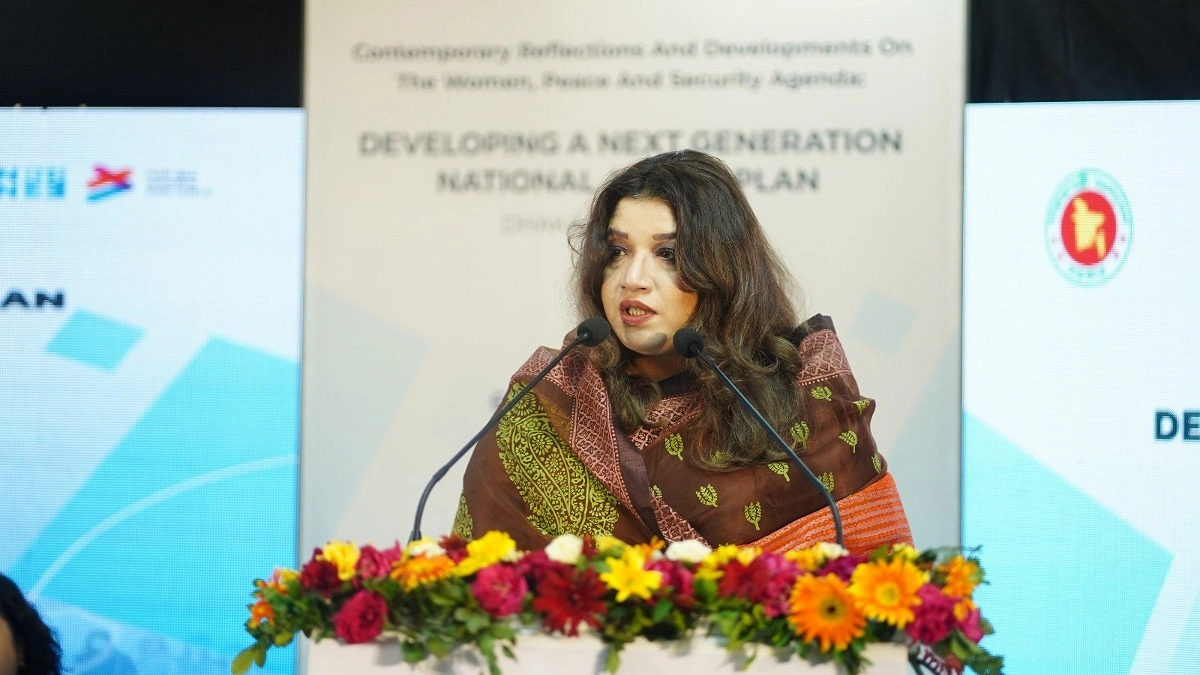
Deputy Foreign Minister Shama Obaed Islam has said that repatriating the Rohingya to their homeland is achievable through strengthening bilateral relations with Myanmar, closer engagement with the United Nations, cooperation with regional partners including ASEAN, and intensified international humanitarian and development activity in Rakhine.
She said accountability must be ensured for the Rohingyas’ repatriation, alongside creating a safe and conducive environment in Rakhine. “The goal is singular — that the Rohingya can return to their homes with safety and dignity,” she said.
She made these remarks at a discussion session held Sunday at the Bangladesh Institute of International and Strategic Studies (BIISS) auditorium.
Shama Obaed made clear, “Our main objective is to maintain international attention, strengthen humanitarian assistance, ensure accountability, and above all create a favorable environment for repatriation.”
Turning to bilateral talks with Myanmar, she said priority has been given to swiftly completing the verification process to move toward repatriation. This process cannot continue indefinitely, she said, and must be completed quickly based on existing bilateral understandings. In doing so, she said, the practical situation of children born in refugee camps and Rohingyas who arrived from Rakhine after 2017 must also be taken into account.
On humanitarian assistance, the deputy foreign minister said Bangladesh will continue fulfilling its humanitarian responsibility, but sustaining this assistance is becoming increasingly difficult as international funding declines. She called on donors and international partners to play a stronger role in sustaining life-saving assistance.
Highlighting the need to maintain balance in camp assistance, Shama Obaed said humanitarian aid must be managed in a way that does not unintentionally create a tendency for further displacement or complicate future repatriation.
She said the key to sustainable repatriation lies in Rakhine State, where security, respect for identity and rights, and legal recognition for the Rohingya must be ensured. Alongside that, she said, freedom of movement, livelihood opportunities, and access to education and healthcare are needed. Confidence must also be built that the Rohingya will not be displaced again after repatriation.
Calling for greater international engagement in Rakhine, the deputy minister said the UN, ASEAN, development partners and other international partners need to cooperate on practical confidence-building initiatives and humanitarian and development activities there. This would ease the path to repatriation while benefiting both returning Rohingya and the local population.
She placed importance on continuing the process of justice and accountability in resolving the Rohingya crisis. Shama Obaed said Bangladesh continues to support various international accountability processes, including the Gambia v. Myanmar case at the International Court of Justice. There is no scope to view justice and repatriation separately, she said — accountability and sustainable repatriation reinforce each other.
She noted that Bangladesh has already proven it can handle a crisis with humanity. Bangladesh has shown patience and maintained its diplomatic commitments, she said, and history also proves that repatriation is possible.
The deputy foreign minister said the time has come to move forward in a coordinated way on the country’s political will, international diplomatic engagement, interim humanitarian assistance, and practical steps toward repatriation.
She said an important conference on the Rohingya crisis will be held at the upcoming UN General Assembly session, which Bangladesh’s prime minister will also attend.
Shama Obaed said that through firm diplomacy, strong national coordination and sustainable international cooperation, it is possible to turn the expectation of Rohingya repatriation into reality. She said the path forward must be toward dignified repatriation rather than prolonged displacement, and toward resolving the crisis rather than merely managing it.