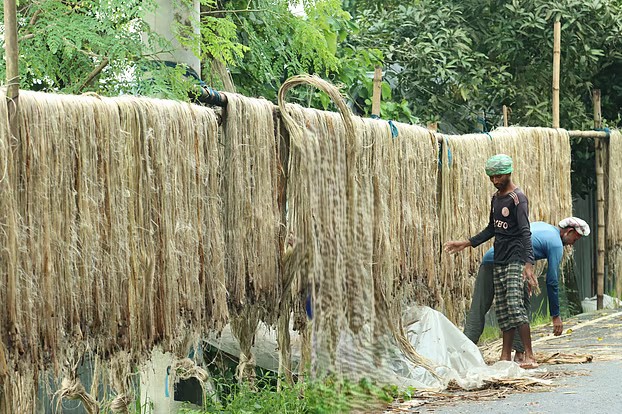
The golden age of jute in the country is now past, but jute and jute products have not lost their importance in export trade. After four straight years of decline, jute and jute-product exports have rebounded, hitting a three-year high in the just-ended 2025-26 financial year — though the sector is still far behind its pandemic-era record. For a decade jute exports stayed near $1 billion, but during the pandemic, in 2020-21, they jumped to $1.16 billion, the highest in 16 years; exports then fell for four straight years. In 2025-26 they rose nearly 8 percent to $880 million, the highest in three financial years.
Jute-product exporters say flooding damaged jute production last year, pushing up raw-jute prices, so exports rose in value terms because of high prices — but not in volume, though there is scope to raise volume too by smoothing the raw-jute supply chain, improving research and product quality, and bringing in foreign investment. Bangladesh is the world’s second-largest jute producer, growing 9 million bales a year. A Bangladesh Investment Development Authority (BIDA) report said jute-product exports could be raised to $5 billion, though no effective government steps to boost exports have been seen.
According to the Export Promotion Bureau (EPB), Bangladesh exports raw jute along with jute yarn, sacking and diversified jute products to countries including Turkey, China, India, Egypt, Uzbekistan, Indonesia, Morocco, the UAE, Jordan, Pakistan, Russia and Iran. In the past financial year, raw-jute exports fell 11 percent to $130 million, though in volume terms they fell about 77 percent, with 38,000 tonnes exported against 1,67,000 tonnes in 2024-25. Jute-sacking exports rose 5 percent to $130 million, and jute-yarn exports rose 18 percent to $490 million, though in volume terms yarn exports fell 2 percent, with 4,28,000 tonnes exported against 4,38,000 tonnes the previous year.
Bangladesh Jute Spinners Association (BJSA) president Tapas Pramanik told Prothom Alo that raw jute had to be bought at 5,500 to 6,000 taka a maund in the past financial year, up from 3,000 to 3,500 taka the year before; because of the price rise, a $1,000 product now costs $1,200 to $1,300, so exports rose in value terms. He said jute-product exports could easily be taken to two or three billion dollars if the raw-material supply chain were smoothed and incentives arranged for exports to new markets.
Diversified jute products have the greatest global potential, but Bangladesh’s exports of them are low: $74.4 million in the past financial year, about 11 percent less than the year before. Entrepreneurs say orders from the European Union, a big market for diversified jute products, fell 20 to 25 percent because of the Iran war, mainly as high fuel prices cut sales of non-essential goods, while higher raw-jute prices raised production costs. Global demand is rising for jute home-decor items and for jute shopping bags, technical textiles, ready-made garments, gardening, automobile and packaging uses, along with demand for charcoal made from jute sticks in China and other countries. Md Rashedul Karim, managing director of the diversified jute-product exporter Creation, said margins on jute yarn and sacking are very low per tonne, so exporters struggle to hold margins when raw-jute prices rise; there is no alternative to diversified products to raise jute-sector exports, and countries like China and India have moved ahead, so raising diversified-product exports needs research into new products and foreign investment in the sector.
বাংলায় মূল প্রতিবেদন পড়ুন · Read the original Bengali report