The death toll from the glacial-collapse disaster in Nepal and Tibet has risen to 1,287, with 5,083 people still missing.
The country’s disaster management agency released the figures on Friday.
The agency said 1,287 bodies have been recovered so far, with 5,083 people still unaccounted for.
Earlier, police had put the death toll at 1,280, with 4,798 people missing at that time.
The new figures show an increase of seven deaths and 285 missing from the previous count.
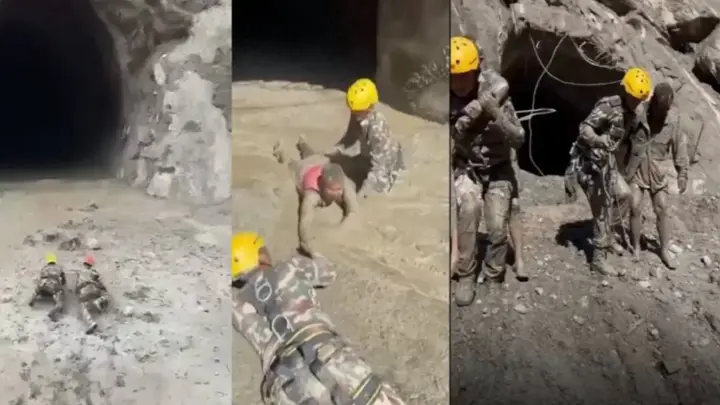
Meanwhile, nine days after the flooding, two people were rescued alive today from a tunnel at the Trishuli-3A hydropower project, raising hopes that more people may still be alive inside.
The two rescued were Sanjay Sah, a foreman in the project’s mechanical department, and Kabir Maharjan, a supervisor in the same department.
The rescues were confirmed Friday by Shree Ram Neupane, a lawmaker and engineer with the Rastriya Swatantra Party (RSP), who has been involved in the rescue operation since Aug. 26.
Neupane said Sanjay Sah was rescued first on Friday, followed by Kabir Maharjan.
He said rescuers were continuing their search after receiving information that more people may be inside the tunnel.
Rescue efforts had earlier made a significant breakthrough after human voices were heard from inside the tunnel. Rescuers were also able to establish contact with the people trapped inside.
After the voices were heard, the Nepali Army and Armed Police Force intensified efforts to reach the inside of the tunnel.
Neupane said rescuers had called out to those trapped inside, telling them, “Don’t panic, we’ve come to rescue you.” A voice from inside the tunnel then responded, “Okay.”
He later said rescuers had confirmed that multiple people remain trapped inside the tunnel.
New risk
Two natural lakes formed on the first day of the glacial collapse, raising fears of renewed flooding if the water overflowed. One of the lakes had largely drained by Saturday evening. However, late Saturday night, China detected a new hazard via drone.
According to CCTV, a major new landslide occurred 2.8 kilometers downstream of the two lakes, naturally forming another dam and water body. The new lake has again raised fears of a sudden flood. As a precaution, rescue teams and security personnel near the Gyirong border crossing have been moved to a safe distance.
Chinese scientists say long-term effects of climate change are causing this kind of instability in the icebound regions of the Himalayas. China has already sent more than 2,100 rescue workers to respond to the disaster and has allocated a large amount of emergency relief. It is also using heavy drones and advanced life-detection devices to search for missing people.