The amount of liquidity support given to weak banks by printing money to keep them afloat is steadily rising. Over the past three months, Bangladesh Bank has provided a further roughly Tk17,000 crore. With that, the central bank’s total lending to these banks has crossed Tk85,000 crore (Tk850 billion, about $7 billion). Although the money was given to manage the banks’ acute liquidity crisis, they have long been unable to repay this large sum.
It has emerged that during the Awami League government — ousted in the student-people uprising — more than a dozen banks were subjected to large-scale looting. Several groups, including S Alam, were involved in this looting, which left the banks financially weak; some cannot even return depositors’ money.
In this situation, printing money to give liquidity support to the crisis-hit banks began towards the end of the Awami League government. Under the interim government, as the banks’ crisis deepened, liquidity support was again provided. Later, although some stability returned, during the BNP government Islami Bank became unstable again over the appointment of a new chairman to its board, and Bangladesh Bank once more had to provide liquidity support.
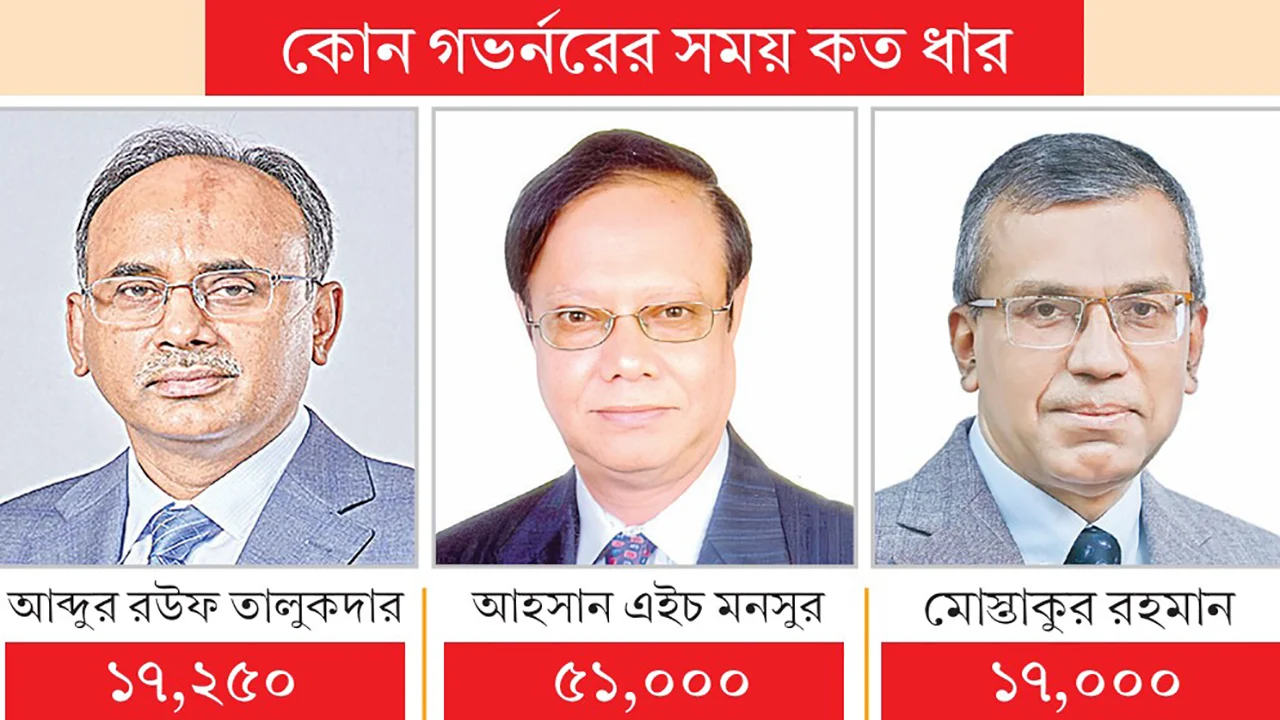
Sources say Bangladesh Bank has so far lent more than Tk85,000 crore in printed money to 13 banks. Of this, Tk17,250 crore was given under Abdur Rouf Talukder, the last governor of the Awami League era; Tk51,000 crore under interim-government governor Ahsan H Mansur; and Tk17,000 crore under the current governor, Mostaqur Rahman.
People connected to the sector say it is true the banks fell into crisis because of looting. But the way the money is being provided is not producing the desired improvement, they say, and there are questions over how long the banks can be kept alive by printing money like this. Although some banks are being merged, progress on that front is very limited.
During the Awami League government, the wounds in the banking sector were kept hidden. But towards the end of 2022, reports of loan fraud at various banks under S Alam’s control began appearing in the media. Customers then started withdrawing their money from the banks, pushing them into a liquidity crisis.
The banks also failed to maintain, with Bangladesh Bank, the Cash Reserve Ratio (CRR) as statutory cash-liquidity reserves and the Statutory Liquidity Ratio (SLR) in government securities. Even so, the then governor, Abdur Rouf Talukder, kept them afloat by granting various irregular facilities.
Central bank officials said each bank keeps a current account with Bangladesh Bank’s Motijheel office. From this account, a bank must maintain its CRR as a statutory cash-liquidity reserve and its SLR in government securities. Inter-bank settlements, refinancing from the central bank and all other transactions also run through this account.
Ordinarily, a shortfall in CRR and SLR should not cause a shortfall in the current account. But after the loanable funds of the banks under the control of the controversial S Alam Group ran out, former governor Abdur Rouf allowed transactions illegally. Towards the end of 2022, this new method was introduced by letting the current accounts of five Shariah-based banks go negative. In this way, the banks continued transacting without hindrance throughout the Awami League government.
After the fall of the Awami League government, the new governor, Dr Ahsan H Mansur, took charge, stopped these illegal facilities and announced that banks would no longer be given printed money as before. But he could not hold to that decision for long: with the current-account shortfalls and the halt to printed-money lending, the banks struggled to return customers’ money. As unstable situations began at branch after branch, the central bank again started printing money and lending.
Bangladesh Bank has lent the most printed money to Islami Bank Bangladesh — Tk17,000 crore. It is followed by First Security Islami Bank with Tk15,810 crore. Also lent were Tk12,010 crore to EXIM Bank, Tk10,841 crore to Social Islami Bank, Tk10,568 crore to National Bank, Tk5,420 crore to Union Bank and Tk4,900 crore to Premier Bank.
Beyond these, Tk4,270 crore was lent to AB Bank, Tk3,003 crore to Global Islami Bank, Tk624 crore to Bangladesh Commerce Bank, Tk252 crore to ICB Islamic Bank and Tk252 crore to Padma Bank.
Bangladesh Bank spokesperson and executive director Arif Hossain Khan said: “Providing liquidity support like this will no longer be right. The central bank is giving this support out of a kind of compulsion. Because if depositors do not get their money back, a loss of confidence could develop in the banking sector, which risks deepening the crisis.”
বাংলায় মূল প্রতিবেদন পড়ুন · Read the original Bengali report