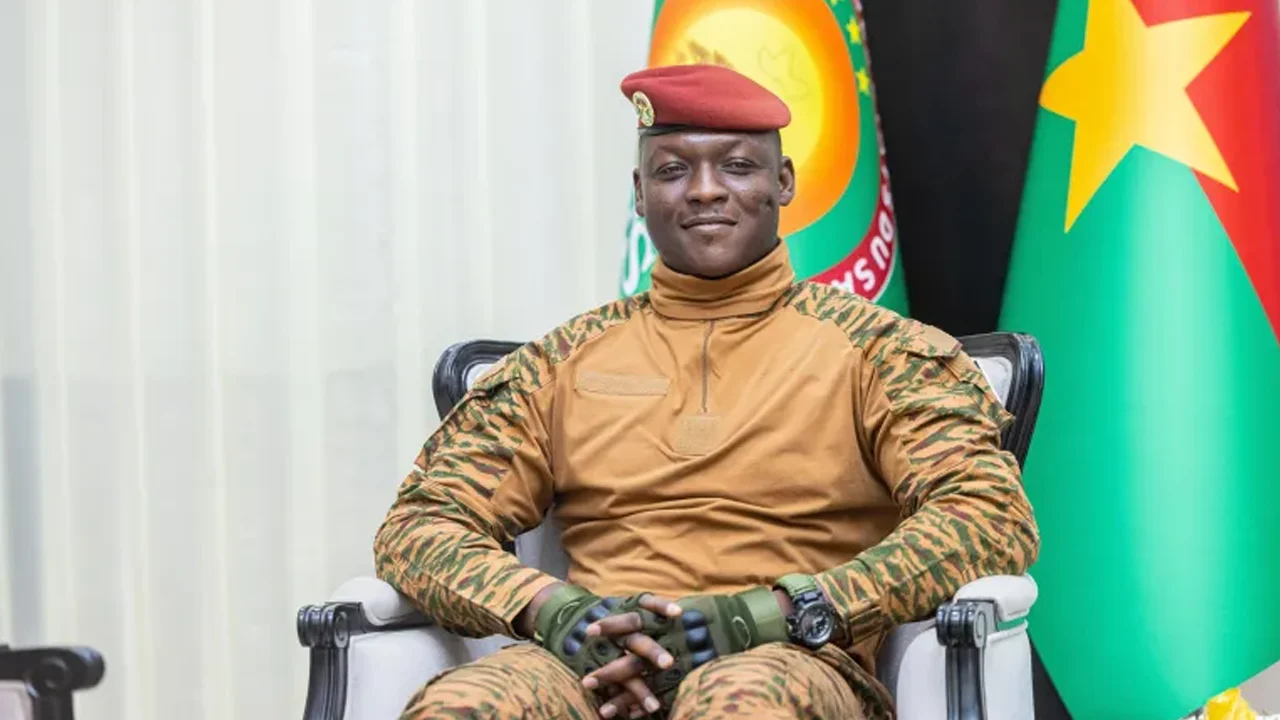
Capt. Ibrahim Traore, a 38-year-old military officer, has become one of Africa’s most discussed leaders. After taking power in a 2022 coup, supporters came to view him as a symbol of national sovereignty and resistance to foreign influence.
His popularity has grown abroad, but questions about his rule are increasing inside Burkina Faso. Restrictions on political activity, a continuing security crisis and uncertainty over whether promises of national renewal will bring meaningful change have become major tests of his leadership.
In April, Traore told the people of Burkina Faso to forget democracy, arguing that the country was in a revolutionary period rather than a democratic phase.
His government subsequently extended the military-led transition and dissolved political parties, indicating that a rapid transfer of power to a civilian government was not an immediate priority.
The contrast between Traore’s international image and conditions at home is now one of the central questions surrounding his leadership.
Why Traore is popular
Traore is popular beyond Burkina Faso. He has tapped into dissatisfaction across many African countries with foreign military intervention, economic dependence and political elites seen as detached from the public.
After taking power in September 2022, he removed French troops from Burkina Faso, strengthened relations with Russia and emphasized local industry and agriculture.
His government has presented economic self-reliance as a national priority. Like other military governments in the Sahel, Burkina Faso is moving away from Western security partners and building new relationships.
Traore frequently invokes the legacy of former revolutionary leader Thomas Sankara, who ruled Burkina Faso from 1983 to 1987 and remains a symbol of anti-imperialism and self-reliance in Africa.
Supporters say Traore has restored national pride and challenged the country’s longstanding dependence on external powers.
Nigerian security analyst Kabir Adamu, founder of Beacon Consulting Ltd., told Al Jazeera that events in Burkina Faso reflected a changing relationship between public legitimacy and government effectiveness.
Adamu said Traore had reorganized the security system around the idea of sovereignty more than operational effectiveness.
Policy changes under Traore
Traore has tried to translate his sovereignty message into policy. His government has sought to expand local production, increase state control of strategic industries and reduce dependence on foreign partners.
The government says it has increased investment in agriculture, particularly the production of staples such as rice and corn. It has also sought to develop local manufacturing and processing industries.
Other measures have included infrastructure projects and steps to increase national participation in important parts of the economy.
Government supporters say the initiatives are building a foundation for economic independence and allowing the country’s resources to support its own development.
The government has also expanded the Volunteers for the Defense of the Homeland, a civilian force that assists the military with security operations.
Continuing security crisis
Security remains the greatest test of Traore’s leadership.
He promised when taking power to address a crisis that had persisted for years, but Burkina Faso remains one of the most violence-affected countries in the Sahel.
Armed groups linked to al-Qaeda and Islamic State have exerted influence over large areas of the country for years.
The military has intensified nationwide operations since 2022, and the government says it has recaptured several towns and strategic areas.
Ghanaian security specialist Mustafa Bature Salama told Al Jazeera that Traore’s presidency would ultimately be judged on how much the security situation improved.
Burkina Faso still faces threats from Jama’at Nusrat al-Islam wal-Muslimin (JNIM), al-Qaeda’s Sahel affiliate, and Islamic State’s West Africa branch, Salama said.
More than 2 million people have been displaced and millions need humanitarian assistance, he said. Independent verification of official security claims has also become difficult.
Restricted access for journalists, researchers and humanitarian organizations has made it harder to establish the full situation.
Concerns over political freedom
Critics say Traore’s government is moving beyond a military transition toward increasingly centralized power.
Authorities dissolved political parties and suspended political activity in January, arguing that such activity caused division during a national crisis.
The military transition had already been extended, further delaying a return to civilian rule. Traore therefore faces two major challenges: addressing the security crisis while balancing political freedom with public expectations.
বাংলায় মূল প্রতিবেদন পড়ুন · Read the original Bengali report