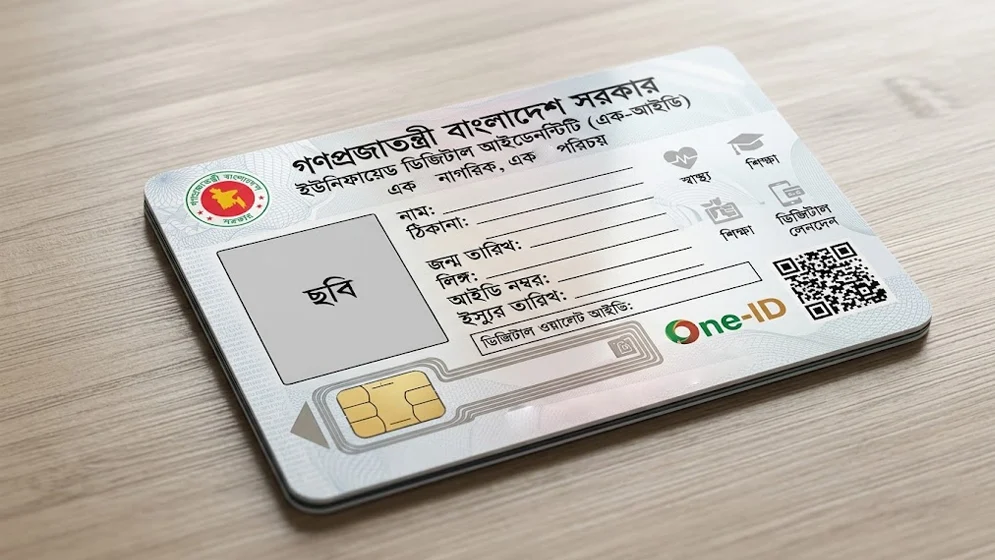
The government has taken an initiative to give every citizen in the country a single identity document starting from birth. Called the “Unified Digital Identity,” or “One-ID,” the document is meant to serve as a citizen’s permanent, unique identity for life. The plan is for the ID to be used to access health, education and other government services.
To that end, the Information and Communication Technology (ICT) Division has taken up a new project. Called “Digital Service Transformation for Access and Resilience,” or “D-STAR,” the project will be implemented by the Bangladesh Computer Council. It is set to run from 2026 through 2031 and has been sent to the Planning Commission for approval.
ICT Division Secretary Mamunur Rashid Bhuiyan confirmed the plan Thursday.
Currently, children are issued birth registration certificates, followed by a National Identity Card (NID) at age 18. Under the new system, there would be no age limit — citizens would be issued a single ID immediately after birth. Once the new card is introduced, citizens would no longer need to repeatedly provide the same information to different government offices.
ICT Division officials say that once the unified ID is introduced, the functions of various existing cards would gradually be consolidated into it. Services currently provided through cards such as the national ID, family card and farmer card are also planned to eventually be delivered through the One-ID, though the details have not been finalized.
The government is drawing on the experience of the United States, Singapore, Estonia and India in developing the unified ID, officials said. ICT Adviser Rehan Asif Asad has described the concept behind the new system as “one citizen, one digital identity, one wallet” — meaning each citizen would have a single ID card that also serves as their digital identity, with plans to enable digital transactions through it as well. What specific information the new ID will contain has not yet been determined.
According to the project’s initial proposal, IDs are planned for roughly 180 million citizens, based on the latest census data from the Bangladesh Bureau of Statistics. However, 200 million cards are planned for production and printing.
The cost of producing and printing each polycarbonate chip card is estimated at $2, or roughly 246 taka at current rates. Distribution and delivery of each card is estimated to cost an additional $1, or roughly 123 taka. That puts the total cost of production, printing, distribution and delivery at roughly 369 taka per card.
The project’s total cost is estimated at 9,193 crore taka. Of that, the government will provide 7,663 crore taka, with the remaining 1,530 crore taka coming from a World Bank loan.
The project’s largest expense will be card production, printing, biometric data collection and distribution, with a proposed budget of 7,380 crore taka for that category.
Bangladesh currently maintains several forms of identification and numbering systems, including the national ID, birth registration, passport, driving license and tax identification number. Experts say that if effective interoperability can be established between these databases, citizens would no longer need to repeatedly provide the same information. That would ease the burden on citizens accessing government services and could make service delivery simpler and more effective.