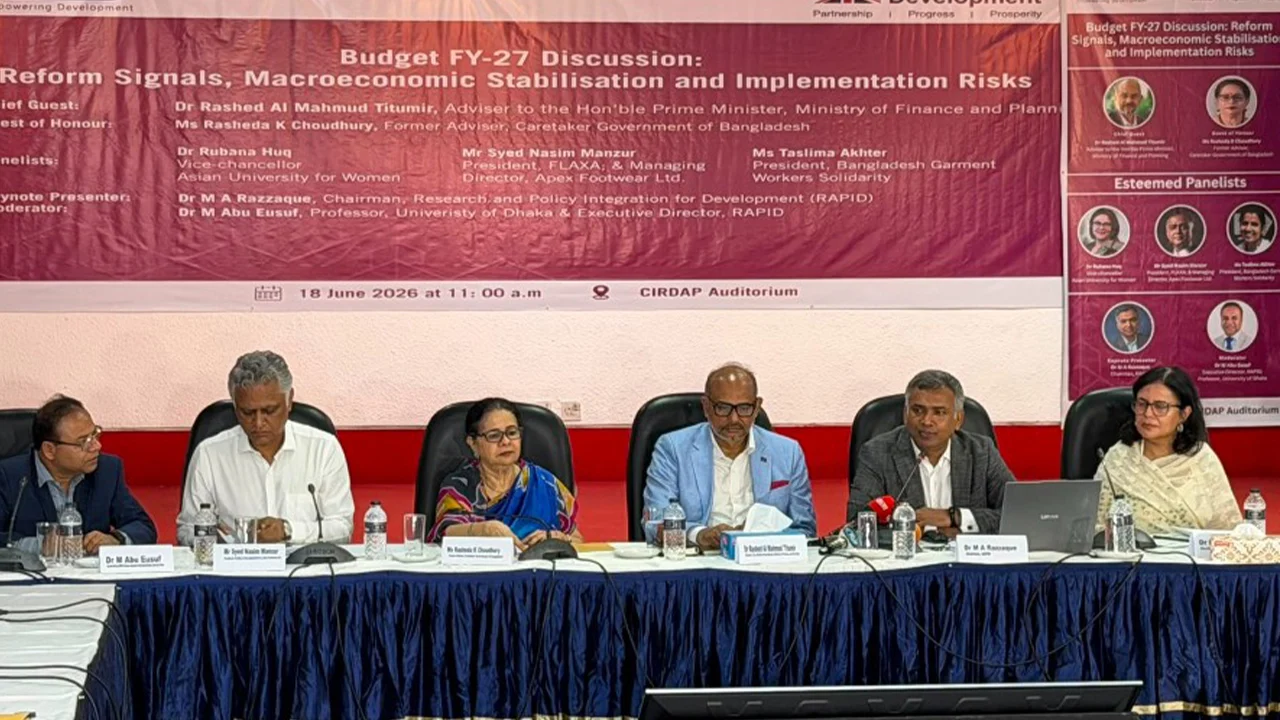
The government is prioritizing the mobilization of domestic resources by expanding production capacity, accelerating industrialization and widening the scope of economic activity, rather than raising tax rates. At the same time, it has taken steps to reform revenue management, establish good governance and create an investment-friendly environment to ensure long-term economic stability, the prime minister’s finance and planning adviser, Dr. Rashed Al Mahmud Titumir, said.
He made the remarks Thursday at a post-budget discussion organized by the research institute RAPID at the CIRDAP auditorium in the capital.
Titumir said that to strengthen the economy further, priority must be given to production-oriented industrialization alongside raising productivity. Expanding the industrial sector would draw new investment, create jobs and restore momentum to overall economic activity, he said. On revenue collection too, the main strategy should be to broaden production and business activity rather than increase the tax burden.
He said the government was gradually moving toward a production-based economic structure as part of its preparation to face possible future global and domestic crises. To achieve this, a three-pronged strategy of recovery, reinstatement and reconstruction for dynamism was being followed.
The finance and planning adviser said policy consistency was crucial to winning investors’ confidence. For that reason, a five-year tax framework had been included in the budget for the first time. Clear action plans had also been adopted to ease regulation and reduce administrative complexity, he said.
The central bank had already announced a stimulus package of 60,000 crore taka (about US$5 billion), he said. Implementing these measures was expected to boost the pace of private-sector investment. (1 crore = 10 million; 1 lakh = 100,000.)
Calling for scrutiny of government activities, Titumir said constructive criticism was needed to ensure accountability. Learning from past mistakes, the government was placing greater emphasis on transparency and accountability in implementing policy, he said.
Highlighting the need for good governance in revenue management, he said merely broadening the tax net or adjusting rates would not bring the desired results. It was essential to remove systemic weaknesses and build administrative capacity. Although the iBAS system was in place, problems such as tax exemptions, evasion and fraud had not yet been fully eliminated, he said. For that reason, separate task forces had been formed for income tax, customs and VAT to carry out regular monitoring.
At the discussion, RAPID Chairman Dr. M.A. Razzaque said the government’s initiatives based on the “three Rs” — recovery, reform and reconstruction — were positive, but there were concerns over their effective implementation. Unless stability was restored to the economy, controlling inflation would be difficult. Placing excessive emphasis on growth before inflation was brought down could increase price pressures further, he said.
He said raising Bangladesh to a trillion-dollar economy would require about 8 percent nominal GDP growth over the long term. If economic stability could be ensured, however, even 5 percent growth could help achieve the desired goal. Effective steps must also be taken to prevent excessive depreciation of the currency, he said.
He added that even if the National Board of Revenue applied its full capacity, a shortfall of about 1 lakh crore taka against the target could remain in the coming fiscal year. The government would also face challenges in raising foreign loans, as financing from development partners worldwide was shrinking.
The RAPID chairman said state liabilities had risen significantly in recent years, becoming a risk for the economy. In 2025, spending on interest payments was equal to about 36 percent of the NBR’s total revenue collection. In the coming fiscal year, about 31 percent of possible revenue income could be spent servicing foreign loans. If the trend continued, pressure on financial management would increase further in the future, he said.
On education and health, he said the move to raise the education allocation was positive. But effective use of funds had to be ensured and investment in research increased. Although there were allocations for the health sector, they often could not be spent properly. A specific and accountable system was therefore needed to implement development spending, he said.
বাংলায় মূল প্রতিবেদন পড়ুন · Read the original Bengali report