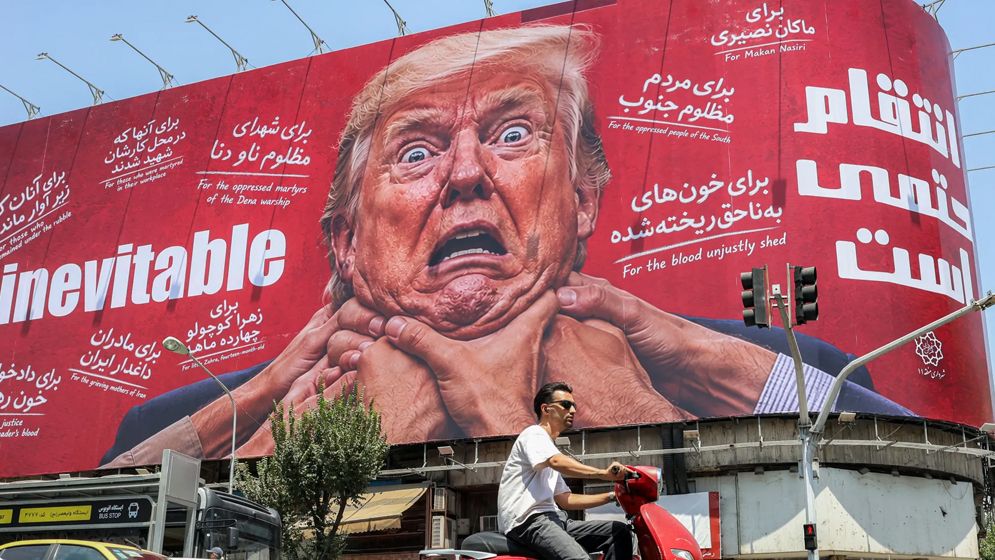
As the war with Iran enters its sixth month, this week’s mix of dire warnings on one hand and intense diplomatic activity on the other has laid bare the increasingly cornered position of U.S. President Donald Trump. Having begun this unpopular war with a promise to end it in just a few weeks, he is now in serious difficulty trying to find a way out. The account could not be independently verified.
Trump must now choose mainly between two difficult options. The first is to accept an interim deal being worked out between Oman and Iran, which would give Tehran a degree of authority over the Strait of Hormuz that it did not have before the war.
The second is to carry out the threat of fresh, heavy military strikes by escalating the war — a course that could lead to an even longer crisis.
According to analysts, accepting the first option would be the biggest concession granted to Tehran since the United States and Israel launched their joint strikes on Iran on 28 February. It would give the Islamic republic at least temporary formal recognition of its oversight of this vital global energy-transport route — something the Trump administration had vowed to prevent.
On the other hand, signalling through major new air strikes could be politically very risky for Trump, especially ahead of November’s crucial U.S. midterm elections. Moreover, since earlier bombing failed to force Tehran to yield, fresh strikes offer no added prospect of success.
Trump could, beyond these two paths, also decide to maintain the current shaky status quo — keeping a naval blockade on Iran’s ports and occasionally carrying out retaliatory strikes in response to any attack on shipping. But this strategy, too, would give Trump no honourable exit matching the initial notion that the war would be over by mid-April.
Aaron David Miller, a former Middle East negotiator under both Democratic and Republican administrations, said: “Trump now faces a long list of bad options. But he may now have realised that this war cannot be continued indefinitely. A concession will have to be made somewhere, and that could be accepting Iran’s new political reality in the Strait of Hormuz.”
But in response to questions from Reuters, one U.S. official, speaking on condition of anonymity, said any “temporary” shipping route would be entirely “unobstructed” and would not be under the control of any one side.
Deadlock at sea
U.S. Secretary of State Marco Rubio has firmly said the Strait of Hormuz — the route for nearly a fifth of the world’s oil and liquefied natural gas (LNG) — cannot in any way remain under Iran’s control or subject to its fees; it must be kept as an open international waterway.
But Trump has previously contradicted Rubio on several war-related matters, and analysts believe this time may be no exception.
High gas prices in the United States, a decline in Trump’s own popularity, and intense discontent among ordinary Americans over the war are steadily narrowing the president’s room for political manoeuvre. The longer the war drags on, the less his threats have worked to make Iran yield. Rather, analysts say, it may now be President Trump who has to make the biggest concession.
Reopening the Strait of Hormuz is seen as the main condition for returning to the negotiating table between the United States and Iran. Washington wants those talks to centre on Iran’s nuclear programme, which was the declared main goal of Trump’s military campaign.
But whether the United States will accept the Iran-Oman deal is now the key question. A senior Iranian source and two regional officials told Reuters that, under the proposed terms, Tehran would gain some oversight or control over ships entering the Persian Gulf. Although Trump called a deal to open the waterway “imminent”, Iranian officials said many details remain unresolved.
বাংলায় মূল প্রতিবেদন পড়ুন · Read the original Bengali report