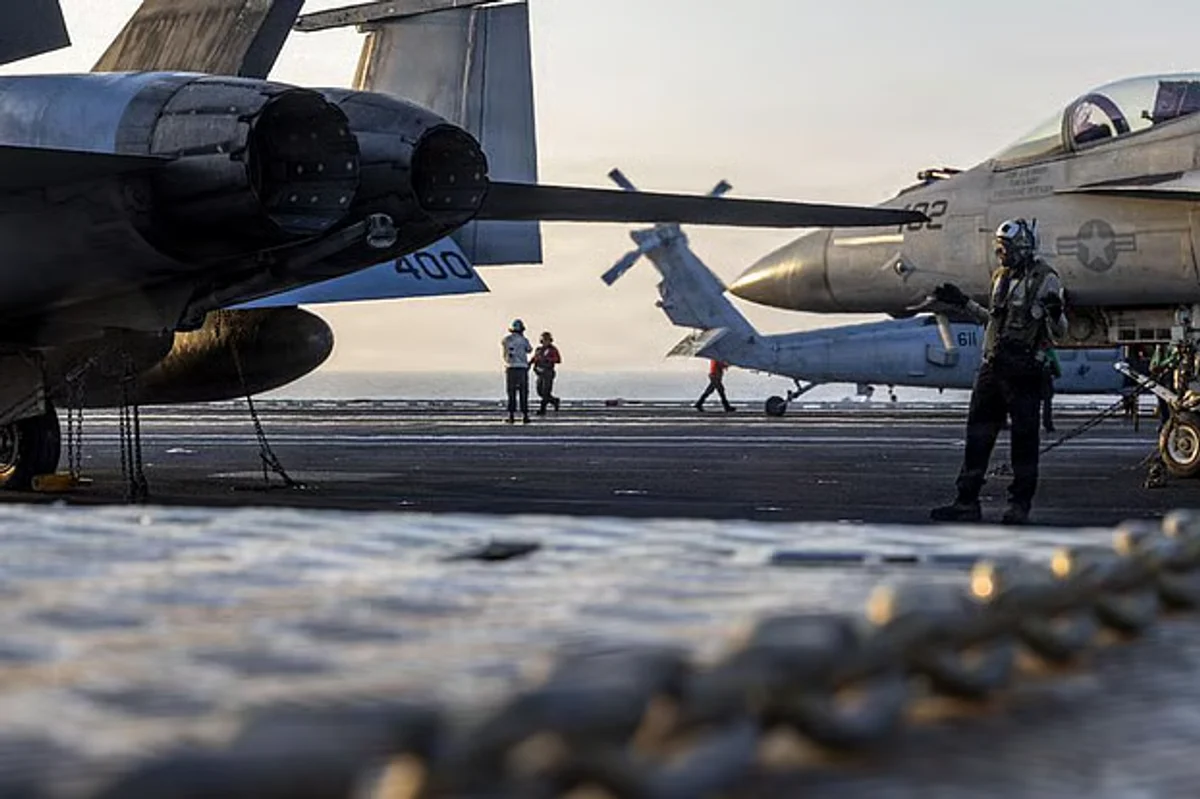
Families and crew members of the aircraft carrier USS Abraham Lincoln have raised alarm over a deepening mental health crisis among the ship’s roughly 5,000 sailors, who have spent more than 250 days continuously at sea with no confirmed return date.
The concerns were raised directly to senior US Navy leadership at a heated town hall meeting in San Diego, attended by Acting Navy Secretary Hung Cao and other senior officials, according to Stars and Stripes. Two sailors’ spouses who attended confirmed the accounts.
Approximately 200 people attended the San Diego meeting. One sailor’s wife said she received a message from her husband on the day of the meeting expressing hopelessness about his situation. She emotionally conveyed the message to the assembled officials.
The officials did not directly respond to the specific account but assured attendees that mental health counselors, chaplains, and medical staff were available aboard the ship. They added that additional mental health specialists were being sent to the carrier.
The concerns raised at the meeting closely mirror accounts shared independently with military newspaper Stars and Stripes by sailors and their families in recent weeks.
Interviews with active-duty sailors and their families, along with dozens of social media posts by crew members, paint a picture of extreme exhaustion and collapsing morale. Sailors have reported struggling with serious mental health challenges, and at least one crew member was physically restrained from an attempt to leave the ship, according to multiple sailors aboard.
The carrier’s crew has faced extraordinary conditions: 40 days of direct combat operations against Iran under the US 5th Fleet, amid an unprecedented 250-day stretch at sea without a regular port call.
The carrier departed San Diego last November for a planned Pacific deployment but was redirected to the Middle East, reaching the region in January. It has now been deployed for more than eight months without a standard port call, a record-setting stretch. The deployment was originally scheduled to end in May but has been extended indefinitely, with no specific return date announced.
Families and sailors have said they accept that long deployments, separation from loved ones, and dangerous missions are part of military life. But many have complained that the crew is being forced to operate under abnormally harsh conditions without adequate consideration for their physical and mental well-being.
A parent wrote to Stars and Stripes in July expressing deep anguish over their child’s situation aboard the carrier and the mental state of the crew.
One sailor’s wife said the situation had become unbearable: “I am watching my husband mentally break down. It feels like they are losing all hope.”
The Navy has acknowledged that the Lincoln is operating in an extremely hostile and combat-disrupted environment, which has severely disrupted traditional supply lines in the Middle East. The Navy has prioritized mission-critical supplies — food first, then medical supplies, and lastly mail.
The Navy said in a statement Monday that senior leadership “continues to assess and monitor the well-being of our sailors.”
Two town halls were held last week — one in person and one online. Vice Admiral Douglas Verissimo, commander of Naval Air Forces, and Vice Admiral Joseph Cahill, commander of Naval Surface Forces, attended alongside other senior officials. Acting Navy Secretary Hung Cao attended the in-person session.
One attendee directly addressed the officials, saying: “You have completely shattered the trust between us and the leadership.”
According to USNI News, the Lincoln departed its home port of San Diego for the Pacific deployment less than a year after completing a previous 162-day deployment in December 2024. The carrier reached the Middle East in January and has remained in the Arabian Sea since.
The crew confirmed that the carrier had earlier faced food rationing, severe water shortages, and extended periods without laundry service. Most of these issues have since been partially resolved. A brief port stop in Oman in early July provided the crew with fresh fruits and vegetables for the first time in months, though many sailors who were allowed ashore were confined to a secured perimeter. An earlier stop in Guam in December also left many crew members unable to go ashore.
Sailors and their families have described disrupted mail service, grueling work hours with minimal rest, and an overwhelming sense of uncertainty.
A 2025 study published in the journal Military Medicine, surveying 956 sailors aboard carriers, destroyers, and amphibious ships, found that insufficient rest during deployment and limited access to quality healthcare were the greatest sources of psychological distress. Disrupted communication with family and friends was also cited as a major concern.
Retired Chief Petty Officer Thomas Natzman, who served 20 years in the Navy and completed four deployments, said the uncertainty over when a deployment will end places immense psychological strain on sailors. “There is no Monday, Tuesday, or Wednesday — every day is just a day. You try to stay positive as best you can,” he said. “The problem is, when you’re at sea for a very long time, at some point the effort to maintain morale just stops working — and that’s when things start to deteriorate.”
If you or someone you know is in crisis, contact Kaan Pete Roi at +880 9612-119911 or the national emergency helpline at 999. In the United States, contact the Veterans Crisis Line by dialing 988 and pressing 1.
বাংলায় মূল প্রতিবেদন পড়ুন · Read the original Bengali report