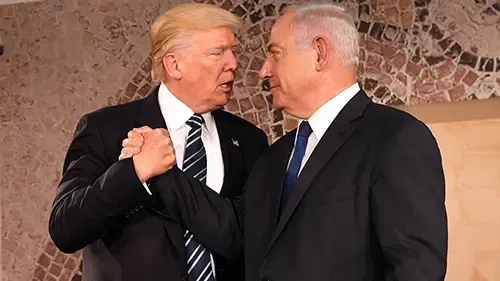
The United States and Israel are discussing the possibility of imposing a land blockade on Iran to intensify economic pressure on the country, Britain’s Telegraph reported.
After months of air strikes and prolonged military pressure failed to make Tehran yield, US President Donald Trump and Israeli Prime Minister Benjamin Netanyahu are considering a new strategy to tighten economic pressure. At a meeting in the White House Oval Office on Tuesday, the two leaders discussed increasing pressure on Iran through “kinetic and non-kinetic means,” the report said.
Under the proposed plan, the US and Israel could pressure Iran’s neighbours to tightly control or temporarily close border crossings, which could significantly disrupt Iran’s imports and exports. “Imagine if the land routes are completely closed. What happens if Iran can import nothing and export nothing?” a senior Israeli official told the Telegraph.
Retired US Lieutenant General Sean MacFarland said enforcing such a blockade would be “almost impossible” in practice, but that isolating Iran economically would be possible if its commercial capacity were shut down. Economic pressure was the most effective path, he said, though it would need a military component. He noted that Iran shares land borders with many countries and that cutting off all support would be very hard, especially as Iraq is close to Tehran.
The plan could target key land crossings such as Incheh Borun and Sarakhs, which link Iran with Turkmenistan. Iran shares land borders with Iraq, Turkey, Pakistan, Afghanistan, Turkmenistan, Armenia and Azerbaijan, so implementing the plan would require their cooperation — which could hurt their own economies and raise the risk of Iranian military retaliation.
According to the report, land and sea blockades are intended to limit Iran’s ability to acquire new weapons. Under a new military cooperation deal with China, Tehran is awaiting hundreds of rocket launchers from Beijing; the roughly $70 million deal includes man-portable air-defence systems (MANPADS) and missiles, with ships from China usually docking at the southern Iranian ports of Bandar Abbas and Chabahar. A Telegraph source said Trump was now seeking new options as the current strategy to reopen the Strait of Hormuz had not produced the desired results, and was weighing ways to raise tensions to bring Iran back to the negotiating table as part of his “maximum pressure” policy. The report said the land-blockade plan could also be a red herring, put forward to confuse Iran about the real next step.
Citing intelligence, the report said Iran’s leadership was divided, with one side worried about economic collapse and another in favour of continuing the war. An Israeli official said Iran faced a severe fuel crisis, with diesel running out at many petrol stations and long queues forming. The report described the recent Trump-Netanyahu meeting as positive and cordial. An Israeli official said three possible options on Iran were discussed — reaching a diplomatic settlement, maintaining the naval blockade, or resuming military strikes — but that Netanyahu did not push for any one of them. “We are protecting not just our lives but yours too. We are fighting a battle of civilization against barbarism,” he said.
বাংলায় মূল প্রতিবেদন পড়ুন · Read the original Bengali report