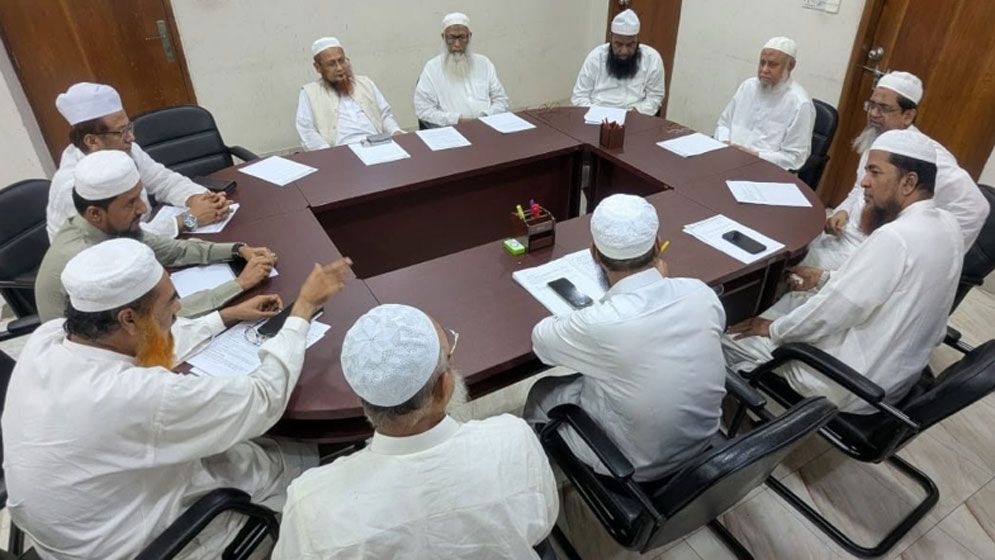
Al-Haiatul Ulya lil-Jamiatil Qawmia Bangladesh has expressed deep concern at what it called one-sided campaigning in various media and on social media in the country over a number of isolated incidents and allegations involving Qawmi madrasas.
The body, the highest combined authority for Qawmi madrasas, has at the same time decided to set up a central “Qawmi madrasa monitoring cell” and to open a hotline to receive complaints, with the aim of verifying allegations, gathering information and evidence and strengthening oversight on various matters relating to Qawmi madrasas.
The decisions were taken at a meeting on “the role of Al-Haiatul Ulya in preventing propaganda against Qawmi madrasas and dealing with the situation that has arisen,” held at Al-Haiatul Ulya’s office in Dhaka on Wednesday.
Representatives of six Qawmi education boards took part in the meeting, held under the direction of the chairman of Al-Haiatul Ulya, Allama Mahmudul Hasan.
It was chaired by the co-chairman of Al-Haiatul Ulya and senior vice-president of Befaqul Madarisil Arabia Bangladesh (Befaq), Allama Sheikh Sajidur Rahman.
The information was given in a press release sent by the office manager of Al-Haiatul Ulya lil-Jamiatil Qawmia Bangladesh, Maulana Mu Osiur Rahman.
Speakers at the meeting said that where any crime, irregularity or immoral act takes place, a proper investigation and lawful trial must be ensured. There is no scope for giving any kind of shelter to a guilty individual or institution, they said. But a tendency had been seen recently in some media to call the entire Qawmi madrasa education system, and hundreds of thousands of students and the teaching community, into question over isolated incidents, which was extremely worrying.
The meeting said Qawmi madrasas have a long-standing contribution to religious education, moral values, the building of humane character and social service work in the country. Yet attempts were being made to place the liability of individuals and institutions accused in some recent incidents on the entire Qawmi education system. That was creating confusion among ordinary people and amounted to an attempt to create a negative impression of Qawmi madrasas.
Appealing to the public, the meeting said no news, video, statement or information circulated on social media should be accepted or spread without being verified. It also called on the media to present responsible, objective and evidence-based news.
The meeting announced a special hotline on the number 01700-763178 (WhatsApp) for receiving complaints, information and evidence, fact-checking material and related documents concerning Qawmi madrasas. Messages, voice calls, photographs, videos and necessary documents can be sent to the number.
A central “Qawmi madrasa monitoring cell” was formed at the meeting, made up of representatives of the six boards under Al-Haiatul Ulya. It was also decided that each board would form a separate “madrasa monitoring cell” to monitor the activities of the madrasas affiliated to it. A decision was also taken to strengthen madrasa inspection and monitoring activities further.
It was also decided to form a “legal panel” made up of experienced High Court and Supreme Court lawyers, with the aim of providing necessary legal assistance and taking legal steps on various matters relating to Qawmi madrasas.
Those nominated as members of the central “Qawmi madrasa monitoring cell” formed at the meeting are Allama Sajidur Rahman, Maulana Mufti Ruhul Amin, Maulana Musleh Uddin Raju, Maulana Mahfuzul Haque, Maulana Bahauddin Zakaria, Maulana Ubaidur Rahman Khan Nadvi, Maulana Abdul Basir, Maulana Mufti Enamul Haque, Maulana Ekram Hossain Wadudi, Maulana Muhsin Sharif and Maulana Mufti Mohammad Ali.
বাংলায় মূল প্রতিবেদন পড়ুন · Read the original Bengali report