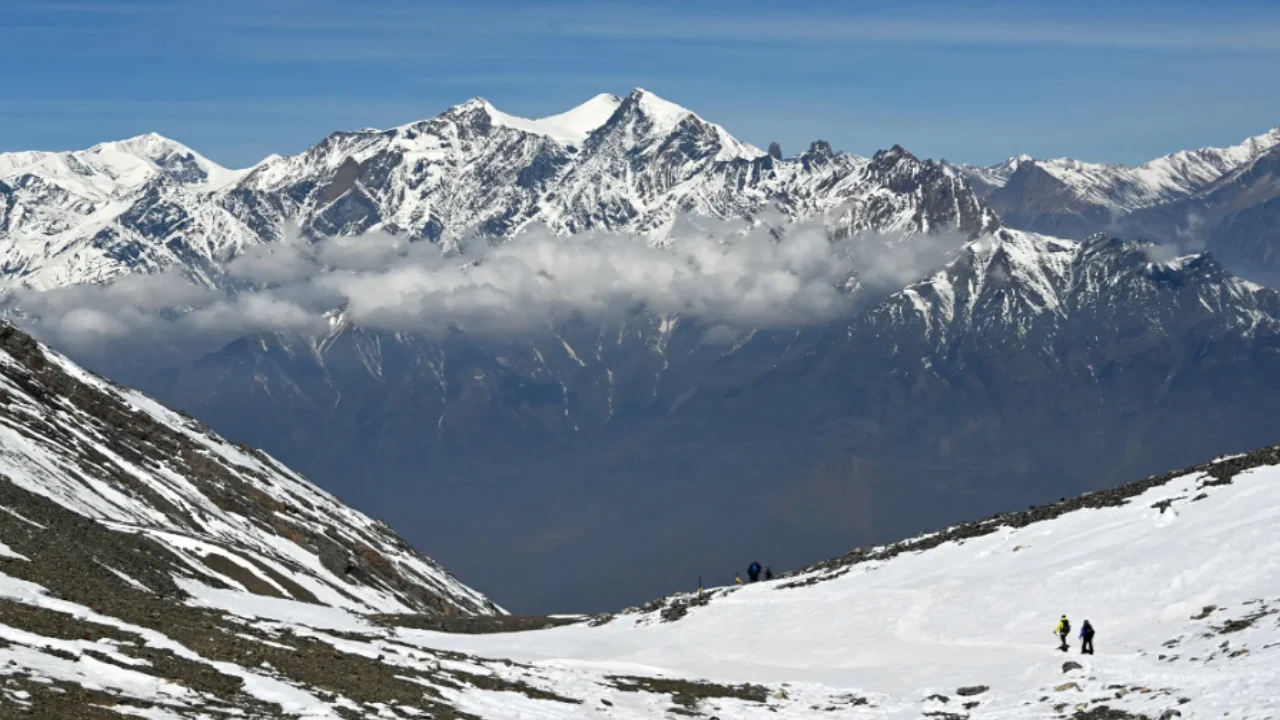
After the devastating flash flood on the Nepal-Tibet border killed hundreds and left a large number of people missing, new concern has emerged over the impact of climate change on the Himalayas. Because of global warming, Himalayan glaciers are melting rapidly, and permafrost — frozen ground beneath the mountains — has also begun to thaw. This is weakening mountain slopes, increasing the risk of large-scale glacier and rock collapses.
Experts say the Himalayas are now at risk not only from melting ice itself, but from the resulting loss of the mountains’ geological stability. Ice and permafrost beneath and around glaciers once helped keep mountain rock stable. As temperatures rise, that natural bond is weakening. This can trigger a chain of disasters, from landslides to flash floods.
Scientists say global warming is making glaciers and the ice-rock structures of mountains increasingly unstable, raising the risk of sudden glacier collapse, landslides and flash floods. Another factor behind such hazards is the rapid growth of human settlement and infrastructure in Himalayan river valleys. Roads, hotels, hydropower stations, commercial buildings and tourist centers have been built close to rivers. As a result, the scale of damage grows whenever a major landslide or flood strikes the mountains.
The devastating flood began in Nepal’s Rasuwa area on August 26. It was initially thought to be an earthquake, but the US Geological Survey (USGS) later said the magnitude-5.2 tremor recorded there was not an earthquake at all — it was caused by a glacier collapse and a massive volume of ice and rock rushing downhill.
According to scientists, after a huge section of ice and rock atop the mountain broke off and fell, it rushed into the river, creating a massive surge of water, ice, mud and rock. At one point, the river’s water level rose by roughly 9 meters in just 30 minutes. As a result, riverside settlements, roads, bridges, power stations and other structures were submerged within moments.
Scientists caution that further research is needed to confirm exactly how directly climate change is linked to the event. However, even before Nepal’s recent disaster, that same river system had experienced a glacier-related flood last year as well, which killed nine people and left 24 missing. Scientists fear similar events could occur more frequently in the future.
The Himalayas are one of the world’s most important mountain ranges. The region’s glaciers and rivers are directly linked to water, agriculture, electricity and livelihoods for a huge population across Asia. The lives and economies of roughly 2.1 billion people depend on rivers originating in the Hindu Kush-Himalaya region. As a result, the impact of climate change in mountain areas is not just a problem for Nepal or Tibet — it could affect the whole of South and Central Asia.
Experts therefore emphasize regular monitoring of glaciers and river water levels in remote mountain areas, satellite surveillance, and strengthening rapid early-warning systems. They have also highlighted the need for quick information-sharing between Nepal, China and downstream countries.
While halting glacier change over the coming decades may be difficult because of climate change, preparations can be made to reduce the damage. Nepal’s recent disaster has come as a major new warning for experts to strengthen that preparedness.