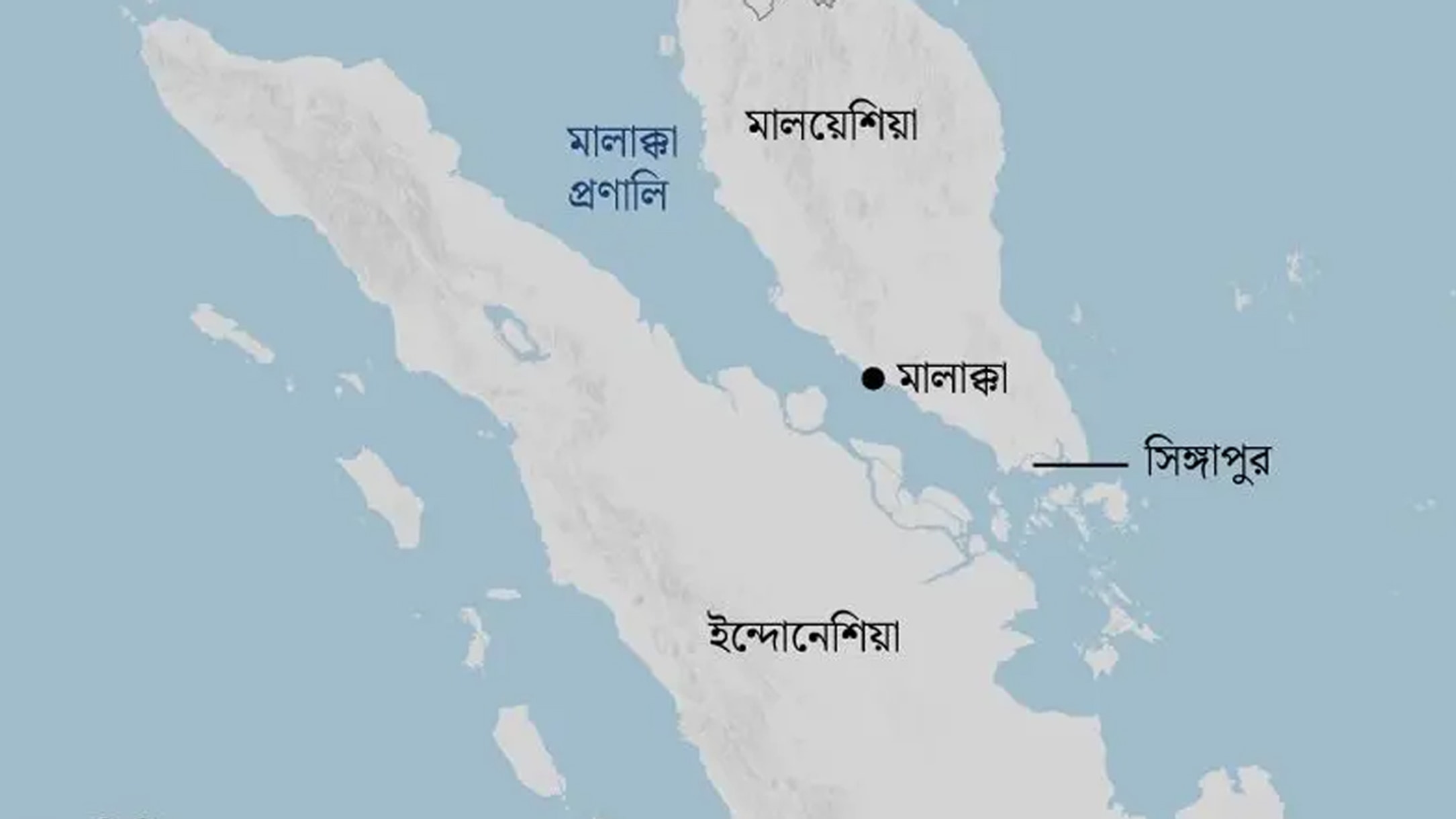
The Strait of Hormuz, one of the world’s most important sea lanes, is at the center of intense discussion. But amid the ongoing impasse, another name vital to global trade has resurfaced in the conversation — the Malacca Strait in Southeast Asia.
The strait is directly linked to the South China Sea, through which about one-third of global trade passes. Its narrowest section, just 2.8 km wide, lies in the Phillips Channel near Singapore.
The Malacca Strait returned to public attention after the United States submitted a proposal seeking expanded permission for military aircraft to fly over Indonesian airspace. The proposal came after the signing of a defense agreement, but the matter remains under consideration, according to Indonesia’s foreign ministry.
Experts said such a move could have a major impact on global geopolitics.
Global importance
Azifah Astrina, a researcher and regional specialist at the University of Illinois Urbana-Champaign, said: “The Malacca Strait is critically important because it is the shortest and most efficient sea route linking the Indian and Pacific oceans. As a result, it is essential for trade between the Middle East, Europe and East Asia.”
According to the latest report from the U.S. Energy Information Administration, an average of 23.2 million barrels of oil were transported daily through the route in the first half of 2025 — about 29 percent of all seaborne global oil shipments. Over the same period, 260 million cubic meters of liquefied natural gas were also transported through the route daily.
Goki Balsi, a transport specialist at Britain’s University of Leeds, said the route carries not only fuel but also electronics, consumer goods, industrial products, machinery and automobiles.
“About 25 percent of the world’s automobile trade passes through this route. Dry goods such as grains and soybeans are also moved through the strait,” Balsi said. He added that while the Strait of Hormuz is important for geography, fuel transport and various commodities, the Malacca’s role is broader.
“Hormuz is essentially a fuel route. But the Malacca Strait is used not only for fuel but also as a trans-shipment hub for a wide range of goods,” he said. Astrina added: “It can certainly be said that the Malacca Strait is one of the most important arteries of the global economy.”
According to the Singapore-based ReCAAP information-sharing center, 108 incidents of piracy and robbery occurred in the Malacca and Singapore straits in 2025, the highest since 2007. Piracy remains a persistent concern in the strait. The area is also exposed to natural disasters such as tsunamis and volcanoes. The 2004 tsunami devastated its southern region.
Why the concern now?
Experts said the Malacca’s importance is now becoming sensitive not only economically but also geopolitically. “If tensions over maritime dominance escalate between China, the United States or India, this route could be severely disrupted,” Balsi said.
Astrina said increased U.S. access to Indonesian airspace could create long-term instability. According to her research, the current security framework of the Malacca Strait was not built to handle rivalry between major powers. It was largely designed to address piracy, smuggling and other maritime crimes.
“When a major power like the United States expands its activities and presence in this region, it creates a security situation the current system was not built to manage,” she said. But she added that the likelihood of major short-term disruption was low. “Commercial shipping will not be disrupted right now because the interests in keeping trade flowing are strong, so everyone wants to maintain that,” she said. The greater risk, she said, lies in the long term.
“The concern is that if China sees this as a U.S. surveillance buildup near critical maritime routes, it may respond — not by directly halting trade, but by expanding its influence across the region. That’s where the risk lies. Gradually, we may see a shift from a cooperative, rules-based security environment to a more competitive one,” she said. She cautioned that even without direct conflict, such a shift could have real consequences.
“For global trade, the impact will be indirect but powerful — insurance costs will rise, risk perceptions will climb and instability will emerge along a sea route the world economy depends on heavily,” she said. She warned against an oversimplified view of Indonesia’s role. “There is no room to view this as if Indonesia is aligning with one side. Indonesia is expanding cooperation with the United States, maintaining strong economic ties with China and balancing those relationships by engaging other partners such as Russia. The reality is that great-power competition is now entering a region that has long served as a joint and effective corridor for global trade.”
The ‘Malacca dilemma’
In 2003, then-Chinese President Hu Jintao coined the term “Malacca dilemma” to describe China’s heavy dependence on this sea route. According to data from the U.S. Energy Information Administration and the China Power Project, about three-quarters of China’s oil imports and roughly 60 percent of the total value of its seaborne trade pass through the Malacca Strait and the South China Sea.
“It’s not just China. Japan and South Korea also depend heavily on this strait for fuel. About 90 percent of their oil imports pass through it,” Balsi said. He added that the route is also crucial to Singapore, which is home to the world’s second-busiest container port and a major hub for ship fuel supplies. Reducing China’s reliance on the strait is not practical, Astrina said. “In the near future, there is no effective way for China to substantially reduce its dependence. Alternative routes such as pipelines or other corridors may offer some help, but they cannot replace Malacca on a large scale,” she said.
Balsi agreed. He said the Sunda and Lombok straits, both within Indonesia’s territorial waters, could serve as the two most effective alternatives. Of the Torres Strait near Papua New Guinea, he said it is shallow and ecologically sensitive, with coral reefs that prevent large commercial vessels from passing through. Routing ships around southern Australia would involve excessive time and cost, he said. Astrina believes these limitations will lead China to focus less on eliminating the vulnerability and more on managing it.
“The core of the dilemma is not about reducing dependence but about how China manages that dependence. That is why China is focused not only on finding alternative routes but also on expanding its influence and presence across the broader region, particularly in the South China Sea and key maritime routes,” she said.
বাংলায় মূল প্রতিবেদন পড়ুন · Read the original Bengali report