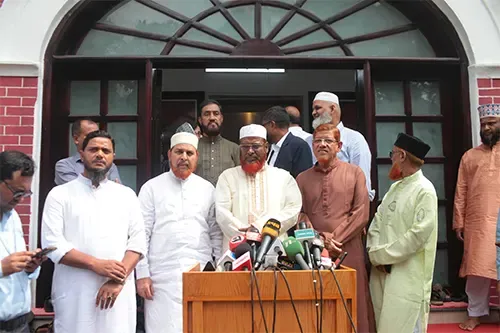
Jamaat-e-Islami Secretary General Mia Golam Parwar has said that, as the opposition party, Jamaat will cooperate with the government on its good work and protest against actions it considers against the public interest — but said that opposition will be constructive and within the rules. He said Jamaat wants to keep parliament functioning and play the role of a responsible opposition party in the country’s democratic transition, rather than resorting to the intolerant, destabilizing or violent methods used in the past.
He made the remarks after a meeting with editors of print media outlets that began at noon Monday.
Mia Golam Parwar said the meeting, held at the invitation of Jamaat-e-Islami’s Amir and leader of the opposition in parliament, brought together editors of the country’s print media in his honor. Discussions covered the country’s current political situation, national problems, public hardship, the crisis surrounding implementation of the mandate delivered by the referendum held on the basis of the July Charter, the role of Jamaat-e-Islami and the 11-party alliance in parliament, and the responsible role of the opposition.
He said the policy guiding Jamaat’s role as opposition in parliament is one the party’s Amir has stated both inside and outside parliament. “We will play the role of a responsible, constructive opposition,” he said. “We will break from the poor tradition of conventional opposition politics in this country and cooperate with the government on good work that advances the country’s stability, politics and democratic transition. And we will protest against everything bad and against the public interest.”
Mia Golam Parwar said this policy was presented to the editors, some of whom praised Jamaat’s parliamentary approach. He said several editors remarked that, in 54 years of independence, this was the first time they had seen an opposition party play such a significant role — keeping the country stable in a constructive way while opposing where opposition was warranted and cooperating where cooperation was warranted.
He said the party’s Amir expressed gratitude to the editors and told them Jamaat would continue to protest against all injustice and anti-public actions, but that its opposition and protest would always be lawful and constructive.
He said the Amir also took questions from editors and exchanged views on Bangladesh’s prevailing political situation, the international and geopolitical situation, and relations with neighboring countries. The discussion also covered various Jamaat policies and positions the Amir has previously outlined at public rallies and in parliament, and those he presented at Sunday’s 11-party alliance rally.
Mia Golam Parwar said the editors had advised Jamaat to oppose constructively, engage in dialogue, and remain in the streets over public demands where necessary — but not to destabilize the country through the kind of intolerant or violent path taken by past opposition parties.
He said six months have now passed since the 13th national parliamentary election, during which time Jamaat’s leader and the opposition leader in parliament held an open, public exchange with editors of national newspapers for the first time. He said the editors were very pleased with the meeting and said they hoped for similar opportunities in the future to share their views.
He said the meeting also touched on how opposition MPs are treated by the ruling party in parliament — including alleged discrimination in the allocation and distribution of development funds, opportunities to speak on the floor, and treatment in lawmaking and the handling of notices. The Amir also briefed the editors on Jamaat’s role in parliament on issues including the power and gas crisis, implementing the referendum mandate, commodity prices, and the rights of expatriate workers.
The Jamaat leader said the party has, in many instances, not received fair treatment from the speaker or other relevant authorities in parliament, and said it has faced discrimination in various respects, which was also raised with the editors. He said journalists and editors present the truth to the nation through their writing and journalism, and that the Amir sought their cooperation in supporting the opposition’s role in the country’s democratic transition.
He said the editors recalled how past opposition parties in parliament had destabilized the country and rendered parliament ineffective, and praised Jamaat’s approach as an exception to that pattern. “We want to keep parliament functioning,” he said. “But we want to fulfill our responsibility as a constructive and responsible opposition.”
Mia Golam Parwar said Jamaat had also told the editors that those in government must be responsible too — that the opposition alone cannot bear all the responsibility, and that cooperation and a responsible role from the ruling party are also needed. These were the issues discussed at Monday’s meeting, he said.
Those present at the meeting included Manab Zamin Editor-in-Chief Matiur Rahman Chowdhury, Prothom Alo Executive Editor Sajjad Sharif, Daily Star Editor Mahfuz Anam, Somoyer Alo’s Syed Shah Newaz Karim, Naya Diganta’s Salah Uddin Babar, Banijjo Protidin’s Gias Uddin, Jai Jai Din’s Shafik Rehman, Desh Rupantor’s Mustafiz Shafi, Khaborer Kagoj’s Mostafa Kamal, Bonik Barta Editor Dewan Hanif Mahmud, Daily Wadar Editor Shafiqul Alam, Ajker Patrika’s Kamrul Hasan, Dhaka Mail’s Harun Jamil, Protidiner Bangladesh Editor Maruf Kamal Khan Sohel, Inqilab’s A.M.M. Bahauddin, Amar Desh Editor Mahmudur Rahman, Manabkantha Editor Shahidul Islam, Agamir Somoy Editor Mostafa Mamun, Bhorer Dak’s K.M. Belayet Hossain, Kalbela Editor Santosh Sharma, Ittefaq Editor Tasmima Hossain, Daily Evening News’s ABM Selim Ahmed, and Dainik Ediin’s Mostafa Kamal Mazumder.
বাংলায় মূল প্রতিবেদন পড়ুন · Read the original Bengali report