The government has issued a warning to state-owned BASIC Bank regarding new lending. At the same time, the bank’s board has been told to work toward re-establishing the institution as a CMSME-focused, well-governed and financially sustainable state-owned commercial bank. The Financial Institutions Division has issued a number of policy directives aimed at pulling the country’s state-owned BASIC Bank out of the fallout from financial irregularities and weak management and restoring it to a strong, profitable position. At the same time, the bank has been told to learn from past mistakes and move forward in a way that does not create new loan problems on its path to recovery. A special meeting was recently held between the bank and the Finance Ministry’s Financial Institutions Division, at which these directives were issued. The information was learned from relevant sources.
It is learned that BASIC Bank suffered severe damage between 2009 and 2014 due to major loan scandals and the irregular disbursement of funds. A large portion of the loans disbursed became non-performing, weakening the bank’s financial foundation. Long-term capital shortfalls and a crisis of depositor confidence disrupted the bank’s normal operations. As a result, its large-loan activities had come to a near-standstill.
Those involved say BASIC Bank’s capital position remains weak, with a continuing shortfall. Its capacity to generate profit has also not been fully restored, and it has not regained the strength to become financially self-sufficient. The bank’s own accounts show it remains in operating and net loss. For this reason, the financial institution has been given certain warnings and directives.
The Financial Institutions Division says special caution is therefore needed in extending new loans. Before approving large loan proposals, a borrower’s actual repayment capacity, business cash flow, group exposure, beneficial ownership, and the real value of collateral must be strictly verified. To avoid excessive concentration of lending, the bank must ensure portfolio diversification, avoiding excessive concentration risk. In expanding CMSME lending as well, proper evaluation, cash-flow analysis and close monitoring must be ensured, so that loan quality is never compromised. The bank’s turnaround must not be disrupted by new loan problems.
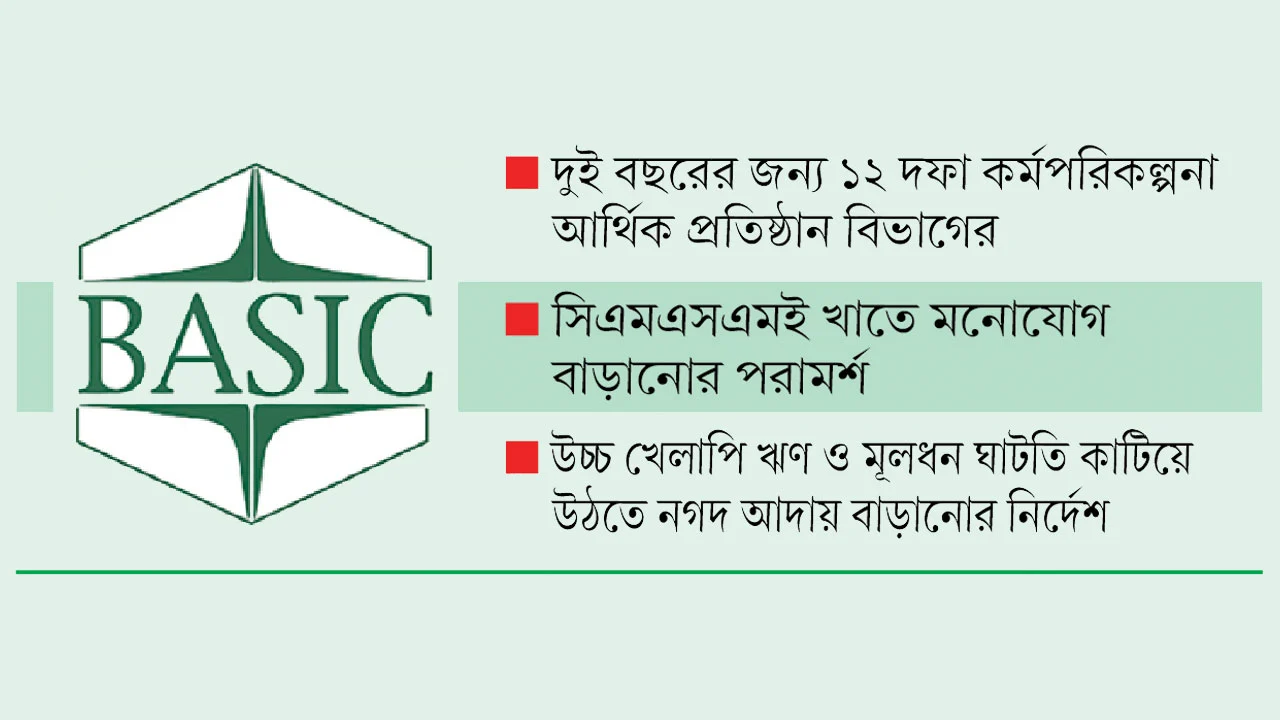
The meeting, chaired by Financial Institutions Division Secretary Nazma Mobarek, was also attended by BASIC Bank’s board of directors, managing director, and other officials. At the meeting, 12 priority action points were set for the bank to work on over the next 12 to 24 months. These are: resolving problems on a large-defaulter-account basis; increasing cash recovery from classified and written-off loans; strictly preventing new defaults; making proper use of Bangladesh Bank’s exit facility; increasing quality lending centered on the CMSME mandate; converting deposit growth into profitable assets; reducing operating losses; reducing the capital shortfall; increasing cost efficiency; making maximum use of skilled manpower; strengthening internal controls and risk management; and rebuilding customer confidence and institutional reputation. In these areas, the board has been asked not merely to make pledges, but to set specific targets.
BASIC Bank’s biggest structural problem at present is its high level of non-performing loans (NPL). According to December 2025 data, the bank’s NPL ratio stood at roughly 56 percent, among the highest of any state-owned bank. At the meeting, the bank was directed to give cash recovery the highest priority. The most important issue for BASIC Bank, the meeting found, is recovering cash. Certain steps were ordered for this purpose. The directive states: not just rescheduling, but direct recovery. Rather than relying solely on accounting adjustments such as loan rescheduling, restructuring or write-offs to reduce non-performing loans, direct cash recovery must be given the highest priority.
It is learned that, for a long period after its founding, BASIC Bank maintained a distinct and successful identity in financing small, medium and industrial enterprises. The bank has been directed to steer its future business model back toward that original, historic core identity — that is, toward financing CMSMEs, small industries, productive sectors, women entrepreneurs, and sectors capable of creating new employment.
In addition, the bank has been directed to fill its capital shortfall through its own capacity, prepare an acceptable capital restoration plan, improve its provisioning system, cut unnecessary expenses, sell non-core assets, build a roadmap to strengthen capital by increasing its own income, make proper use of skilled personnel, base postings and promotions on merit, assign qualified officers to credit and risk management, and form a strong CMSME and recovery team.
BASIC Bank PLC Managing Director Md Kamruzzaman Khan said the coming period’s program would be carried out in light of the ministry’s directives.
বাংলায় মূল প্রতিবেদন পড়ুন · Read the original Bengali report