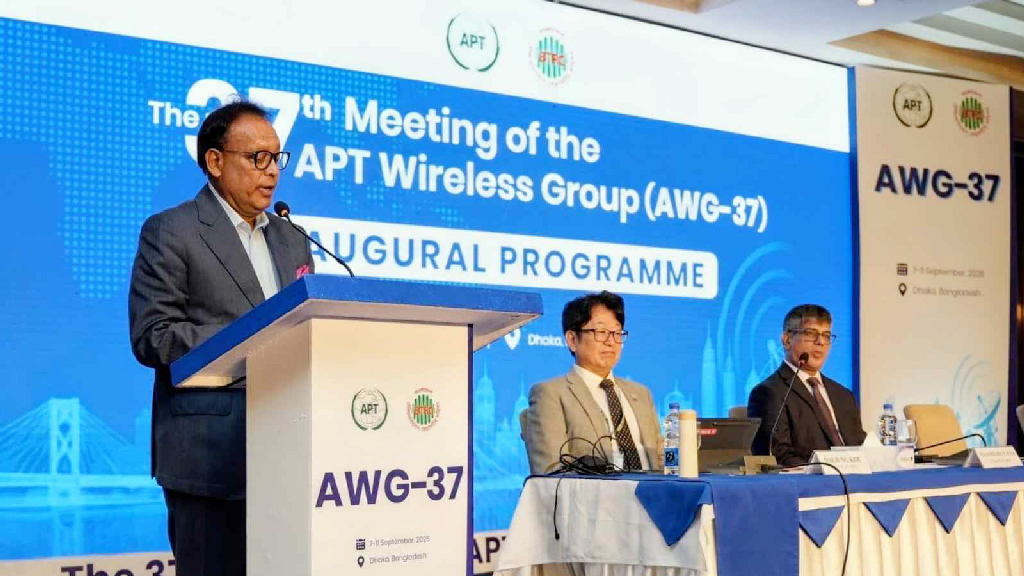
Posts, Telecommunications and Information Technology Minister Fakir Mahbub Anam said Bangladesh’s main goal is now quality, meaningful connectivity, not just connections. He also said the country needs to build its capacity in future technologies including AI, cybersecurity, software, hardware and 5G.
He made the remarks Monday as chief guest at the opening ceremony of the 37th meeting of the Asia-Pacific Telecommunity (APT) Wireless Group, held at the Grand Ballroom of the Radisson Blu Water Garden Hotel in the capital.
Fakir Mahbub Anam said Bangladesh had about 191 million mobile subscriptions as of July, with more than 108 million subscribers using 4G service. The country has more than 49,000 4G sites, roughly 46,000 towers, and 173,000 kilometers of fiber-optic network. He said the main goal now is not simply expanding connections, but ensuring quality, affordability, reliability and meaningful connectivity.
The Bangladesh Telecommunication Regulatory Commission (BTRC) organized the AWG-37 meeting to strengthen regional cooperation on the development of wireless communication technology, spectrum management, and next-generation mobile communication systems across the Asia-Pacific region. The meeting, held under APT’s supervision, runs from Sept. 7-11. A total of 395 delegates from various APT member countries are expected to attend — 168 in person and 227 virtually. Over the five days, 52 sessions will be held, including two plenary sessions. Topics will include 5G expansion, 6G systems, spectrum planning, spectrum sharing, satellite and low-earth-orbit satellite communication, and railway radio communication.
Bilkis Jahan Rimi, secretary of the Posts and Telecommunications Division, said the telecommunications sector is changing rapidly. Timely policy, modern infrastructure, capacity-building and international cooperation are essential to ensuring the benefits of new technology. She said Bangladesh’s long-standing cooperation with APT has played an important role in exchanging knowledge and technology, and expressed hope that the meeting would further strengthen mutual experience-sharing and regional cooperation.
The event was chaired by BTRC Chairman Maj. Gen. (retd.) Md. Emdad Ul Bari, who said Bangladesh wants to further strengthen regional cooperation and technical knowledge exchange in the IT and telecommunications sector, and is eager to play a more active role in building technological capacity across the Asia-Pacific region.
The APT Wireless Group is one of the leading platforms for regional cooperation and technical coordination on radio communication in the Asia-Pacific region. It works with member countries’ industry, academia, and radio communication, spectrum management, satellite communication and emerging technology sectors on technical knowledge and experience exchange, research and regional coordination. The platform includes Bangladesh, Afghanistan, Australia, Bhutan, Brunei, Cambodia, China, India, Indonesia, Iran, Japan, South Korea, Laos, Malaysia, the Maldives, Mongolia, Myanmar, Nepal, New Zealand, Pakistan, Papua New Guinea, the Philippines, the Solomon Islands, Thailand and Vietnam. These countries work jointly on developing radio communication systems, effective radio networks, efficient spectrum use, and exchanging technical knowledge and experience.
APT Secretary-General Masanori Kondo said the AWG-37 meeting would create an opportunity to exchange experience, offer expert opinions and discuss the potential impact of these technologies for the Asia-Pacific region. He also noted the AWG community’s contribution to strategic planning work.
APT Wireless Group Chair Daejung Kim said radio communication is going through a profound transformation, and that mutual cooperation is more important now than ever in this rapidly changing environment. He said no single country or institution can meet these challenges alone; through AWG, member countries can pool their expertise and experience, strengthen mutual understanding, and contribute to developing solutions relevant both globally and regionally.